Authenticity: Sources II, or, Stripes!

In any decade, I love stripes.

Stripes. I love them, really, I do. Gowns, petticoats, cats. Why do I want to use them so much?

For the guys, because I can document what they’re wearing, at least based on their current state of residence and their current nominal “home” unit with the BAR.

Here’s why:

1777 Oct 22
An inventory of Searjeant George Babcock’s
Wearing Apparil who was Killed at fort Mercer
Octor 22d 1777 Belonging to Capt Thos Arnold’s Comp’y in Colo Green’s Regemt

Two Check Linen Shirts
one Pair of Striped Linen overalls
one Striped Cotton & linen Jacket without Sleeves
one flannel Jacket without Sleeves
one home spun Woolen Jacket without sleeves
one Linen & Worsted cotee
one Kersey outside Jacket Lined with flannel
one beaver Hat & one Pair of shoes
one Pair of blue worsted stockings
one pair of thread ditto
one pair of blue yarn Stockings
one Linnen Handkerchief
one knapsack

(Clothing inventory, Capt Thos. Arnold, Col. Christopher Greene, Rhode Island Regiment
RIHS MSS 673 SG 2, S1, SSA Box 1 Folder 13)

From RIHS MSS 72, Preserved Pearce papers,  Tailor's and Tavern account books, 1778-1781.
From RIHS MSS 72, Preserved Pearce papers, Tailor’s and Tavern account books, 1778-1781.

This inventory has formed the basis for many of the clothing choices I’ve made for Mr S and the Young Mr from their check linen shirts to their blue stockings. I was criticized for the size of the checks of their linen shirts (too small! I heard), but feel vindicated time and again by the extant garments I’ve found (aprons, mostly) in this period. The checks are small.

The best piece of evidence I found was serendipitous: whilst going through tailor’s books Thursday, looking for stays, I found a scrap of blue and white checked linen used as a binding. The biggest lesson from that scrap is that I need a deeper, more indigo-rich blue and white to begin with.

The “Striped Linen overalls” in the inventory are definitely on the list of things I’d love to make, along with the “Striped Cotton & linen Jacket without Sleeves.”

One of my favorite garments of all time. Boy's frock, ca. 1760-1770. RIHS 1959.6.1
One of my favorite garments of all time. Boy’s frock, ca. 1760-1770. RIHS 1959.6.1

There are extant Rhode Island garments from made of blue striped linen, documented to the period we interpret, and another one, recently acquired (coming soon to a database near you!) from which a pattern has been taken.

After a while, though, blue stockings and checked linen shirts seem…ordinary. Common. You might start to wonder if they’re just another re-enactorism, they’re so ubiquitous.

It’s worth checking again to see that these are, in fact, common garments, probably as prevalent then as they are now.
Authenticity: Sources I

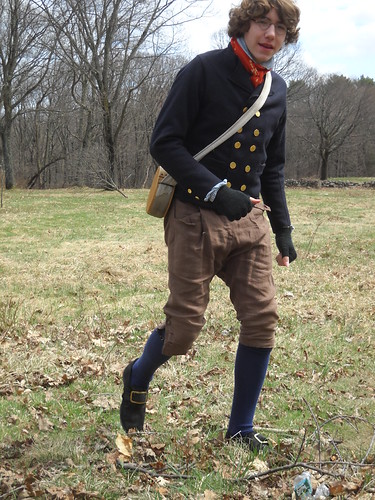
There he goes!

You know this guy: the reluctant drummer and avid ensign who wants to be in uniform but struggles with the fact that he might be seen by someone. (14 is complicated.) I’ve been mulling over several upcoming events and the comments that swirl around on the Interwebs after any large event, and, as I often do, find my clarity in writing. That means you’ll have to wait till the end of this post or a series to get “answers,” or what pass for them.

One of the things I struggle with is that the kid is not a mannequin. He has stated quite plainly that he feels like I fuss too much over his appearance, when he has nothing to do at events, which leads him to believe that I am fussing over nothing. There’s some truth in that, right: while God and authenticity may be in the details, all is for nought if there’s nothing to do or interpret.

This means I cannot simply dress him up as I see fit, I have to negotiate with him, and keep on eye on what he’ll be doing. And I don’t have the time to make all the lovely things I’d like to make (or not all at once, anyway) so it’s a matter of choosing.

June 21, 1774 Connecticut Courant
Connecticut Courant, June 21, 1774

Let’s start with what the kid has already: the blue jacket, checked shirt, neck cloth, breeches, stockings and shoes. I went to the newspapers (the lower sorts’ Vogue) looking for examples of runaways, and found some good ones. On June 21, 1774, an ad was published in the Connecticut Courant for a boy who had run away in a “check linen shirt, pair of striped linen trousers, one pair brown plain cloth breeches…” but the Young Mr wants no part of striped linen trousers, and his breeches are linen, not wool.

Essex Gazette, January 10, 1775

On January 3, 1775, the Essex Gazette ran an ad for a boy in a “short blue jacket, snuff colored breeches and long trousers.” Now that’s more like it!

Long trousers sound good to the kid, more “normal” than breeches,  but there’s a jacket in there that would satisfy my stripey love. For the short run, even if I don’t get the trousers made up in the next couple of weeks, he’s reasonably well documented, or at least within the realm of plausible appearances, even if he should be in wool and not linen, and even if one of the best reasons for making trousers is to replace the poorly-fitted breeches.

Kids shouldn’t just get a pass for inauthentic clothing, and children in what are really costumes do make me crazy–probably because I’m hand-sewing clothing for a wily teenager to grow out of, and looking for sources to make sure the choices I make have some form of documentation.

About those bed sacks…

Sunset over the fields at OSV.

They’re so worth doing.

What, you want photos? Well, wait till September, when I hope we’ll be deploying them at Saratoga. Have a sunset instead.

They were simple to make, and I ran two up on the machine last Thursday afternoon. Ticking fabric, stitched up like a market wallet, using the selvedge as the “finished” edge of the center slit: what could be simpler? I made one two 36″ widths across and 74″ long, and the other one 60″ width folded in half lengthwise, and longer–perhaps 78″. (The second sack was from a 2 1/2 yard remnant that needed trimming.) Both were stuffed with hay and crickets and dragged into the tents.

It’s not like sleeping on your squishy, puffy mattress at home and yes, some campers laughed at us, but in the end, our camp goes up and comes down faster, takes up less room in the car, and we have less to hide. The bed sacks vastly increased how warm we felt, and with several wool blankets we were pretty comfortable. The most uncomfortable thing was the slope: gravity’s a bitch and she wins every time.

The other thing we use are canvas drop cloths from Home Depot for ground cloths. They’re cotton canvas on one side, and treated on the back to be wet-resistant. From 10 feet, they look fine if a corner escapes from a tent, though once you drop a bale of hay on them they really don’t move.

Sturbridge: Always Something to Learn

Adorable, right? But so very miserable.

This year, it was about anxiety.

After some too-public parenting and a minor diversion home and back to Sturbridge this past weekend, I can say that yet another event has taught me yet another set of lessons.

To wit:

  • Adolescents do not think clearly and will not tell you what is going on except under duress. Expect tears.
  • Keep the kid busy.
  • First aid help exists, use it.
  • Pack Gatorade.
  • Bed sacks increase warmth and comfort immensely.

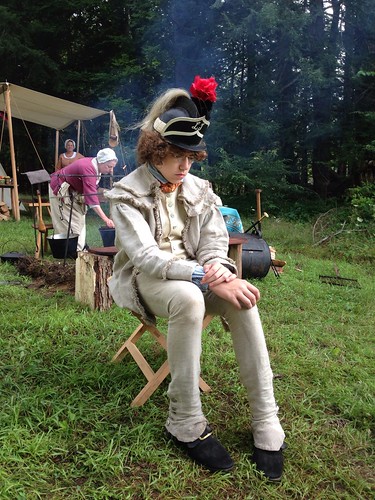
The Young Mr, seen above in Full Pout Mode, had a roiling head full of anxiety made worse by heat and dehydration, for which he refused water and the suggestion of luxuriating in the air conditioned splendor of the upholstered sofette in the lobby of the Bullard Tavern. He made it through one activity and then I took him home because he felt so unwell, complaining of a headache and a stomach ache and feeling hot and then cold that I thought he was really ill. (We’ve had some tense “will-he-or-won’t-he puke-in-my-purse” train rides home, so I tend to overreact.)

Here he is as the ensign, displaying the colors.

Not until Auburn and a large bottle of Gatorade later, when suddenly his stomachache and headache were gone, did I figure out that it was mild heat exhaustion and anxiety, not flu or something worse. And then realized I could have taken him to the first aid station instead of home. But, once home, after a nap and a fight and a dish of curry, he’d promised to go back up on Sunday, which was much better.

Their lyrics were hilarious.

Again, he got to serve as ensign and carry the colors, marching behind the guys as they sang their way through the village. But somehow, Sunday, everything seemed better than it had the day before, when he hadn’t told me how much he fears the start of high school, and how worried he is about his future.  No more reading the New York Times for him…

This isn’t the costume or action report you might want, but living history with an adolescent is challenging. The Young Mr is just too young to field (he’s only 14 but almost 15) and he doesn’t want to be a drummer. It’s a challenge to find things that he can legally and safely do that integrate him into the unit of guys, which is what he really craves. Perhaps it’s because he gets to try out what it’s like to be a man, while still being a boy.