Prince of Wales’ banyan, ca. 1780. Royal Pavilion & Museums, Brighton. ID CT002728
Soooo, what about that banyan?
Cotton chintz printed in red, brown and purple with blue pencil. Batting seems to be cotton by the way it has bunched in the diamonds, but I expected wool. If it is wool, it is super fine lambs’ wool. Since it was for the Prince of Wales, I think that’s possible.
The mariner’s cuffs are pieced onto the end of the sleeves, reducing bulk (no double layer). The buttons at the cuffs are round, domed, self-covered buttons.
The double breasted closure is made with multi-colored silk braid frogs and silk dome-shaped buttons.
The collar is quilted, too.
The center back seam does not bother to match the pattern; it’s just sewn up the center.
Triangular piecing at the side seams helps give this flair in the skirts. You can see this in the photo at left.
The sleeves are set in, two-piece sleeves typical of menswear.
That’s everything I can remember from my visit on Saturday with Sew 18th Century. I really do have to go back with a notebook and a stool!
Prince of Wales’ banyan, ca. 1780. Royal Pavilion & Museums, Brighton. ID CT002728
Alert! This item is currently on display at the RISD Museum of Art in Providence, through August 18, 2013. I have been to see it twice now.
As much as I am itching to get this on a table and investigate it, I am limited to craning my neck and squatting in front of the case. Awesomeness in cotton, this banyan has a five-button mariner’s cuff with a double arc like a broken pediment on a chest-on-chest. It would be a crazy thing for a Continental private to come strolling out of a tent in, not to mention impossible to make before the next camping excursion, but holy cats! that’s one fine banyan.
The RISD Museum is free on Sundays. You, too, can entertain the guards by craning your neck–photography is not allowed. Next visit: sketchbook.
There are a lot of other wonderful things to see, too–silk jersey breeches I expect to see on a colleague at some point, an indigo silk frock coat, the greatest great coat ever, and Fred Astaire’s tails, as well as a small section that I think does everything PUNK wanted but failed to do.
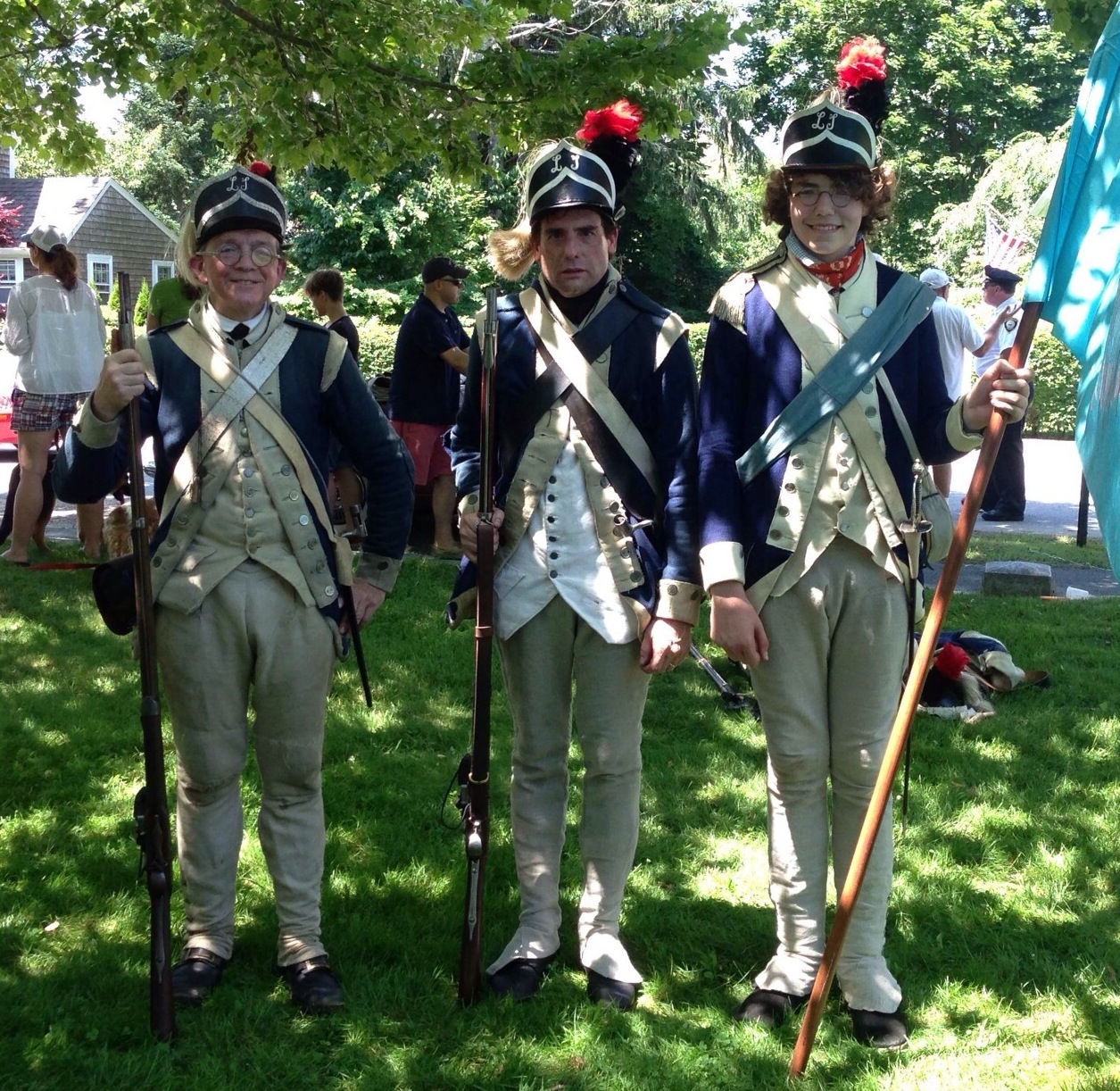
10th Mass fittings: Mr Cooke, Mr S and the Young Mr.
There is good, if slightly terrifying, news about how to get better at sewing. It took me two years to get to a decent place, but this sped up considerably in the past year because of the weeks when I sewed for 30 or 40 hours a week. This business is about practice, looking, and patience … and also asking for help. Some of the help you can get online, some of the help you can get from whatever human is handy, and some you need a master for.
The Rhode Island pair, pattern by me based on Mill Farm breeches.
Online tutorials have saved my bacon: I make gowns with Koshka’s tutorial handy because after intensive menswear, I forget how this gown business works. The random human help I get comes from Mr S, who patiently takes photos as I try to fit backs or see what’s wrong. Trust me: you cannot see your own back in a mirror, so take a photo, or get someone else to. The masters who have helped me are Sharon Burnston and Henry Cooke. From both of them I’ve learned how to look and how to think about historic costumes. Sharon’s workshop really helped my sewing, and watching Henry has taught me a lot about fit. Also from both: patience.
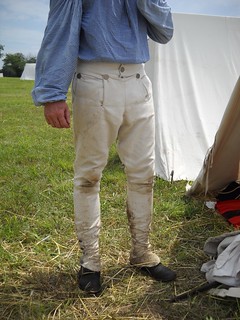
When it came to Mr S’s overalls, I needed a professional bail out. Mr Cooke offered to help after watching me basting the things at MMNHP, and here’s what I wrote in reply:
[the] overalls have reached a rather bad place, and are now only half-basted on the legs after a third fitting attempt. He appears to have lost more weight. The fit in the seat confounds me, and when I get one leg right, the other twists. Your help would be deeply appreciated…
In the end, my basting was ripped out and Mr Cooke sat on the floor and basted the overalls on to Mr S. The process took a bit more than an hour, during which time Mr S became very familiar with the curtain material in Mr Cooke’s workroom, and realized that it was identical to the curtains he’s had as a child. This memory transported him back to a childhood trip to Williamsburg, when he yearned to be one of the costumed interpreters at CW. It was a transformative afternoon for Mr S and his overalls.
Now that they’ve been worn, I know that I need to:
Adjust the waistband and seat
Add a leather strap under the foot
Finish the in-and out-seams (with fit proven, felling can begin)
Switch ankle buttons from plain and RI mix to all plain or 10MA
Take a pattern from the legs!
There is hardly any seam allowance over Mr S’s single-speed bike-riding-up-hills calves, so a pattern from the legs would make the next pair that much easier. He has two pairs, so why should I bother? Because he will undoubtedly wear these out doing as many belly crawls, stream fordings, nettle bush tangoes and other light infantry activities as he possibly can. At some point, mending will cease to be an option.
So how would I pass on the lessons I’ve learned? In some ways, by writing honestly about the struggles and successes in getting these things right, and to let you know that practice really does make a difference. It’s also become clear that maintaining an open, curious mind willing to accept criticism and new ideas will make you a better sewer, and maybe even a better living historian/reenactor…dare I say person?
Yes, we have those at work. I tend to set enough goals for 3 single-spaced pages, and actually accomplish many of them. My boss, though a Known Over Achiever, thought I should work on this…tendency. So I came up with six goals for the first six months, and mostly got them done, along with a lot of other things.
When I updated the Projects 2013 page here, I thought perhaps I should heed my boss’s advice (don’t tell her that, I have a reputation to maintain) and, you know, assess my goals versus reality ratio.
It’s a long list of stuff, when you get down to it. How did I do, and what else needs to be done? Here’s a chart for the first six months of this sewing year; not all items were planned…some just happened, like kittens.
Item
For whom
When finished
Did it get made?
Tan wool waistcoat
Mr S
1/1/2013
Yes!
Red wool waistcoat
Young Mr
1/15/2013
Yes!
Off-white cotton trousers
Young Mr
1/18/2013
Yes!
Ikea curtain petticoat
Kitty
2/11/2013
Yes!
Black Taffeta Bonnet
Kitty
2/11/2013
Yes!
Shift
Kitty
2/11/2013
Yes!
Monmouth Cap
Young Mr
3/29/2013
Yes!
Blue wool jacket, 1770-1800
Young Mr
3/31/2013
Yes!
How Now Brown Gown
Kitty
4/7/2013
Yes!
Linen Hunting Frock
Young Mr
5/26/2013
Yes!
Linen Hunting Frock
Mr S
6/14/2013
Yes!
Striped pocket
Kitty
6/15/2013
Yes!
Blue checked linen bags (2)
Kitty & Mr S
6/15/2013
Yes!
Chintz jacket
Kitty
6/15/2013
Yes!
Linen Overalls
Young Mr
6/15/2013
Yes!
Black straw hat
Kitty
6/22/2013
Yes!
Alterations to Green Frock Coat
Mr S
Not yet
Nearly!
Linen Overalls
Mr S
Wearable
Nearly!
The Cherry Seller Gown is not on this list because it was started 7/4/2013, and is thus in the second half of the sewing year. A blue linen unlined frock coat for the Young Mr was started 7/7/2013, so counts towards the second half as well. For the coming months, here’s what I know I would like to get done:
Item
For whom
Due Date
Notes
Blue linen frock coat
Young Mr
7/14/2013
Ack!
Alterations to Green Frock Coat
Mr S
7/14/2013
More Ack!
White linen shirt
Mr S
11/2/2013
Just needs one…
Tan Virginia Cloth petticoat
Kitty
8/9/2013
1763
White linen petticoat
Kitty
8/9/2013
1763
Bed gown
Kitty
8/2/2013
For OSV!
Bed sack
Kitty & Mr S
7/19/2013
For Salem or OSV
Proper 1770s frock coat
Mr S
10/5/2013
For Quincy
Striped 1790s petticoat
Kitty
10/5/2013
For JBH
Printed 1790s shortgown
Kitty
10/5/2013
For JBH
Dress for a Lady, TBD
Kitty
10/5/2013
For JBH
10th Mass 1781 Regimental
Mr S
11/2/2013
Putnam Park
Neckstocks
Young Mr & Mr S
TBD
10th Mass
The list seems alternately doable and crazy. So what am I sitting here writing for? I’ve got to get backstitching!



 Kirsten Hammerstrom
You must be logged in to post a comment.