Fun and Feasting in Cambridge

Well, we didn’t feast, it was too hot. But I helped make a feast. I didn’t document it with  photos because I didn’t think my companion would appreciate it. But here’s what we did.

General Washington was set to dine with the gentry, so a repast needed to be made. The captain’s wife volunteered to provide the meal and I served as scullery maid, a role I do find comfortable. (Anyone else identify with Daisy on Downton Abby? She’s the character I feel most like.)

The menu:

Salmagundi
Onion Pie
Bread & Cheese
Pickles
Fruit
Ratafia Cakes
Claret

We worked in the NPS staff kitchen in the carriage house behind Longfellow House: air conditioned, but the kitchen is in a former bathroom. Still, there was a sink and some counter space, so we were set.

A salmagundi is a kind of mixed salad, by which I do not mean tossed. It is perhaps most similar to a chopped, layered salad today. Colonial Williamsburg has an adaptation here, and that formed the basis of our creation.

We used one bag of pre-washed leaf lettuce, one roasted chicken (I did not have to rip it up! I got to chop eggs instead), two tins of anchovies, a medium ham, a lemon, etc. Although we had wooden bowls for prep work, we ran out of places to put the chopped ingredients, so ended up using the NPS staff containers from the dish drainer. With a glass full of egg yolk, a bulk food container of egg white, a black plastic dish of ham and a plastic water cup of anchovies arranged on the crowded sink, we achieved a workable if slightly bizarre mise en place.

What’s astonishing is how much space all that food takes up. You think it’s not enough when it’s contained, but get it on a platter and wow! That’s a shockingly large amount of food. The captain and his wife will be enjoying that salmagundi all week, I fear.

The onion pie was pre-baked from the CW recipe as well. I favor Chesire Pie, and know it is a unit favorite (since four of us devoured one for breakfast at Monmouth…mmmm, pie….)

The pickles were amazing! Made from a 1747 Hannah Glasse recipe, pickled cucumber slices are pretty simple. You may, of course, wish to reduce the quantities:

“To pickle large cucumbers in ſlices. TAKE the large cucumbers before they are too ripe, ſlice them the thickneſs of crown pieces in a pewter-diſh ; to every dozen of cucumbers ſlice two large onions thin, and ſo on till you have filled your diſh, with a handful of ſalt between every row : then cover them with another pewter-diſh, and let them ſtand twenty-flour hours, then put them in a cullender, and let them drain very well ; put them in a jar, cover them over with white wine vinegar, and let them ſtand flour hours ; pour the vinegar from them into a copper ſauce-pan, and boil it with a little ſalt ; put to the cucumbers a little mace, a little whole pepper, a large race of ginger ſliced, and then pour the boiling vinegar on. Cover them cloſe, and when they are cold, tie them down. They will be fit to eat in two or three days.”

Read more at Celtnet: http://www.celtnet.org.uk/recipes/glasse-of-pickling-14.php
Copyright © celtnet

Ratafia cakes are funny little things. I only had one, when they came back from the table (I did mention Daisy, right?) but I might try them. They are not ideal for camp eating–in fact, they would be downright inappropriate–mostly because they are rather fragile and travel poorly.

The rest of us–the privates and sergeant and the Young Mr, who was playing Washington’s aide de camp as a young scamp–ate bread and cheese and fruit in the shade of a tree. It was too hot to eat much.

Alterations in Force

Horrid Green Frock Coat at Birth

Remember this coat? I’ve been attempting to solve this coat for a while. While the Zombie Coat had to be put aside after the tail pleat debacle (what was I thinking? Sewing while tired means hems only, or simple straight seams), I finished up the Horrid Green Frock Coat. It is somewhat less horrid now. Mr S wore it yesterday to be a member of the Jackson’s militia impression of the 10th MA at Longfellow House in Cambridge.

The sleeves were removed and the seam taken in to remove excess material. Perhaps I could have slimmed it a bit more, but it needed to sit the armscye.

The shoulder seam (where back and front join) was also taken in and snugged up twice. The side seams were taken in a great deal from the armscye down, but not enough. To fix the remaining bagginess at the small of the back above Mr S’s hips, I will have to take more out of the front panel, “and work it into the side pleats.” (Easy enough for the Master to say, harder for my brain to figure out.)

Somewhat better, but two more seams to snug.

This is the closest photo to the one above. You can see that the line of the front has been changed and slimmed, and a collar added for stability and style in addition to those cuffs. I also changed the shape of the pocket flaps, and moved them to change the look of the front panels. They don’t have to match the pocket slits, as long as they don’t reveal the slits (one bag is madder linen, I ran out of large pieces of green), so I moved them to change the look of the front.

The mariner’s cuffs were fun. If the Zombie behaves decently this week, I’ll give him mariner’s cuffs on his too-short-blue-wool-sleeves. Well, I’ll probably give him mariner’s cuffs anyway, just so he can get the coat on and off.

On Brattle Street, Cambridge, while it was still “cool.”

And, finally, a full-length view of the coat. It takes more than webbing and belts to reshape a silhouette. It’s taken 13 months from first making that coat to get it to this point. Thanks to an expert’s chalk marks in February, transforming it into something at least wearable was possible, though at first sight, those chalk marks were devastating and overwhelming. It took overalls to get me to face this coat, so thank goodness for the horribleness of overalls.

In the Pink

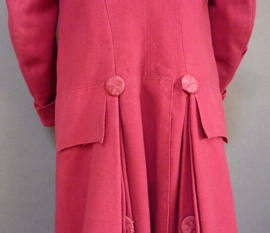
Detail, back pleats
Detail, back pleats

I swear I try to be positive about the mistakes I make. But not only did I discover this morning that I had lost my struggle with spacial processing, now I have found clear imagery to show how I should have handled the pleats on the Zombie Coat. Live, learn, unstitch and restitch: that’s all I can do. Now I have only to decide whether to do the unstitching this weekend, or next week. It will have to be done: now I know the way I’ve done it is wrong, and the master’s eye will be on that mistake and then he will know, and I will know that he knows, and it will just go on from there to tired shame.

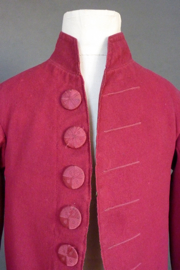
Man's wool  coat, 1770s. Meg Andrews.
Man’s wool coat, 1770s. Meg Andrews.

My favorite part of the description is this:

Either the coat was altered for another man or the wearer got fatter! … There is a half moon insertion under the arms… There’s no detail photo of that half-moon insertion, but I do so wish there was. The description notes additional changes: “If you look at one cuff you can see a lighter part of a button shape next to the seam. The cuffs have been removed and then added to the edge of the cuff to lengthen the sleeve.” At least we know garments in the past, even ones as lovely as this, were altered and changed.

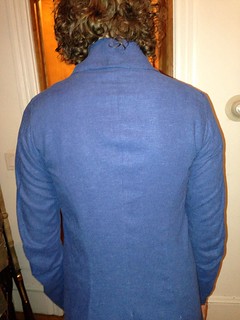
Puckering on the Zombie Coat. It’s still a nice blue, and you know what? It fits me, so maybe he’ll lose it to his refugee mother.

I will probably be inserting shapes of various kinds into the Zombie Coat, since I do now have a diagnosis for this puckering at the shoulder blades. “Viewed from the back and sides, it appears that the sleeve is binding on the front of his shoulder, causing pulling across the back shoulders – the puckers are caused by the stretching of the fabric across the rounding of the back and shoulders. If you make the top of the upper sleeve wider, or raise the shoulder cap it will create more fullness over the top of the sleeve and reduce the binding that is translating down the sleeve and across the back.”

By the time I make the changes I need to, the Zombie Coat will have acquired its own pre-history.

Sewing for Zombies

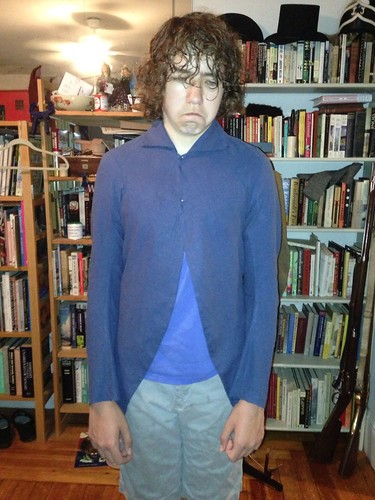
Death by Fitting

He doesn’t always look this horrible, but when the Young Mr sets out to look like death, he does it very well. Dressing 18th Century style comes at the price of fittings, and while we like to cut a fine enough figure at an event, we want no part whatsoever of the process. Even the promise of playing with a dog won’t get us to a fitting. And he dearly wants a dog…so you know fittings are a trial.

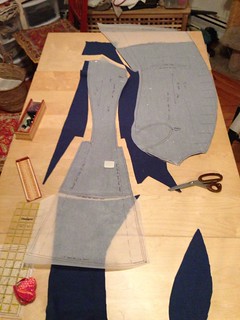
Cutting Out on Sunday

The pattern is by Henry Cooke, based on both a Rhode Island original in a private collection and a jacket in the collection of the Connecticut Historical Society. It is solidly 1770s-1780s, unlined, and both originals made up in brown linen. (From the pattern notes and what I know of the CHS jacket, accession number 1981.110.0; their catalog links are unstable, search for 1981.110.0.)

It goes together well; I started without directions, but as I am more idiot than savant, I got myself confused. I did have to alter the sleeve for the Young Mr, as he has long, thin arms. The rest of the pattern seemed to fit him pretty well, all in all, but a few untoward things happened between measuring, mock-up, basting and fitting. Still, it can be worn, with improvements made next week after he wears it in Cambridge this Sunday.