Tentage

Scene of the Camp on Hampton Green, 1781

Like many other reenactors/living historians/suckers for wool in summer, I’ve been following the First Oval Office project with interest and envy. Imagine my delight upon finding this blog by Tyler Rudd Putman, who is working on that and many other projects of interest.
The common tent project l is one that I really do hope to take on someday, though I doubt I can ever achieve a tent of this level of quality. (Reader, I cannot weave.) But I can aspire, at the least, and I see that a hand-sewn tent is something even I can achieve. It won’t get done by me in just one day, but over the course of several weeks I could get one done as long as I cleared the downstairs of all our furniture, and put up with a cat sewn into a seam. (My assistant has been lying down on the job, melting in the heat.)

The Howling Assistant Lies Down on the Job

I’ve been thinking about tents since the after-dark hilarity at Monmouth setting up an unknown tent in the dark with a brittle pole that had to be repaired with string from a pasty wrapper, and the later perhaps over-zealous cleaning by Mr S of the tent abused by a cat and identified on the NJ turnpike’s extended play of “What the Hell’s that Smell?”

I’m not sure why we’re allowed to remain in our regiments, really, I am not. But I suspect that an ability to produce Chesire Pork pie is a factor in our favor.

We’ll be setting up tents at OSV in just about a week, broken pole and all, and looking ahead to that, I give you the following links for further reading on tents.

John U. Rees on tents in both armies of the Revolution.

How to fold a tent.

Period (British) images.

Even more documentaton: scrolling down, Rhode Islan had a return of 147 tents in May, 1781– that’s about 882 soldiers, at 6 men per tent, a max of 1029 at 7 men per tent. (At least one is always on duty, so there would not be more than 5 or 6 sleeping at any one time).

Amazing and image-rich essay, The Tent Article

Lochee, Essay on Castremetation, which I read and forget by the time it is dark and some man is trying to reason with me about how a camp should be arranged, when all I want to do is sleep. With that in mind, a brush arbor is starting to look good…
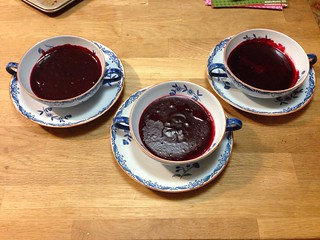
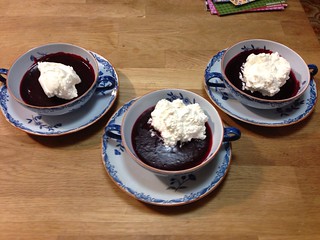
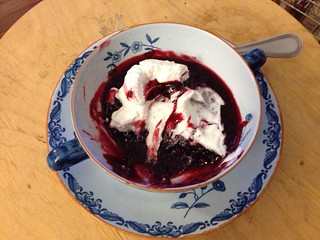
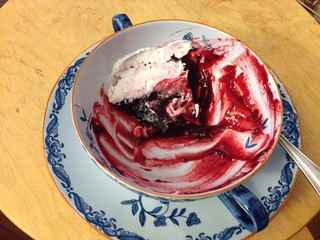
Flummery, and other flimsy excuses

Flummery, in Oest India bowls.

We did not go to Salem. If you were there, you already know this. Mr S was only willing to go up on Saturday, but I wanted to go on Sunday. After looking at the schedule, we couldn’t figure out why the Young Mr would ever want to go. A bored teenager is a terrible thing to be around. So what did we do instead?

We cleaned, for one thing. We laid in provisions, which disappear at an alarming rate each week. We went to the weird antique place and found a brass kettle and a copper skillet. We went to the lumberyard, twice, and bought lumber, once. We did several loads of laundry. (By now, I know you are incredibly jealous of this glamorous lifestyle; I assure you, it gets better.) I cleaned the bathrooms and replaced the shower curtain.

Served!

What incredible banality! But this is what the kid wants: weekends where we are home, cooking and cleaning and being normal. At a certain point, if I cannot figure out what he’ll do at an event and assure him that he will be busy, he does not want to go. (Not that I blame him, for I like to be busy as well.) So a weekend of normal, when we have drilling next week and OSV the next, is probably worth having, for family peace.

Of course, I’d rather be busy in another century, so I cleaned the tub early and moved on to more engaging tasks, flummery, for one.

The guys weren’t sure about this at first, but it is fabulous. It would make an excellent “blood” pudding for a vicious pirate banquet. The recipe is ridiculously easy.

Blackberry Flummery
4 Cups Blackberries
2/3 cup sugar (up to ¾ cup if you prefer sweeter)
½ cup hot water
Juice from ½ lemon, strained of seeds
½ cup cold water or milk
2 T corn starch (AKA corn flour if you’re not in the US; the fine white stuff)

Excellent with cream.

Wash the blackberries and put into a large saucepan with sugar and hot water over medium high heat. Bring to a soft boil and cook until the fruit is soft and falling apart.
Remove from heat, and push through a fine sieve with a spoon. Discard seeds and cores.

In a small bowl, whisk cornstarch into milk or water.

Return fruit to pan and place over heat, bringing to a soft boil again. Stir in cornstarch mixture until completely blended and fruit begins to thicken.

Slowly stir in lemon juice, taking care to keep fruit from thinning or thickening too much.
When blended, remove from heat.

Pour into 3 to 8 individual ceramic or glass serving dishes; portions will depend on audience.
Chill for at least two hours. Serve with whipped cream or yogurt.

Almost gone!

I made three servings, because I thought that was right, but I think six would have been better, based on intensity rather than richness. Not to worry: we ate it all.

Cooking this up is easy, but the blackberry mixture does have a tendency to get everywhere and make you and your kitchen look like your hobby is home butchery. Don’t wear white, and keep your sponge handy.

…For the Approaching Summer

Summer is, of course, fully upon us and those of us on the eastern seaboard feel its oppressive and sticky heat. Ordinarily, my town isn’t terribly hot and cools off at night, but like everywhere else, this is not the case. Last weekend, I wore wool; technically a wool and cotton blend, but more problematically, burgundy in color. This is the price of gowns inspired by London watercolors.

Summer

This leads to constant questions: Aren’t you hot in those clothes? Aren’t you dying of the heat?

There is an underlying tone that suggests that perhaps the people of the 18th century didn’t know enough not to wear wool, or perhaps they only had winter clothes. I’ve heard “well, they didn’t know any better,” as if they never took their clothes off, and if only they had, 18th century men and women would have promptly abandoned their stays, gowns, waistcoats and breeches for tank tops, shorts, and wife beaters. Of course, history is not a Fiat commercial.

Well, what did “they” do?

Barbara Johnson's book, 1764.
Barbara Johnson’s book, 1764.

They took their trade to James Green and merchants like him who offered “Piece Goods of every kind … suitable for all Seasons, but more particularly for the approaching Summer.” (Boston Post Boy, August 8, 1763.)

And what would be suitable? Cottons, fine linens, light silks, in light colors.

Barbara Johnson chose floral prints on white backgrounds in July and August of 1764, both could be “suitable for summer.”

And as you probably know, the answer to “Aren’t you hot?” depends on who you are, but is often, “Not really. Once my shift/shirt is soaked with sweat, I’m pretty comfortable.” This is true as long as your shift/shirt is made of linen; cotton and cotton/linen blends don’t wick as well as linen.

Washington’s Army En-scamp-ment

It is known that the troops serving as the Army of Observation in the months after Lexington and Concord lacked discipline. General Washington found them sorely wanting when he took command of what became the Continental Army, superseding General Artemus Ward. You can read the measures Washington put in place here, from Artemus Ward’s orderly book in the collections of the Massachusetts Historical Society.

This lad became Washington’s Aide-de-camp, scampering out of trouble…barely….

When you have this kind of documentation, it makes recreating an event that much easier, and more fun. (We did note that sometimes striving for authenticity makes us behave very seriously; perhaps a little more fun is in order.)

Luckily for us, the Young Mr was assigned to be General Washington’s aide-de-camp. Aide-de-scamp would be more like it. He thoroughly enjoyed carrying the General’s equipment and accouterments, handling the items with obvious care and confusion–he was clearly impressed by what he was carrying, acted (rightly) as if he’d never seen things so fine, and then proceeded to place them carefully on the ground outside the general’s tent…respectful but not quite right, thus a little disappointing, but setting the proper tone.

After lunch, the sergeant standing guard caught the aide-de-camp stealing fruit from the general’s table. This made a fine show with the sergeant yelling at the aide-de-scamp and shaking him by the scruff of his jacket (the sergeant being shorter than the scamp). The scamp continued to eat the peach, but it was ripe, and part of it went flying off the pit, fortunately not into the sergeant’s face. All were pleased by this little scene, no one more than the scamp.

The Lexington Training Band was busted for card playing, and for drying their dirty laundry on the general’s tent. The scamp was accused of stealing stockings, and chased, in another very satisfying scene. Next weekend, he’ll have General Gage to reckon with. I expect to find him in irons.