D-Day: Robert Capa

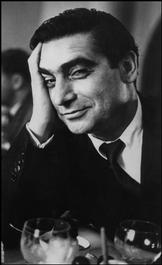
Robert Capa, American, b. Budapest 1913 - d. Indochina 1954
Robert Capa, American, b. Budapest 1913 – d. Indochina 1954 © International Center of Photography

Once upon a time in the Midwest, I worked in a Department of Photographs and Prints. (That’s where I met Mr S, when he was hired as the first museum Photographer, though he was initially known as the Badger in the Basement for the tenacity with which he defended his studio.)

I am fortunate to have a visual memory, and that’s part of how I got my job, and part of how I got to be an Assistant, and then a full, Photo Editor of the museum’s magazine. I love images, and I love photography, and I suppose I must love photographers, too, since there’s one around here somewhere in this place that I call home.

FRANCE. Normandy. June 6th, 1944. Landing of the American troops on Omaha Beach. Robert Capa, International Center of Photography
FRANCE. Normandy. June 6th, 1944. Landing of the American troops on Omaha Beach. © Robert Capa © International Center of Photography

One of the best assignments was photo editing an article based on the World War II diary and service of a local doctor who served in the Army infantry. He wasn’t the most enlightened or unbiased man, but in the 1940s, I suppose that was sadly normal. I read the piece for placement and image ideas, not for tone or subtlety. North Africa, Monty, Casserine, Messina, Easy Red and Omaha: that’s what I underlined.

My go-to for WWII photography was Robert Capa first and last. There’s Blood and Champagne, but the book I read first was Slightly Out of Focus. It was written by Capa, just as he wrote Images of War. (I discovered these killing time on summer weekends in the air-conditioned fine art reading room of the downtown public library.) Capa did not love war, even as he thrived in the combat photography environment, and said, “If your photographs aren’t good enough, you’re not close enough.” But he also noted, like Cartier-Bresson, that you had to like people to take good photographs of them.

His images are dark: not just the imagery, but the prints themselves. A well-printed Capa has deep, rich, dark tones (D-Day images excepted, thanks to a horrendous processing error), and even decades later, a vintage Capa print has magic.

I called Magnum, back in the days when one called, described what I had seen, cited the books I’d read, listed what I wanted prints of to use in the magazine. I think I knew enough to get a little more: vintage prints of images I hadn’t seen. They arrived, sandwiched in cardboard, in a FedEx envelope.

TALY. Near Troina. August 4-5, 1943. Sicilian peasant telling an American officer which way the Germans had gone. Robert Capa, International Center of Photography
TALY. Near Troina. August 4-5, 1943. Sicilian peasant telling an American officer which way the Germans had gone. R © Robert Capa © International Center of Photography

There were photos like this one, and one of a soldier shaving, using his helmet as a basin. There were images I’d seen, and some I had not. They were dark, and sympathetic, and captured the war and humanity as no other images I’ve seen have ever done.

His portfolio was huge, and includes not just war photography, but fashion and film and humorous photos, too. Holding one of his prints–or at least a print made close to the time when he had shot the negative, and might have been alive–was as close as I was ever going to get to meeting Robert Capa. For all he lived through–escaping Fascism, documenting the Spanish Civil War, the Rape of Nanking, the Blitz, all of World War II– Robert Capa died after stepping on a land mine on the road to Thai Binh in what was then French Indochina.

INDOCHINA. May 25, 1954. Vietnamese troops advancing between Namdinh and Thaibinh. This is one of the last pictures taken by Robert Capa with his Nikon camera before he stepped on a landmine and died at 14.55. © Robert Capa © International Center of Photography

It seems so sad, and yet one has to remember that he died working, doing not just what he loved–taking photographs–but what he had to do. He didn’t love war, but he loved people. The beauty of the images he made almost undoes their purpose, in recording war’s horrors, but the real affection for people that comes through in those contrasty prints redeems the violence, I think, giving us sympathy for the people uprooted, displaced, used and abused by war, whether soldier or civilian. Through that love,Capa found courage and we can find truth. Keep looking: there is more to see.

HSF # 11: Squares, Rectangles and Triangles

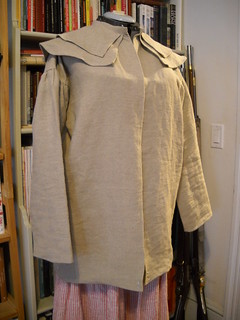
Hunting frock from the side. Just two sizes of one curve

I drifted away from the HSF. While, at some point, I had plans for HSF #11: Squares, Rectangles and Triangles, and they were even written down somewhere, something like table clearing and recycling happened…but, hey wait a minute, if you will allow me one curve done twice, I give you the Hunting Frock! (also, the checked bag).

Since there was a search for “best rifle frock for rev war reenacting,” I think this probably bears going into.

Presented, for your consideration, The Facts.

The Challenge:  HSF #11: Squares, Rectangles and Triangles

Without fringes or hem

Fabric: 100% “Osnaburg” linen, acquired from Henry M. Cooke IV of Historical Costume Services. I think he orders from the Ulster Linen Co. We are talking bolts here, people.

Pattern: Cut by Mr. Cooke, who used a yardstick, chalk, and an extant shirt (for the cape curve). I have watched him cut two now, and it’s pretty cool.

Year: 1778-1781 <choke> I forgot to ask.

Notions: Does thread count? That’s all this takes.

resolver

How historically accurate is it? Based on Mr. Cooke’s research into the hunting shirts worn by Massachusetts troops, and revised to reflect recent research by Neal Hurst, this frock pattern reflects the most current, accurate representation of the hunting frocks (sometimes called shirts) worn by Continental troops during the American Revolutionary War. The garment is entirely hand-sewn using, as much as possible, the correct (thankfully basic) stitches. Flat-felled seams, all that good stuff. Any place it is incorrect is purely my own genius.

Triangles and trapezoids!

Hours to complete: Remember those soul-crushing hours? Yes, these were among them. Actually, no, it’s not too bad. Perhaps twenty-four? You can power down on one of these, but even once you have the initial fringing done and the fringes attached, you will have more thread-pulling ahead of you.

First worn: Monday, May 27, 2013, for the Memorial Day Parade in Warren, Rhode Island.

Total cost: $45, for the linen and the cutting. Your mileage may vary, as the Young Mr and Mr S are in the regiment for which Mr. Cooke is the adjutant.

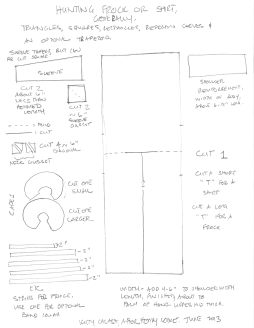
Hunting Shirt/Frock Schematic
Hunting Shirt/Frock Schematic, no scale whatsoever

To the person looking for the “best rifle frock for rev war reenacting,” I have to say, it depends. If you are with a Rhode Island regiment, for example, the linen you choose could be brighter, to reflect the fact that the state called for “whitened towcloth” for hunting frocks for Rhode Island troops. I have found some I think might be likely at Burnley and Trowbridge, but I have not checked it with the RI captain. You need to know if your regiment or group favors hunting shirts (pull over) or hunting frocks (open down the front), and then you need to figure out what kind of linen they were wearing in the period.

But, like a shirt of the period, these garments are very simple: triangles for the gussets (or squares), rectangles, and just the curved cape. The pattern (schematic) at right is adapted from what I have seen Mr. Cooke cut, which is quite similar to the Brigade of the American Revolution pattern I had for the Rhode Island frock I made (also entirely by hand). Since these were so close to shirts, they would have been very easy to construct, and since they’re large, measurements could be generalized. The BAR pattern does not use the under-arm gussets, and the sleeves are not tapered; there is more fringe on the standard Rhode Island frock than on the Massachusetts frock, but there seem to have been variations at the time.

You may also wish to consider whether or not there is a difference between hunting frocks and rifle frocks (I do not know, please don’t ask, I wasn’t told this would be on the test).

For more, here is Neal Hurst, on Fringe on the American Hunting Frock. You can read it before or after you pull threads out of those two inch strips until only 6 to 8 remain in the center. Happy fringing! 

What’s behind that green suit?

The American School, by Matthew Pratt, 1765. MMA 97.29.3

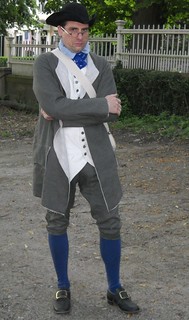
Mr S. has a green linen suit in the making; that is, he has breeches which mostly fit, and a frock coat in need of serious alteration. Since I will need to alter this coat eventually (that is, take it apart, re-cut and re-assemble it) I have started looking for images of green suits.

Portrait of a Boy, probably of the Crossfield family. William Williams, MMA 65.34
Portrait of a Boy, probably of the Crossfield family. William Williams, 1770-75, MMA 65.34

The green linen the suit was made from is no longer available, so there will be no matching waistcoat. If I can get the thing tweaked to an approximation of ca. 1763, we should be set for the August event (if that happens) and for Battle Road next year, though I know he might want wool. The taunts of “bet you wish you had the rest of that coat” from this year linger in my mind, at least.

The jacket is, admittedly, too short. I begin to wonder if I need to cut it down even more, like a workman’s short coat; the Massachusetts line “Bounty Coats” are cut shorter, and similar to a coat at the Connecticut Historical Society (1981.110.0, search by number here, the links are not stable).

Mr S last June, in the unfinished 36-hour-frock coat

The problem with that plan, at least for 1763, is that the cuffs are clearly larger and coats longer, in 1763, than they are in 1775, at least for gentleman. I realize that this means I am better off starting over completely for the 1763 coat from a muslin up (which against all instinct and principles, I did not do for the 36-hour-frock coat). So I’m waffling here, as Mr S doesn’t always want to portray the day laborer/tenant farmer, but would like some pretensions to artisan and property owner. That means more fabric, and that means starting over completely is in order–breeches, waistcoat, frock coat and all. But wait, there’s more!

The events in the queue before the August 10th event for 1763 include Monmouth on June 15-16 (for which overalls and hunting frock are in production), Washington’s Arrival in Cambridge on July 14, which requires militia clothing, and Old Sturbridge Village the first weekend in August, for which a regimental coat is requested. Somewhere along the line, I’d like to make myself something…but it looks more and more like a summer of menswear. Perhaps cutting down that green coat and altering the breeches for July 14 is the most sensible plan…though where that will leave 1763, or the regimental coat, I do not know.

The Report: Sorry, No Pictures.

We came, we saw, we sewed. Next year, if we go, I would teach (lead?) one class only. It was just too busy to enjoy other classes and prep for my own, so it’s a rational decision.

 It was fun to see the same people again, to meet friends made a year ago. And it was really fun to see costumes and costumers. It’s a different world. And while I’m not saying that re-enactors don’t have fun, or a sense of humor, one finds that the sense of humor is a little…different…and that sometimes, a weekend of all women is a fine thing to have. In two weeks, I will be part of a weekend of mostly men, and I will look back at the air-conditioned hotel nights and hot showers with real longing. (Having just realized that I am about to spend two hot sweaty nights camping and then drive home to New England from New Jersey with a load of stinking kit in the car, I am seriously questioning my sanity. But, onward, to Happy Father’s Day in the miasma of New Jersey.)

So. The conference was smaller this year, but still busy. We skipped the crepes (prep!) and the tea, as my friend cannot eat wheat, and that was OK. I made significant progress on some required overalls, and that was amazing. (PDF files of the classes I taught are on the Dress U Handouts page above.)

On Saturday, my mother took us to dinner at a Thai restaurant in Haverford, which was delicious, and such good company! Ever evangelistic about her hobby, my mother gave us both plants to take home.

Before dinner, we had tried to go swimming in the hotel’s silly pool (it is a curious shape). The pool was nearly at its capacity by volume of guest with an exuberant extended family playing hotel pool volleyball with three inflatable beach balls. After my friend was hit on the head the third time and glared at, we decided to leave.

Glaring and staring continued on Sunday when the Golf Guys arrived. We rode the elevator down with a possible father-and-son duo after dropping off the iPad and projector so we could get some dinner before we donned tiaras. Golf Guy the Younger stared hard: that was the filthiest look I’ve gotten in a long time, and I have a sarcastic teenager at home. He seemed offended by my green silk bonnet (I know, I used almost slub-less dupioni and not taffeta for my Anne Carrowle bonnet) and the notion that I was hoping to get it rained on. Golf Guy the Younger stormed out of the elevator ahead of us, while Golf Guy the Elder held the door, smiled, and said, “After you.” He was the original owner of the thick white leather belt that held up his mint condition mint-blue polyester trousers, possibly purchased with the leather belt. The meatiness of the leather belt reminded me of the thickness of the bayonet belts worn by the Second Helping Regiment, belts which are probably of an age with Golf Guy the Elder’s belt.

Golf Guy the Younger found costumed women so horrifying that he would not even take the door we held for him, though GGtheE attempted to speed up to catch the door. At the Outback Steakhouse (ugh, but handy and with a gluten-free menu and cold beer), more staring happened. It was full of tables of Golf Guys, as weird as the day we drove home from Philly when there was an Eagles-Giants game at the Meadowlands and were surrounded on all sides by cars full of men. Not until we saw men with painted faces did I realize we were headed for a football game, and up on the skyway part of the NJTP, small sedans crammed with large men with blue faces were a sight to behold. We weren’t re-enactors then, but if we had been, I would have put on every uniform hat in our car.

So we had the usual conference mix of meeting people, learning things, and shocking the locals, interspersed with a trip to the Exton Mall for a power cord lost from the projector case by an errant colleague and a couple of tiaras. We were sparkly this year, but had to announce that we had stolen our mistress’s jewels, as the excuse for wearing paste with peasant clothes.

Next year, CSA is in Baltimore at the same time…time to look into train tickets. But now, packing and loading the car for a drive back in the rain. And just like last year, we’ll take 287 instead of 95.