Monmouth Menus

Food: It is always on my mind, even cataloging. When the tan and brown and black colors of a sampler make me think of Tiramisu,  I know it’s time to wrap up work for the day. But food is particularly on my mind this week, as I plan and calculate for Monmouth, hoping to use the lessons I’ve learned in the past instead of just being anxious. I know it’s not a test, but it feels like one, somehow.

The Young Mr has aged suddenly, in Don Draper’s kitchen.

Continental rations were supposed to be a pound of beef and a pound of flour a day for man, half that for a woman employed by the army and a quarter of that for a child. The Young Mr (who isn’t really a child and is sort of a soldier) would get more if he was really a drummer… but in any case, we’re looking at 2 + ½ + ¼ or 2 ¾ pounds of beef and the equivalent of flour at a minimum to feed two soldiers, a woman, and a child per day (at a minimum, I expect to feed the adjutant as well as ourselves).

I float out ideas like fire cake or pudding to take account of the flour, but Mr S reels me in and suggests that we should stick to what we know until we can test other ideas on the landlord’s fire pit. We shall substitute bread, therefore, and I probably will not make a nuisance of myself at the bakery or the grocery and ask them to weigh the loaves, as I have my own kitchen scale and can obsess about this in the comfort of our home.

Too fancy! From the Complete Housewife.

My plan is about the same as every camp dining plan: that’s suitable, given the repetitive nature of Army rations (and the repetitive complaints of the soldiers, echoed in every war).

Friday
Pasties. They keep and travel well.

Saturday Morning
Bread, cheese, strawberries, eggs
Ideally, I’ll find a farm stand where I can buy local strawberries, but we will only get into a discussion of what exactly would have been in season on New Jersey in June 1778, which leads to a discussion of global heating.

Saturday Lunch
Bread, cheese, ham, cookies from home

Saturday Dinner
Beef stew and bread, strawberries, cookies from home

Sunday Morning
Bread, cheese, fruit, eggs

Sunday Lunch
Bread cheese, ham, and anything that’s left

This is essentially the same plan that I had for OSV last year, with the biggest sticking points being: will I remember the eggs? Will I manage coffee? I’m not very good at anything until I have coffee, or some kind of caffeine, which could be a challenge this time around. There’s an ice truck scheduled to go through the camps, but what I want to know is, when’s the coffee truck coming?

New Model Army Stove

From the BAR FB page.

Cooking and eating will be different at Monmouth, because there will be camp kitchens.

This means two things that give me stomachaches: trying something new in public and sharing with strangers. How to alleviate this discomfort? Research, of course, because we don’t think our landlord wants to have an 18th century camp kitchen in our yard, even as an attraction or energy saving option. (Nor have we figured out how to ask him about the hanging-chicken-cooking experiment we want to try using the metal fire pit he lights for snuggling with his many girlfriends.) For more on camp kitchens, you can read John U. Rees’s article here, or check out the work done on the common British soldier in America by the 18th century Material Culture Center.

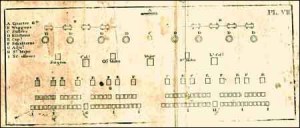
"D" are the kitchens.
The circles are the kitchens.

With a camp kitchen, we can leave our three sticks at home. Kitchens are also far more authentic for a large camp (see the plan from von Steuben at right). I’ve also read that it’s quicker than cooking over an open fire, which is a plus.

A large heap of earth cannot be good in a downpour.

The main downside that I can see to a camp kitchen is rain: from the photo and this drawing, you can imagine for yourself the results of a downpour. At least it’s going to be drier there by the end of the week…

5 Days till Monmouth

This is not Cassandra's idea of a nice frock.
This is not Cassandra’s idea of a nice frock.

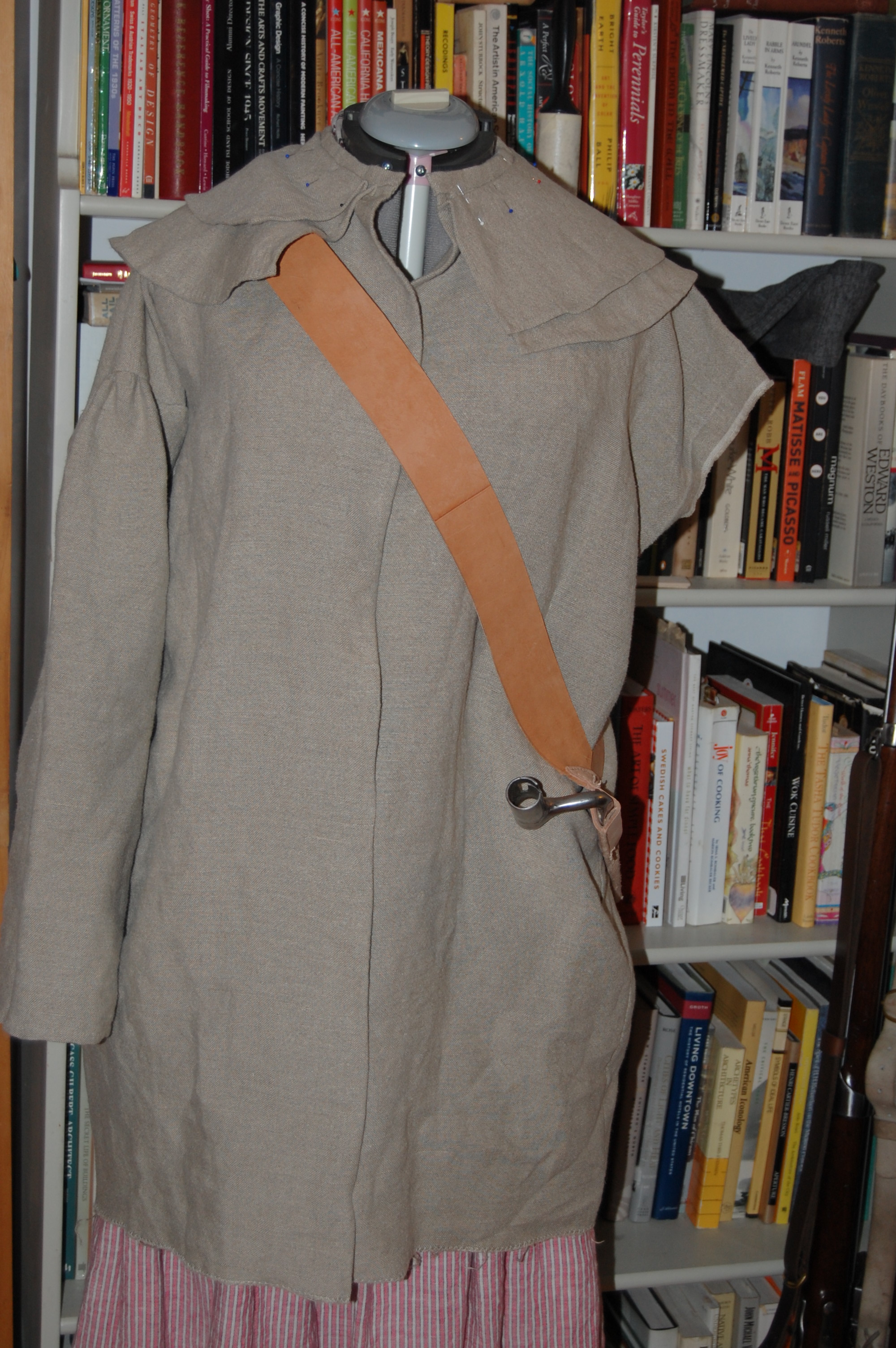
Cassandra doesn’t like wearing uniforms and bayonets. She wants to wear a dress. She will have to be patient. (Actually, she is wearing a chintz jacket in need of a hem, and if I revolt against buttonholes, I might finish that tonight. More fringe must be made this evening for the hunting frock.)

I switched to Mr S’s overalls for awhile, and we’ve done the first fitting, which gets us to buttonholes and then re-basting the inseam and outseam. In the process, I discovered that he does, in fact, have a twisty leg. I do not think it is statistically probable that the two pairs of overalls I have cut for him and the pair cut by Mr Cooke would all include the same slightly on the bias leg. So I reversed my plans to get those done, and will stick with getting them to fitting number two. They will need a master’s hand and eye for fitting.

Sunday: One last strip o' fringe required.
Sunday: One last strip o’ fringe required.

But I think I have a plan for food for Monmouth, have confessed to Mr S that, based on the Monmouth sutler list, we must leave room in the car for possible additions to the Strategic Fabric Reserve, and have convinced the child to try learning a new song on the drum. I also started a new pocket, but I’m not sure if my hands can take the backstitching. Slipstitching and whipstitching aren’t too painful, but backstitching proved quite painful last night. It’s totally annoying, because it’s pointless to post a photo until it’s done and right-side out!

You can see the binding, but not the stripes. Silly!

But this will be a panicky, intense week of samplers, reference, grant applications, and event prep. I suppose that’s not too different from many other weeks…though the last time I had this combination, we were only going to Sturbridge. I took comfort in the idea of how close we were to home, the way the cat knows how long it takes to dash to the basement when the doorbell rings. From Monmouth, it’s a long way back to my own basement.

[Another] Wild & Crazy Idea

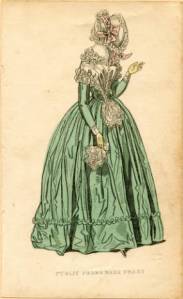
Fashions, 1841. Fashion Plate Collection, Ella Strong Denison Library, Claremont College

Perhaps the Young Mr is correct: I may be crazy.

I have agreed to, at the very least, explore a project and grant funding to recreate an April 17 1841 Suffrage Parade for my workplace. We still have to decide to what lengths we’ll go, but the idea is so appealing that I want to give it a shot. (Orator positions opening soon?)

Public promenade dress, 1842. Claremont College
Public promenade dress, 1842. Fashion Plate Collection, Ella Strong Denison Library, Claremont College

Why is this crazy? Another year-specific event, with the event part to organize, plus wardrobe for at least some people? Pure madness, utter delight. Blame it on the Godey’s Lady’s Magazine paper dolls I bought at the Chicago Historical Society all those years ago. It could even mean another corset, and we all know how much I love making corsets. But I was thinking about how at my age in 1841 I’d be accustomed to an earlier style…but the key, as always, is looking. And looking tells me I need more of a waist than I can perhaps achieve with the stays I have in hand.

To my Pinterest board (thanks for so many wonderful leads, Cassidy) mix of extant garments and accessories, I’ve been pinning from fashion plate collections, including the well-cataloged collection at Claremont College Library.

Fashion plates are one of the sources you have to be careful with. Like Vogue, in fact exactly like Vogue, these are high-style images that are as mannered in their rendering as fashion images are today. Waists will be slimmer and skirts rounder, but the silhouette and shapes will be recognizable in extant garments, painted portraits, and thankfully, photography.

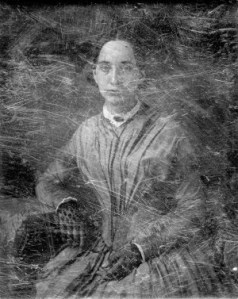
Mrs. Thomas Easterly. Daguerreotype by Thomas M. Easterly. Missouri Historical Society, PHO:17434

The year of the Suffrage March, 1841, is early for photography but not impossible (thank you, M. Daguerre). It’s not the right state, but there is a fantastic collection of images in Missouri. These portraits give a good sense of what people were actually wearing, and what shape their bodies took inside their stays and corsets. (Hot tip: don’t clear daguerreotypes with Scotch-brite pads.)

This is, really, a mad scheme that goes far beyond dress. But a banner painted with an ox and the slogan “I die for Liberty” carried by butchers? A wagonload of disenfranchised Revolutionary War veterans? Enlisting students (not in costume) to follow along behind costumed interpreters marching the known route of the 1841 parade? It’s too tempting not to try.

Bonus: Patterns and plaid!