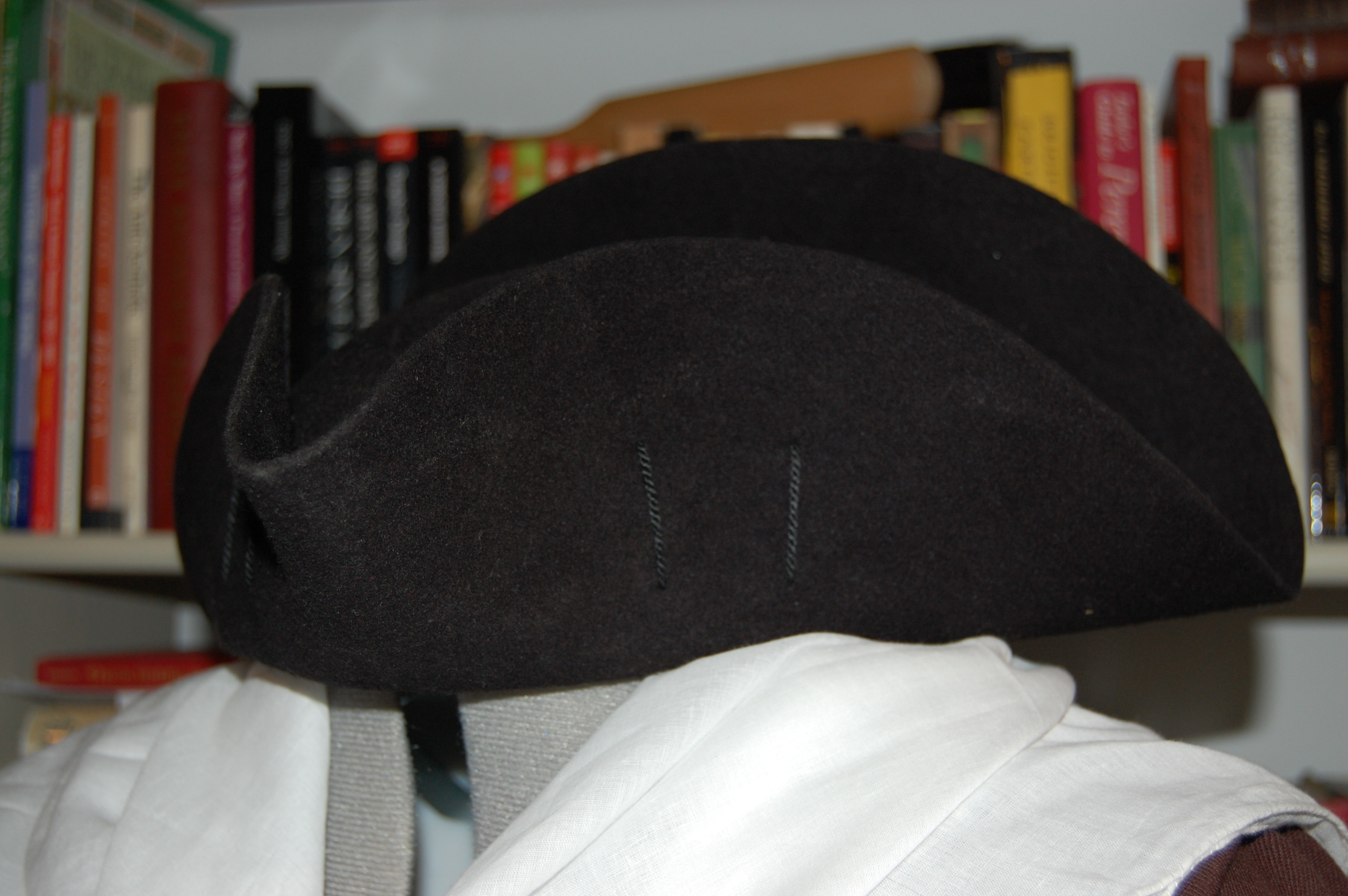
Really, the power of the interwebs. Not that I shouldn’t have contacted the hat maker, but the hat is soft and lovely and looks just like one in a painting at work. And I so readily saw it ornamented with ostrich plumes that would have made it twice as pettable.
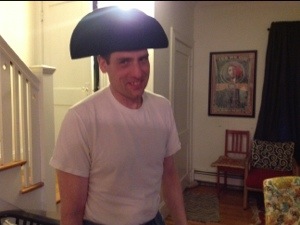
But the hat maker emailed and recommended a technique I will call “steam and cram” but which involves the judicious application of steam followed by placing the hat on the head. So I pulsed steam into the crown of the hat, avoiding a) the neat label pasted on the top and b) the sides, which have such a lovely feel and verticality. And then hat was then placed firmly on Mr S’s head.
Felt is such amazing stuff: I love the way the wool changes as you felt knitting. There is a moment when the fibers change– it’s hard to describe, exactly, but there’s a feeling of release, and then the knitting as a whole becomes more plastic and malleable.
The same thing happened with this hat: while atop Mr S’s head, he felt it relax, and voila! Hat! Fitting!
Lady Francis Scott and Lady Eliot, watercolor by Paul Sandy ca. 1770. YCBA, B1977.14.4410
Why a Riding or Shooting Coat Must be Made. A Diversion to take place in Several Acts, with Entertainments for All.
There was a bit of drama chez Calash following the March 23 inspection at Hartwell Tavern. There was a sense that a certain hat was not quite all it could be. There was a feeling that the hat might have been sat upon by the horse employed by the Captain to make the Regimental Garments. (Why else do they smell the way they do?)
The Matt Hat
So the favorite hat maker was contacted, and after negotiations, a hat was ordered. It was thought it would fit Mr S.
It does not.
It does, however, fit me, which means that in order to make use of the hat, I shall have to make myself a riding habit or shooting coat (the more likely item). Poor me, a tailoring exercise.
We could send the hat back, but instead I’ll knit another Monmouth cap, and put “civilian hat” on the birthday or Christmas list.
I got in a lather about not having mitts. I have been trying to knit a pair from the Mara Riley pattern for some time, as in well over a year. It’s just an unfortunate thing. I understand the pattern, I like the yarn I have, the needles are authentic enough for events, and yet: I cannot get these things done. As a result, I get cold. (I don’t mean that to sound whiny.)
There’s debate in some circles about whether or not knitted mitts were worn in New England, though there is a nice pair of black frame-knit mitts at the MFA, with a history of use in Lexington, MA. That’s a long way from what I can knit, a fair distance from what lower-middling Kitty would wear, and vastly unsuitable for a woman following the army. Still, I want mitts.
‘Camblet’ lined with linen, linen lined with cotton. More pix on flickr.
Fortunately I have developed more patience or bloody-mindedness since then. This allowed me to spend the time scaling up the pattern in Costume Close-Up. That’s where I started in the Fall, but things went better this time, and I actually have a pair of mitts.
Two pairs. I have problems, I try to solve them with sewing.
The Challenge: HSF # 7: Accessorize.
Fabric:
Left: Silk and wool “camblet,” lined with light-weight linen, both from Burnley & Trowbridge
Right: White linen from Fabric-Store.com, lined with printed cotton from Wm Booth Draper.
Pattern:
My own, scaled up from Costume Close-Up, available here for you if you have large hands, print it at 100% on 11 x 17 paper. You will need to tweak the thumb placement. Make a muslin. Make two muslins. It’s worth the effort.
Year:
1750-1800. Narrower than that I cannot get, yet.
Notions:
None.
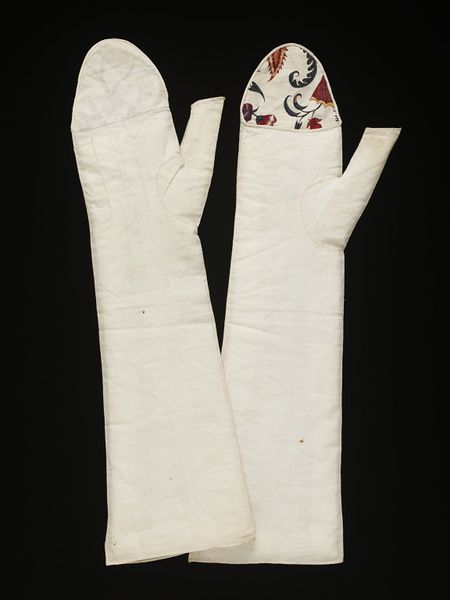
Mittens, 1790-1800. V&A,
How historically accurate is it?
Say 8/10, since I have never examined a pair and don’t know exactly how they were made. Yes, I’ve read the descriptions in Costume Close-Up and Fitting and Proper, but at this foggy insomniac moment, I couldn’t tell you much about those descriptions.
Hours to complete:
The bulk of the time was in the patterning, which took a couple of evenings and 4 muslins. But once you have a pattern that works for you, finishing a pair from cutting to wearing is about 3 hours all by hand. You could cut that significantly using a machine instead of hand back-stitching, and add decorative embroidery, which I really cannot do. Really. Photos to come.
First worn:
To be worn April 13…probably the white linen pair.
Total cost:
Nothing, really, as all fabric was left over in the stash. The pretty printed scraps came in handy.
Garters! Jo-Ann plus Wm Booth Draper, but so far no implosion
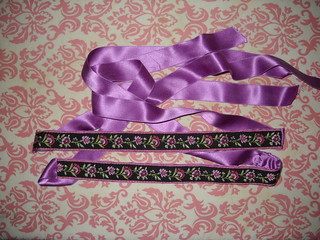
Oh, I made some garters, too. Easy-peasy. Use the Pragmatic Costumer’s Ten Minute Tutorial. Completely makes up for whatever project you think you just screwed up. The main lilac ribbon is silk, the decorative ribbon is so not silk. These are better than no garters, but I expect my stockings will still droop around my ankles, as required by the laws of physics and reenacting.
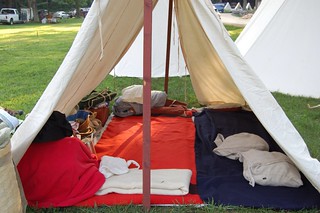
We use as small a cooler as we can, and save it for things that get dangerous, like meat. We skip dairy. If your impression is that of soldiers in the field, forget cream in your coffee or milk in your tea, unless you can point to the farm you stole it from! (See John Smith’s diary.) We hide the cooler under a blanket in our tent. Yes, the blanket is a red bed cover from Ikea and needs to be replaced.
Carrots, onions, potatoes, parsnips, beets, apples, can all travel in bags, baskets or bowls. Think basics if your impression is common soldier or common person.
Rations were generally a pound of beef for a soldier, half a pound for women on the ration, and a quarter pound for children. You can use these proportions to figure out what to make, and John Buss had a lot to say about the quality and frequency of the beef and other rations. Jeremiah Greenman of the 2nd Rhode Island ate dog on the way to Quebec, and that was one time they weren’t the 2nd Helping Regiment. We draw the line well on this side of that kind of authenticity.
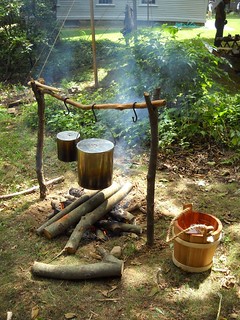
Three sticks, two kettles, one bucket. I love that bucket.
Men carried their rations in haversacks, so yes, a little eeww if you’re thinking a pound of salted beef in a linen sack along with a pound of bread or flour. That’s where the cooler comes in, and a metal bowl or plate. We use split firewood to cut the meat on, and then burn the wood instead of washing a wooden cutting board in the field.
I have brought home-baked tea bread to events, and taken cookies (little cakes) to the farm. But you have to think about the context of the event, and your specific impression. I’d like to strip everything down to the “three sticks, two kettles, no matches” principle, but we’re stuck with cooler because we cook.
What we did at OSV, which was two dinners (Friday and Saturday) and two breakfasts and lunches (Saturday and Sunday) was this:
Friday Dinner: pasties
Saturday Breakfast: apples, bread and ham and cheese. Guess who forgot the eggs and oatmeal? Yes, me! The one in charge of stores. Thankyouverymuch.
Saturday Lunch: Apples, bread and ham and cheese.
Saturday Supper: Beef stew with carrots, onions and potatoes. Authenticity would have made this plain boiled beef but fortunately for us, OSV is a farm, and we could pretend John Smith had helped us enhance our rations. We scraped the kettle clean.
Sunday Breakfast: Apples, bread and cheese. The soldier in the tent next to us appeared with a cup of coffee. We eyed him with real envy; sensing peril, he quickly told us we could get our mugs filled at the OSV store, at a discount. Off we quick-marched, and Bob finished his coffee in safety. It wasn’t very good coffee, but it was the best coffee I had that week.
Sunday Lunch: By this point, the child had eaten anything that remained, and we had to buy lunch.
What did I learn from that experience?
Bring more fruit
Bring more bread
Bring the coffee & the coffee pot
When we consider packing for Monmouth this summer, these are the factors we’ll take into account, and one of the largest factors will be the amount the kid is accustomed to eating.




 Kirsten Hammerstrom
You must be logged in to post a comment.