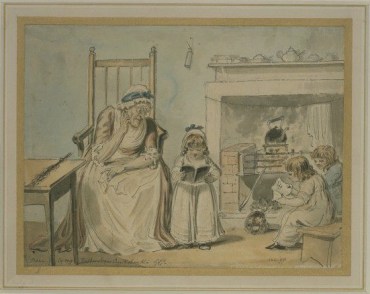
This means a lot to me. I am not one for mush, though oatmeal is a fine default meal substance, and one of my favorite historical quotes is from a long-forgotten pioneer narrative, said by an elderly mother when her daughter got married [I think to a Mormon]: Now we’ll get our gruel reg’lar. My mother and I have said this to each other for decades, and she may have said it to me when I told her I was engaged. We may have laughed like maniacs.
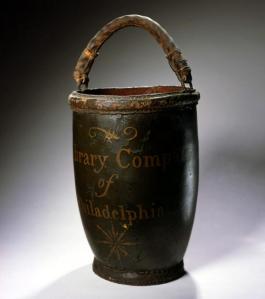
More bucket love. The kettles are nice, too.
But I really enjoy writing this blog, reading your comments, and learning. It makes my day when a reader gets an answer, a new idea, or sees that they’re not alone. And let’s just say y’all help me get through some less-than-silken fantastic days, and I learn a lot along the way. You make me a better blogger, so thanks to You, Gentle Readers, too!
This is all so late now that what I’m going to do is say Thank You Very Much Indeed instead of carrying on the round robin of blog nominations.
Here are five blogs I enjoy checking in on. Perhaps you will enjoy them, too.
In the fine tradition of do-as-I-say, I mean self-perceptive evaluation, I offer some lessons learned from the weekend just past.
Dress for the weather, not for style.
I wore a pair of blue silk stockings because somewhere I found a description of a woman in a brown gown with blue silk clocked stockings. It was flipping 30-something degrees Saturday morning. Did I change my plans? No. Did I regret that later? Yes. And so did the people who had to hear about my numb toes. (Sorry, folks, really. Totally my fault.) And yes, even though the stockings are awesome with lilac silk garters, I should have worn wool. I have a pair already, and for more, I don’t even have to knit them myself.
I have no excuse, really.
Suck it up and get glasses.
My line about always meeting new people at events because I can’t see who they are works for the first ten minutes of a military event, and then I have to try to guess who’s who by their stocking colors. Works so well when everyone wears overalls. Yes, I wear glasses everyday, and need a new prescription. It’s time to get the new script and get the period glasses made. What makes this even worse? I have antique frames. Yes, I deserve your scorn.
Don’t just eat lunch. Eat a snack.
This is a rule I try to follow at work. The 3:00 PM of the soul can be just as debilitating as the 3:00 AM of the soul. Low blood sugar makes you wacky, and if you have a tendency to insomnia-based exhaustion, shyness, or can have trouble in large crowds, one has a responsibility to oneself and one’s companions to take care of some basics. I had my snack after the late-afternoon tactical, two hours after I should have. I solemnly swear that next time, I will eat more cookies sooner.
Evan McGlinn for the NY Times. Click for slide show.
My friend wrote on Tuesday about battle reenactments, and whether or not they’re appropriate or even, well, decent, in a way; she has been thinking about the Battle Road event, Patriots Day, and the Battle at Lexington Green in light of the explosions at the Boston Marathon.
She helped me remember the reading and thinking I had done this past fall when people at work asked if reenactments (and even museum exhibitions) glorified war, and when I started to wonder why, exactly, I was in this hobby. I read Vanessa Agnew on “History’s Affective Turn: Historical Reenactment and its Work in the Present” in Rethinking History 11:3, 299-312 (2007) and “Mobile Monuments: A view of historical reenactment from inside the costume cupboard of history” by Stephen Gapps, also in Rethinking History 13:3, 395-409 (2009). I’m still working my way through “Mimic Toil: Eighteenth-Century Preconditions for the Modern Historical Reenactment” by Simon During, again from Rethinking History, 11:3, 313-333 (2007). There’s a good bibliography at the University of York, but getting at these takes JSTOR or ProjectMUSE access; check with your local public or university library. For list of books about commemoration, History, Memory, and Monuments: An Overview of the Scholarly Literature on Commemoration by Kirk Savageis an excellent starting place. To find out more about why reenactments differ on different sites, and to discover more about the sometimes-fraught relationship between the NPS and reenactors, you can read this on the role of reenactors at National Parks.
The article that resonated most was Gapps. He wrote about a variety of reenactment types, but what made sense to me as a member of two military reenactment groups, both part of the Brigade of the American Revolution, was his writing about the military reenactments. Gapps focuses on Civil War reenacting, and that is an area in which I’m not interested, but his central tenet rang true to me:
…the performance of history has been largely dismissed by cultural critics as a form of nostalgia, but … it actually has a significant role to offer – particularly as a form of public commemoration of shared remembrance of historical events.
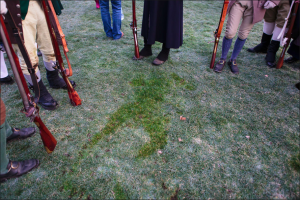
Mr S between the Adjutant and the Dollmaker. Thanks to JacobMar1ey on flickr.
Public commemoration is a large part of the reenactments I’m involved with, but they work differently for participants and spectators, and for different kinds of participants. For a recent example, Mr S and I spent Monday morning in Concord at the North Bridge ceremony, and had two very different experiences.
He came back from the bridge and said, “I was really scared. For a moment there, crossing the bridge and seeing all the British forces, I had a sense of what it must have been like.”
On the North Bridge. Thanks to JacobMar1ley at flickr.
While he had been on the bridge, I was in the gardens with the public thinking, Those poor British soldiers, while I listened to the crackle of candy wrappers and people giggling about their dogs. The crowd spread out on the hill that leads to the Concord River, festival-style, and I was appalled that they came for entertainment to what I thought of as a truly ceremonial and commemorative event. The NPS rules about engagements and casualties suddenly made a lot of sense.
My friend wrote specifically about how reenactments can never portray the reality of fear and horror that is war. She is right. NPS agrees: Even the best-researched and most well-intentioned representations of combat cannot replicate the tragic complexity of real warfare. The activity and logistical support for modern battle reenactments is inconsistent with providing a memorial atmosphere. There is something about reenactments that I cannot fully embrace even as I love them. I have a difficult relationship with “patriotism,” as I have a difficult relationship with America, and much as I have a difficult relationship with my family and friends, whom I also love dearly, though rarely demonstratively.
Naked Raygun, Chicago.
I have been grappling with the concept of America and history and the meaning of American symbols—semiotics—since I started making art. I came of age in the punk years in Chicago, stapling photocopied collages to telephone poles. Reagan was president, nuclear war seemed imminent. I made sculpture and installations about American architecture and literature, as a way to explore American history. I remain skeptical about the political process, even as I engage in it.
So why am I a reenactor? It isn’t always easy. Sometimes it’s uncomfortable, personally—intellectually—it can be difficult to fully embrace sometimes. Recently, with online discussions of gun control and the relationship between rifle/black powder clubs, the NRA, and reenactors, it has been difficult to grapple with all of the different points of view and to be true to one’s beliefs. Most of the time people don’t air their opposing views. Some of us do, as one writer noted, hold our noses and pay our dues. I knew this going in.
But reenacting, in a way, is an art form for me, a very personal one, one that this blog is part of.
Another friend avoids the military reenactments and sticks to living history through museum work. Mr S enjoys the farm work as much as the battles, because he likes working hard. He likes the physical experience of both; he likes the people, too, and whether he’s chopping wood with the hat maker or crossing the bridge with the adjutant, the shared experiences mean a lot to him. For me, the most profound experiences of women’s history have come at the farm, probably because that is the truest means of reaching the past for a woman I have yet to discover. Can I find that moment in military reenacting? Perhaps, by working hard at recreating the army follower experience.
Unlike monuments, reenactments have the potential to create more open ended and contextual historical commemorations. (Gapps, abstract)
One thing I do not like about the battles is the public. I stand on the public side of the rope line, and think, “Those are my people out there, on the field.” The public—the predatory photographers, the hooting guys, the texting teens, the snacking people—seem so out of place to me. I know it’s entertaining, but it’s somewhere between real and not real, and I can’t forget that it is often about something that was real.
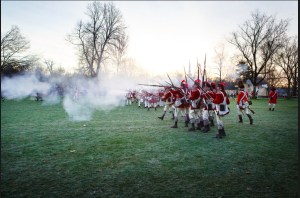
Photo by Evan McGlinn for NY Times. Click for slide show.
Mr S hears spectators yell, Get those British bastards! but that doesn’t mean he likes to hear it. It’s not just because we have friends among those enemies, but because they represent men who, just like the Americans, were scared and wounded, hungry and dying. They were here doing their jobs in a place claimed by the British Crown. Does that yell miss the point of the reenactment as commemoration? Is it simple boorishness? Does the comment show the relationship between reenactment and spectator to be too close to blood sport?
Or is the problem that some of the military reenactments fail to adequately contextualize the ‘battle’ as a commemoration or demonstration? Does narration help? We discussed this in the car on the way home from Battle Road: amplified narration and role-playing can deepen the experience for visitors and reenactors alike. What are the better ways to present history for the public? (We’re not suggesting narration for Battle Road: we were comparing notes on different events, and the different perspectives we have from two sides of the rope line.)
I think it’s encouraging when reenactors, even some who might be stereotyped from a distance as old guys who’ll never change, ask themselves questions about what they do, and how, and why. Questions are where we start, and conversations. I’m glad my friend started a conversation. We won’t all like or agree with every statement, but we have to keep talking.






 Kirsten Hammerstrom
You must be logged in to post a comment.