Sewing for the Adjutant

Falling In, OSV 2012

We were invited to join a Massachusetts regiment after the event at Old Sturbridge Village last summer, and we did. This has been a good thing, though it’s sometimes a little tricky to figure out which unit to “be” with. It is also a challenge because even though the Rhode Island unit has careful (if unwritten and slightly out-of-date) standards, the Massachusetts unit is another thing altogether.
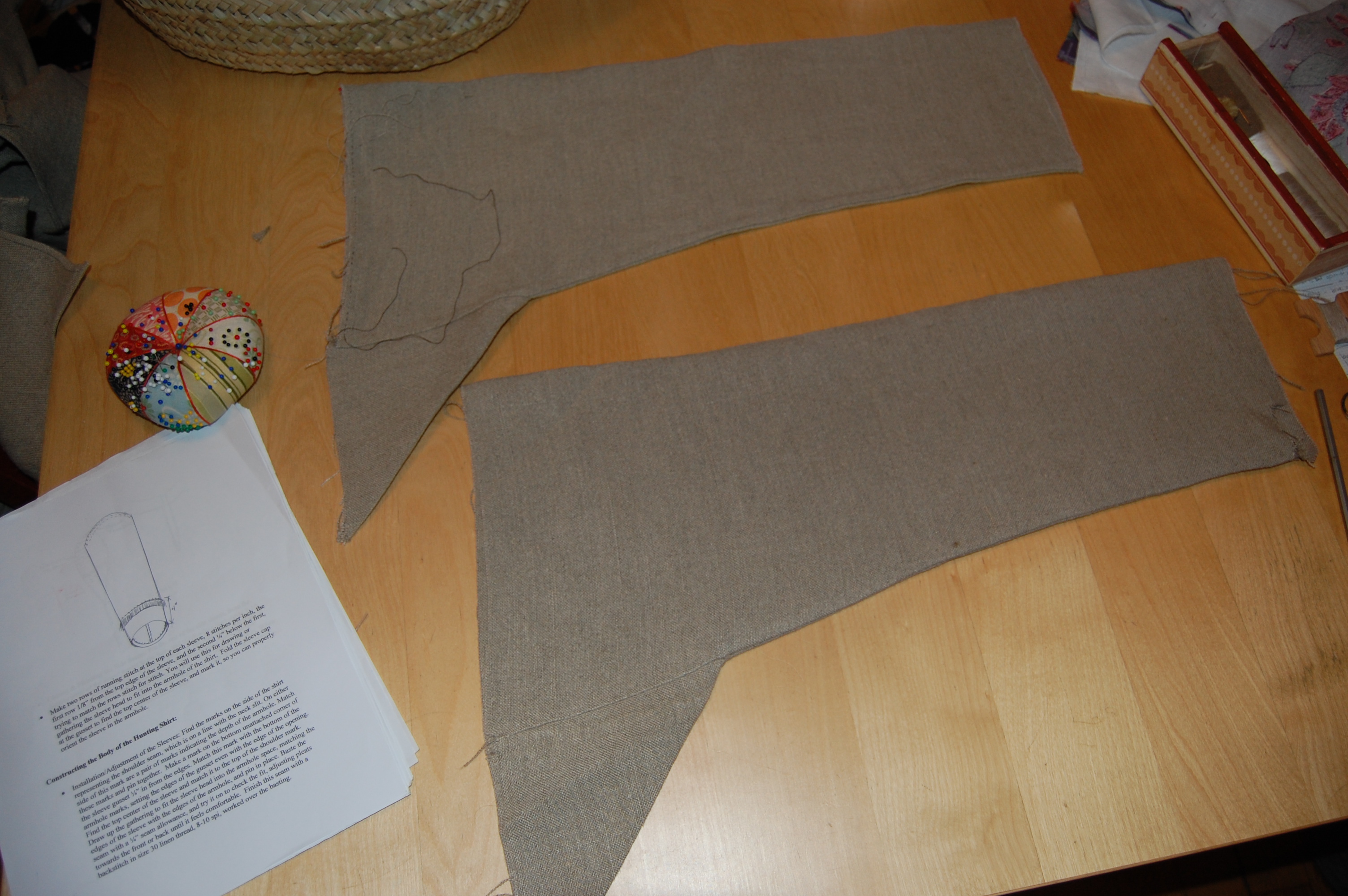
Gathering the first sleeve head. Destination: Saturday afternoon
Gathering the sleeve heads. Saturday is soon!

The women last weekend kept asking what I was working on so assiduously. It was the hunting shirt (to become a frock) for the Young Mr for the new unit. Cut by the master, entirely hand-sewn by me. This is not something they would do.

“Sewing for The Adjutant, ” I said, “is another thing altogether.”

“Don’t even try. Who can sew like that? He’s a professional,” I was told.

What we're aiming for.
What we’re aiming for.

Well, yes.

So wouldn’t that be the very thing to reach for? It’s not like he’s not helpful. I have his shirt to copy, he answers my questions patiently, and I haven’t yet felt like an idiot.

The skill I have I owe in part to my mother and grandmother, and to the Dress U workshop with Sharon Burnston.  Stroke gathers, two-by-two stitching, using the tiniest needle possible are all things I learned or honed in Sharon’s workshop. And thanks to that workshop, this hunting shirt-(perhaps)-soon-to-be-frock is a great deal easier to tackle.

The other part of skill is practice. It’s as true for piano or soccer as it is for sewing. Just keep stitching, and it will come.

And after the fitting, the fringing. That's for someone else to do.
After fitting comes fringing. That’s for someone else to do.

What I find hardest is fit: not only is it hard for me to judge how much to take in a garment to achieve 18th century fit while maintaining enough ease for the wearer to swing an ax (or to accommodate teenage wriggling), alterations annoy me. I suspect that the key may well be not to fit at the end of a day, but at a beginning, or at least a middle. Fitting after a long day of sewing could make you think you were tossing away a whole day of work. It also feels, still, like taking a car to the mechanic or the cat to the vet. There’s something wrong, and I don’t quite understand it. Yet. But with Shoulders Roll Forward and Monkey Arms, I bet I’ll understand more soon.

Townspeople, 1763

I have this friend, DC: I can call him a friend now, but when we worked together, he was more of a nemesis, mostly because of his OCD tendencies, intense perfectionism, and complete inability to meet deadlines. It was a classic example of Mr Failure-to-Plan working poorly with Miss Contingency-Plan-Required. We literally knocked heads installing an exhibition, and I can still feel the hollow ringing pain. But it’s been six years, and with that distance, friendship is possible.

I'm only in this for the cannon.
I’m only in this for the artillery.

But he’s got this idea.  In August 1763, Boston celebrated the Treaty of Peace ending the Seven Years War (known here as the French and Indian War). There are fantastic descriptions of the celebrations and Thanksgiving Proclamations issued by the colonies, and you can read more about it in the Boston Gazette 8-15-1763.

My friend’s idea is to re-create this celebration, complete with cannons and volleys, and to that end he has enlisted local re-enactors, including a unit he didn’t realize I was part of when he asked me if I had a 1763 impression. True to form, we are asking questions he’s not yet prepared to answer… including, what sort of people do you want these townspeople to be? With the calendar as packed as it is, stitching up militia and my own clothes needs to start now, what with the regular regimental requirements due in June and again in August, and oh yes, actually maintaining life and a tolerable standard of cleanliness in the home.  (DC is moving to Europe in the Fall. After this event, when he leaves North America, I expect we’ll be better friends.)

Jean-Etienne Liotard (1702-1789) Portrait of a Woman called Lady Fawkener circa 1760

The reason I want an answer now is simple: I want a hat. After steaming and cramming The Hat onto Mr S’s head, I deeply desire my own Hat. I don’t covet much, really, and a hand-made piece of headwear made by someone you know and respect seems a very innocent thing to covet, even if coveting is wrong.  But to give the Favorite Hatmaker time to create a hat like the one at left, and me time to trim same, I need to know rather soon if I should be a lady or a cherry-seller.

I started a Pinterest board (when all else fails, collect images) of 1763 ideas. It’s a pretty simple thing, really, gown with robings, cap, blah blah petticoats blah blah, but: isn’t it all about the fabric? And the trims? And, lest we forget, the coveted hat!

Paul Sandby, London Cries: Black Heart cherries... ca. 1759. YCBA,  B1975.3.206
Paul Sandby, London Cries: Black Heart cherries… ca. 1759. YCBA, B1975.3.206

The Sandby cherry seller can probably be replicated with an open gown with robings made from B&T’s Virginia cloth; the question is merely of color, drape, and patience waiting for swatches. (Wish Wm Booth still had that yellow and blue striped linen, but my blue and white linsey-substitute would have to do.) This is simple enough, really; I have a cap like the cherry-seller’s cut out, somewhere, or linen to make one, anyway.

Paul Sandby, London Cries: The Fishmonger (detail), 1759. YCBA B1975.3.210
Paul Sandby, London Cries: The Fishmonger (detail), ca. 1759. YCBA B1975.3.210

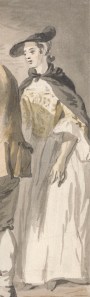
Maybe the compromise is this, yellow, with a black hat. I suspect this hat is straw, but perhaps I could combine the hat above with this idea. The black hat and black cape are very appealing. The answer, of course, is all in research: find out about the men in Thomas Marshall’s Boston Militia, and from there I can find out about, or make intelligent surmises, about the women. But that’s irritating, as military/militia-based history often is–to be dependent on the men. Perhaps the less annoying route lies through JSTOR…. and following up on the memory of a Boston widow-businesswoman.

In the end, I’m realistic enough to know that I shall be lucky to get a new hat trimmed at all, given all the menswear there is to complete between now and August. Even my plans for chitzy sewing this week turned late yesterday into, “Oh, but I thought you liked the Adjutant. We’re going up Saturday for fitting.” I suppose that means they think I’ll finish something enough for fitting.

I came, I saw, I sewed

The usual view: the backs of the bellowers.
My usual view: the backs of the bellowers.

Last weekend was the BAR School of Instruction at the New Windsor Cantonment in Vails Gate, NY. April is an interesting month for travel: changeable weather can land you in a serious fog/cloud, some places aren’t open yet, but the crowds are, mercifully, small.

The meetings and discussions were interesting, and I think its useful for reenactors to continue to ask themselves questions about what they do, and how they do it–questions beyond authenticity. I still think there are great unspoken truths in the Temple Building: in the 21st century, a male dominated, volunteer-run organization will not thrive in its current form.

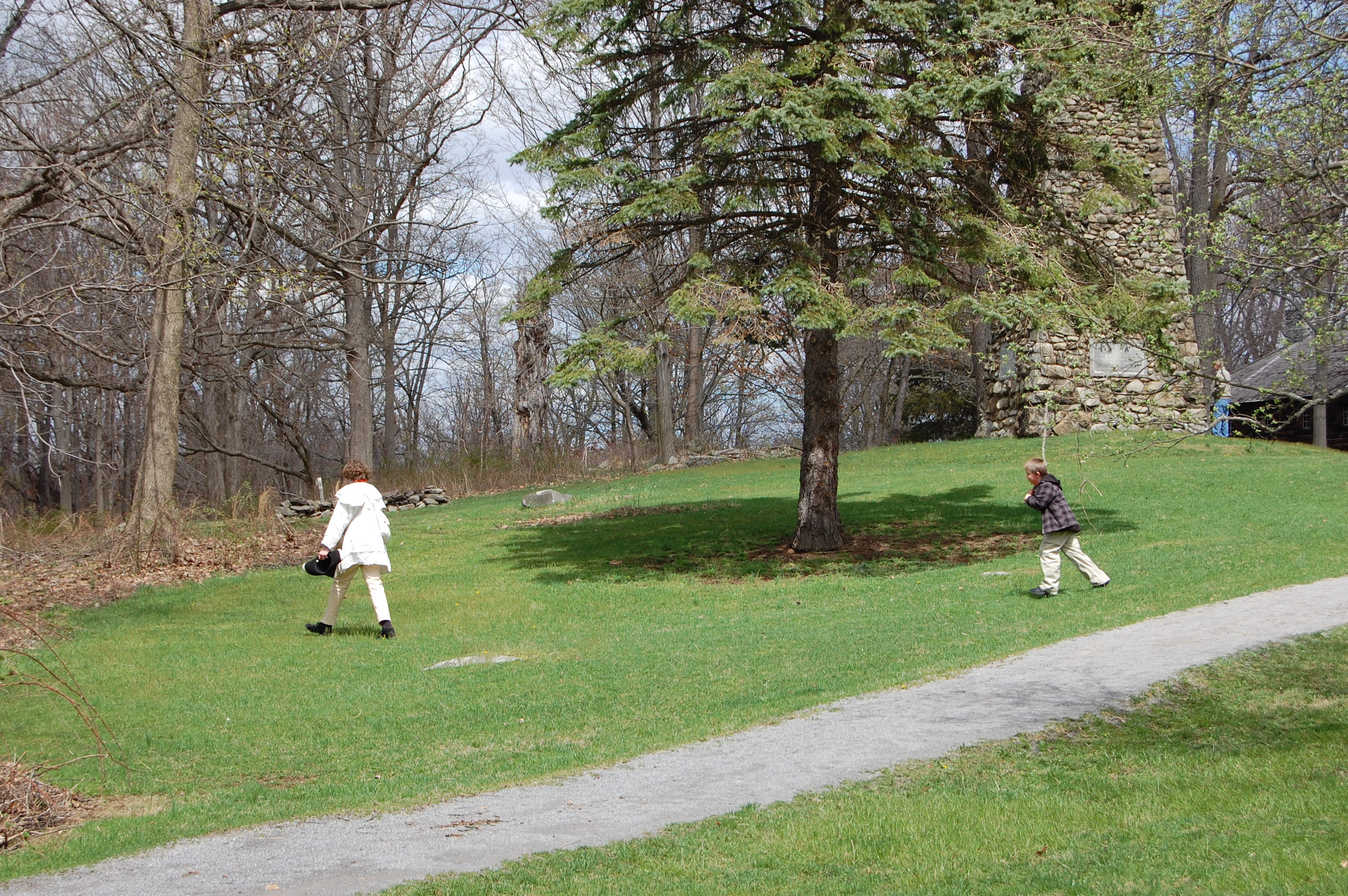
Chase with sticks.
Chase with sticks. He needs drum instruction.

Movement towards demonstrations that make effective use of the actual numbers of soldier who turn out makes sense. as do roles for men retired from the field. More formal interpretive roles for women might strengthen the organization … but for now, I’ll try to learn as much as I can. Laundry: that’s something to work on.

Patina, not dirt.
Patina, not dirt.

Of course, they don’t want their clothes washed. That’s not dirt, that’s patina. I have this for a time to help me figure out how to put together one for the Young Mr, and eventually, for Mr S. It’s less crunchy now that it has hung up for a while, and I do understand the desire for patina. Mr S likes to get his overalls filthy, and his hunting frock. But where would that leave the washer woman?

Mending, I suppose, though I know women were employed by RI state troops to make shirts (there are receipts). We don’t need shirts right now, we need hunting shirts, which it turns out were probably actually hunting frocks, tied at the front with tapes.

Alterations ahead?

Alterations will be ahead for this, though can you call them alterations before the thing is even finished? I started on Wednesday with just the cut pieces, and got this far, plus a completed but not attached sleeve, by mid-day Sunday. (Photos here.) As one of the women at the SOI said, “Without us, they’d be naked and hungry. You think they’d learn to appreciate it.” Probably not until they are actually naked and hungry…

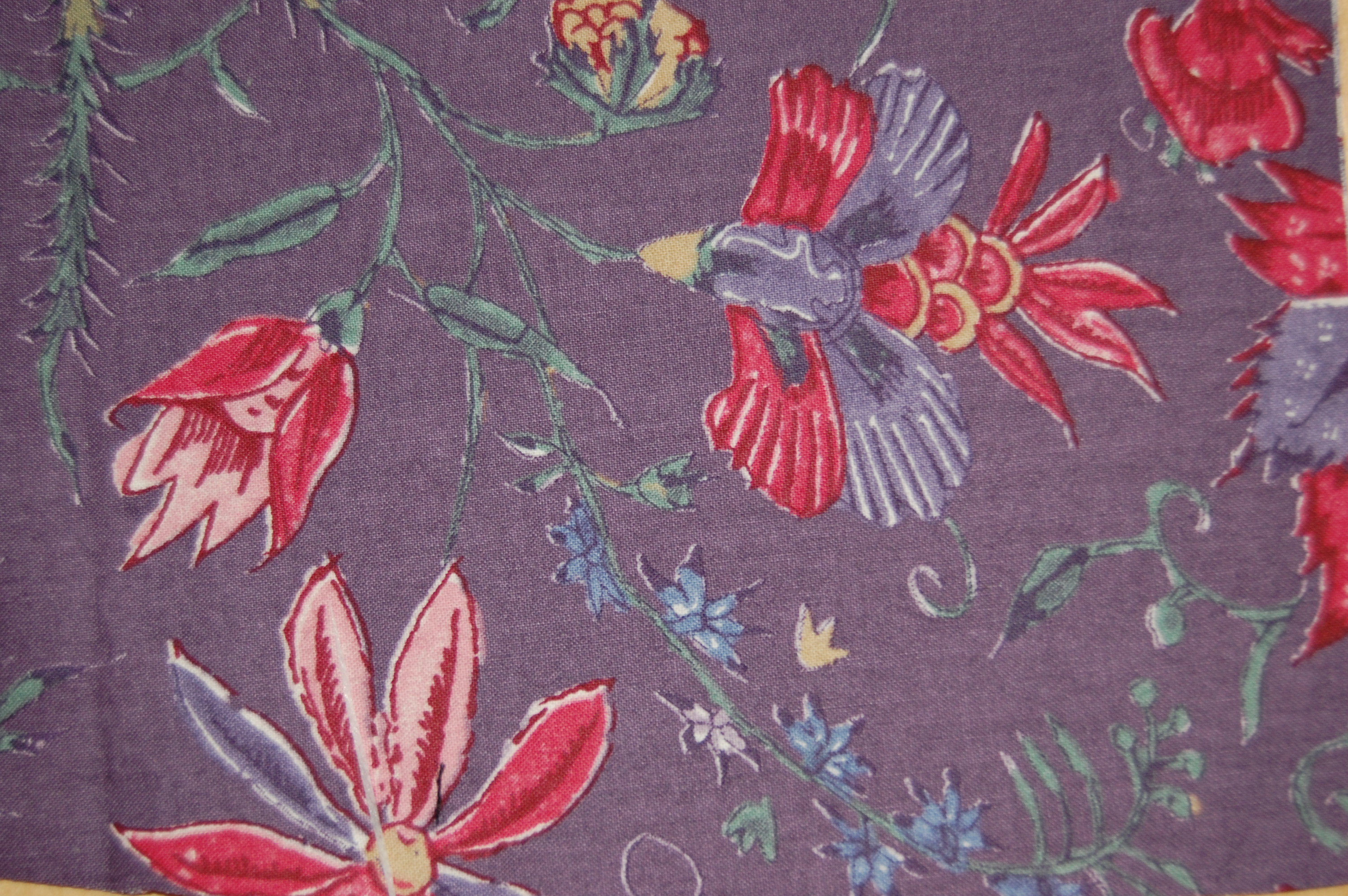
Les Fleur d' Inde
Les Fleur d’ Inde

For relief from the plain linen, I cut out a chintz jacket; the remnant was just enough to get a front-closing short jacket cut. It shouldn’t take too long to make, and will be a nice thing to have in warmer months. And it’s just enough pretty fabric that I might have been able to afford it.

Fog on the Hudson

20130421-072045.jpg Up on the Hudson, it gets foggy. We drove through fog, which was probably a cloud, and remarked on how very different from home it is here. And once again, I demonstrated an inability to navigate through anything but a conventional New England rotary: I have over-adapted.

We went to the West Point Museum (far too warm, folks; artifacts and visitors alike will cook at 72+ F) and enjoyed the artifacts and dioramas. It’s a classical museum, chronological and linear as you would expect it to be. I don’t object to this format at all: it supports limited labeling, which I consider a blessing, really, and allows the objects to speak for themselves and leaves room for the visitor to wonder, find a label, and read more. I did take photographs, but forgot the adapter for downloading the camera.

From there we visited Fort Montgomery, which may well be the site of future shivering.
Here, I did not take photos, especially after I was warned off touching the glass by the curator or site superintendent (honest, I didn’t leave a smudge).

The last stop on Friday was at Boscobel, which I knew of from a book at work. The house is as lovely as you would expect from a place furnished by the former curator of American Decorative Arts at the Met, and funded by Lila Wallace’s fortune. It’s a guided house tour, with an audio tour for the grounds. We lasted through the guided tour (there were only the three of us) and a portion of the grounds.

I’m really glad I lifted the no photography rule at work. Boscobel has some lovely objects. I was interested in several for which there are no catalog images online, no postcards, and no images in their books. I couldn’t capture the sense of place in the house, or the room the way I saw it, and I find that archaic and frustrating.

The tour itself was everything you’d expect a tour given by retired women of means to be: genteel, focused on furniture, and docile. To their credit, they do a good job with photographs to explain how the commodes work, and by the second floor our guide had loosened up a little bit in her blue blazer. But there was little about the family and their lives, nothing about the servants, and some basic misapprehensions about how a house of that size worked. (The cast iron cylinder in a water or tea urn was never heated in the parlor fire, and never by the mistress; sparks! fire! mess on mahogany! Nope, it all happened in the kitchen.)

In the end, Boscobel was lovely and I am envious of the decor and some of the objects and details, but as the tour guide noted, I most liked the “imperfect rooms” (the pantry, the kitchen, the bathing area and the servant’s bedroom).

Huzzah for imperfections! Time to dress for the last day of the common, imperfect soldier before we tear off for home.