Looks like he’ll fall asleep any Minute, Man…it was late.
Nope, I did not attempt HSF # 6, stripes. I made some garters, so if the challenge was strips, I’d be set. Breeches mending, sewing gown sleeves and skirt hem, and the kid’s jacket all took up my weekend, along with just plain living, so no pretty pictures.
I did think about how I choose what I wear, and how it’s a little tricky to sew for the guys, as they are engaged in a different way.
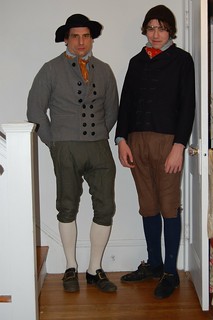
For one thing, they get told what to wear. 1778-1779 Rhode Island troops: you people are all set with your brighty-whities. You’re documented in your whitened towcloth overalls, shirts, and rifle shirts/hunting frocks. Happy marching in your thread stockings, you have broadsides and colonial records to tell you what to wear.
Would you trust these guys? I wouldn’t.
And then we roll back in time to Lexington and Concord, and for Battle Road, what do you wear? Well, they went off in what they had. (By the time they left, the Young Mr’s jacket had one row of buttons and Mr S had better-fitting, mended linen breeches.)
Of course, they were the only guys in short jackets, and they were the guys with the most “lower sorts” impression. To be honest, I do not know enough about the composition of the Rhode Island militia under the command of Nathanael Greene in 1775. Bearing in mind that no Rhode Islanders were at the actual events of April 19, 1775, how should these guys dress? What sort of men comprised the Lexington and Concord area militia, and what would they have worn?
The only way to know for certain is by doing research. What’s the difference between the men in the RI militia and the men who served in RI’s continental troops? Were the militia better off than later enlistees? To what degree did the composition of the troops change over time? And oops, there we went the rabbit hole of history.
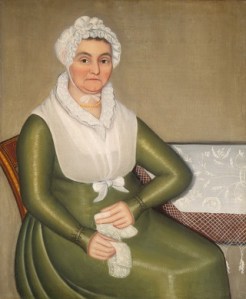
Meet Mary Adams, painted in 1754. She looks to be a certain age, does she not? But she’s still rocking some style. I like black, and wore black clothes almost exclusively for years from high school on, despite the relentless taunts of feral sixth-grade boys. (My nickname was Boots. Costuming and living history is but another episode of dressing funny…)
But I digress.
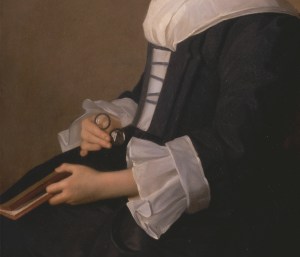
Mary was a happy find this morning, because I knew I’d seen this little detail somewhere…and here it is:
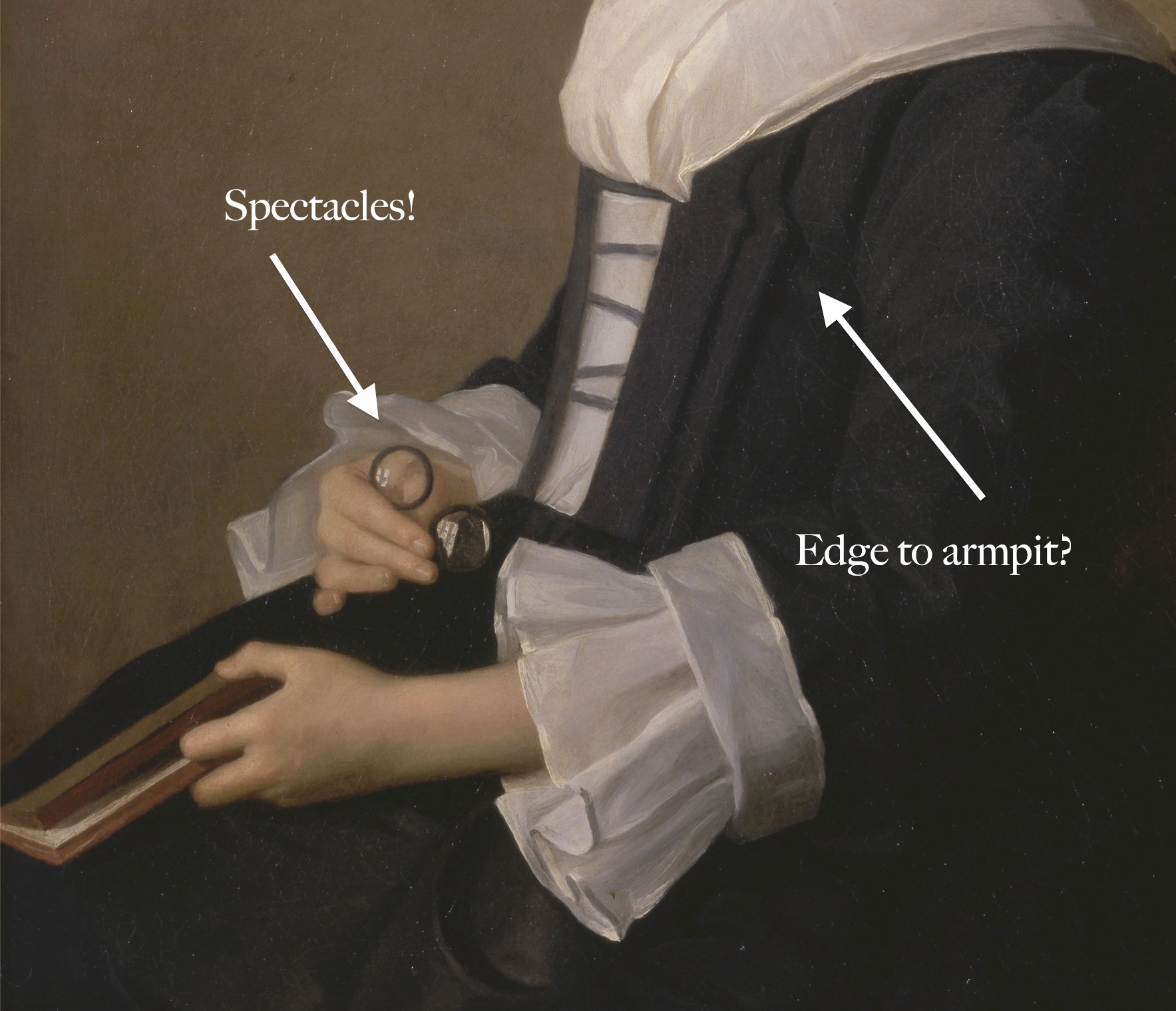
Detail, Mary Adams, 1754,B1981.25.513, YCBA
Did you catch that? It looks remarkably like Mary has laced her gown over her kerchief, and not over a stomacher. I’m doing a little dance, thankyouverymuch, because that is how I roll. Or lace, as the case may be. Look, too, at the top of the lacing: her gown is pulling. Yes. Imperfections, how I adore thee.
Snark aside, it’s a kind of relief. Looking at Copley and Feke and all their sleek silken women is like flipping through Vogue in the doctor’s office waiting room: after a while, I start to feel woefully inadequate in all ways. From the Richard III gown’s wiggly seams to my inability to pin my dresses straight, and heck, the generally asymmetrical rumpled-ness of my presentations… you can get to feeling very low, as Thompson and Thomson observe in Prisoners of the Sun.
Details!
So among the things I note in the painting is the depth of the pull at the top of the gown. Hmm. I feel better about how my flesh and gown relate in the armpit area now.
But if the pull line starts over beyond the robings, that helps a costumer figure out where to put the lace holes and how to arrange the gown. I also like the asymmetry of blue lace zig-zagging down the kerchief. When I work that out on Richard III, and alter my red calico gown, I’ll use Mary’s portrait as a reference.
Finally, and perhaps best, of all, Mary can read. And she need spectacles. That wonderful pair in her hand look like they are cousins of this pair. All in all, a happy find this morning.
I wish I had this workshop to help me! Instead, I have the “assistant” who tends to howl and a room full of garments to finish and alter. The skirts of the brown gown are done and want only tape at the hems, so I can, in theory, move onward to sleeves. I’ll have to scrap plans for an HSF petticoat this weekend, as I have really fallen behind.
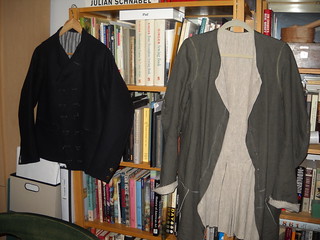
Menswear, to finish and to alter
Battle Road inspection/walk through is Saturday, and second hand reports of the reactions to letters received have me thinking about authenticity, standards, and communication. Last Saturday, I went to see Sew18thCentury and had a lovely time. Not only did we have a delicious late lunch and tea, an interesting chat about ideas and sewing and all sorts of things, I also got to get outta town on my own. (For growing up in a city, I am very happy to spend time in open spaces with grass, trees, and cows.)
I mentioned to Sew18thCentury that we’d wrestled with Fort Ti and chosen not to go because we did not, in our estimation, meet standards, and she was surprised that we didn’t. In truth, we did not. The guys clothes weren’t right, and I know our blankets aren’t right…heck, our tent’s not right.
What makes it all worse is that I know these things aren’t right. So I’ve tracked down blankets and just need to order them, and the tent–well, not this year, but maybe next, I can get around to sewing a linen bell-back tent. Mr S has learned back-stitching and whip stitching this week, so in a year we could tackle a tent together. It’s a process, and this year, unless there was a miracle of increased speed in sewing, I still wouldn’t go to Fort Ti in September.
But what about Battle Road? This inspection is not just for safety, it’s also for dress and appearance. This has thrown me into a tizzy: the jacket’s not done and the coat’s not altered. If the guys don’t pass inspection, they can’t be part of Battle Road, and I’ll feel bad that I didn’t put alterations first. But realistically, I can’t imagine getting their things done by Saturday morning. At least the coat will have the alteration marks made by the master… the road to hell may be paved with good intentions, but the road to Battle Road is paved with pins and linen thread.
I don’t know exactly what “that certain age” is, but I think I’m headed there downhill on an icy street in a speeding carriage.
Here’s another good question: What about age? I didn’t address it directly in working out Kitty’s Brown Gown, but I did consider it. She’s in her 40s, and if you look at portraits by Copley and other artists, older women are often dressed in brown. These are respectable ladies, and when Kitty’s feeling more like a bad servant, she’s happy to wear her ca. 1774 red and black calico dress, and make tracks for Germantown.
I’ve been thinking a lot about personae and impressions, and first person interpretations. One of the best things I learned at a recent workshop was “first person thinking,” and in the historic costuming/re-enacting/living history/ historic re-creationist context, when you wonder what to wear, do, say, pack, eat, I think this is where it starts:
Know Your Self. It all flows from who (and when) you imagine yourself to be.
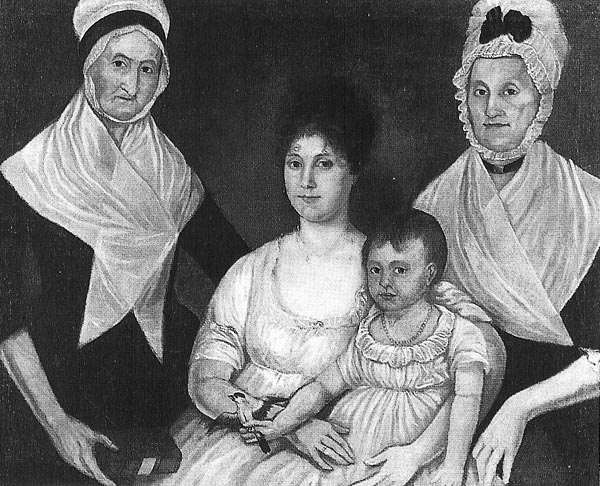
The Ege-Galt Family, 76.100.1, Abby Aldrich Rockefeller Folk Art Center
So let’s take age in account. For Battle Road, 1775, Kitty’s in her 40s. That means she was born around 1735, and came of age in the 1740s and 1750s. Knowing the styles of that time I’m even more comfortable choosing cuffs, because that’s what she grew up with. She’s not going to be very fashion forward–not just because of her class, but also because of her age. (For added fun and dimensions, start thinking about what she saw and read.)
What about choosing fashions for the older set in 1812? That’s where it gets really interesting, to me. Check out the Ege-Galt family portrait, ca. 1802. The older women are NOT in the high-waisted filmy gowns. Left to right, the sitters were born in 1724, 1779, 1801, and 1748. They are wearing more traditional-looking, darker, firmer-stays-underneath, gowns.
John Middleton with his family, ca. 1797 Museum of London 93.28
The same pattern plays out in this image of the artist’s colorman, John Middleton. The older servant is wearing a dark, older-style gown, while Middleton’s daughters are wearing the most fashion-forward clothes.
For anecdotal, quasi-experimental archaeological evidence, here’s my experience. I started out with solid, carapace-like ca. 1770 stays. (Mr S says touching me in them is like hugging a lobster, and then raps my ribs.) They’re not unpleasant, but they are confining, and even comforting. For an event at work, I made a pair of soft, semi-ribbed, transition stays with cups. They felt very strange after fully boned stays.
Long-line stays with cording and a busk? They felt better: more containment. It’s not just about my avoir du pois. It’s about the enveloping sense that the stays provide. The physical difference of the stays made me look at the Ege-Galt portrait again: what would I have felt comfortable and appropriate in, when styles changed radically?
Fashion plates, then as now, have bias in them. Know your self.
Here’s how I’d work it out:
Let’s say Kitty is 45 in 1812: she was born in 1767, turned 20 in 1787: she grew up in full stays. She turned 30 in 1797, just in time to adopt shorter stays, but probably tending to longer line stays with corded bust gussets. Let’s say Kitty’s cousin is 55 in 1812. Born in 1757, she turned 40 in 1797. Chances are good she favored a longer stay with more boning, and maybe corded gussets, too.
1813, chapeau de velours, robe de Merino.
What does that mean for her silhouette? It means that she lowers the waist of her gowns (You win again, gravity!) She also wears darker colors. Filmy gowns of the Regency era fashion plates aside, what did women wear for everyday? If you check Pinterest boards of fashion plates, or the various collections at NYPL, Claremont College, LAPL, and the Met, you can find Griselle, and that’s a help. Better yet, searching extant collections can turn up lovely-in-their-own-right gowns…with color!
The “real people” wore colors, and ajusted styles to their circumstances. I find the 19th U.S. 1812 site useful, not just for their studies of extant garments, but also for their presentations. The 1809 apron front gown from MHS is an excellent example of a non-filmy gown worn by a real woman. Caveat: it’s supposed to be Quaker. MHS has also has a nice set of watercolors online bny Anna Maria vonPhul, painting the town of Saint Louis in the first part of the 19th century. Her characters range in class and age, and reflect what she really saw.
Dolly Eyland, Alexander Keith, 1808; New Art Gallery Walsall P11/02
We have a gown at work worn by Mrs John Brown (also, perhaps, a Quaker) in the late 18th or first quarter of the 19th century. While it has a higher waist and does mimic fashionable trends, it reminds me of the Quaker gowns at the MFA (I think it is earlier). But it’s brown! Practical, attractive in the right shades, brown. Which does at least come in a variety of shades, and can be thought of as an excuse for darker red…






 Kirsten Hammerstrom
You must be logged in to post a comment.