King of the Coats

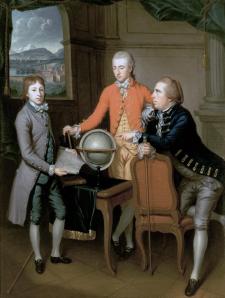
Douglas, 8th Duke of Hamilton on his Grand Tour, © National Museums Scotland A.1991.156

He’s hard to miss, the 8th Duke of Hamilton, in his red coat. I’d hazard it wool, because of the contrast with the sheen of the blue coat his physician, Dr John Moore (at right), is wearing. Dr Moore’s coat gleams like silk; the Duke’s looks dull and woolen. (Look at the way the light strikes the Dr’s shoulder; another clue is the way the button holes are worked.)

The coat below is a simpler, provincial relative of the Duke’s coat. This is the Amos King coat, owned by Colonial Williamsburg. I love the description:

“Wool plain weave fulled and napped “broadcloth”; twill worsted “shalloon” lining; tabby linen lining center back. Pocket flap lined with twill worsted; sleeves lined with tabby linen; right lower pocket is linen; left pocket is leather; inside pocket on left breast is linen, with broadcloth welt.”
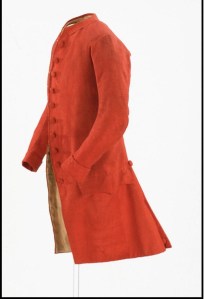
Man's Coat, red broadcloth ca. 1770, CW 1953-59
Man’s Coat, red broadcloth
ca. 1770, CW 1953-59

Shalloon. Tabby. Pocket leather. That paragraph is comprised of many of my favorite fabric and clothing words. And fabrics. And a leather pocket. As you may recall, I have a thing for fabric that is not at all about hoarding, and but rather about establishing reserves. When I see two yards of quality material at discount and purchase it, that yardage becomes part of the Strategic Fabric Reserve so vital to this nation’s safety. (We are all unsafe when a fabric addict is deprived of his or her fix. I’ve got a threaded needle, and I’m not afraid to use it!)
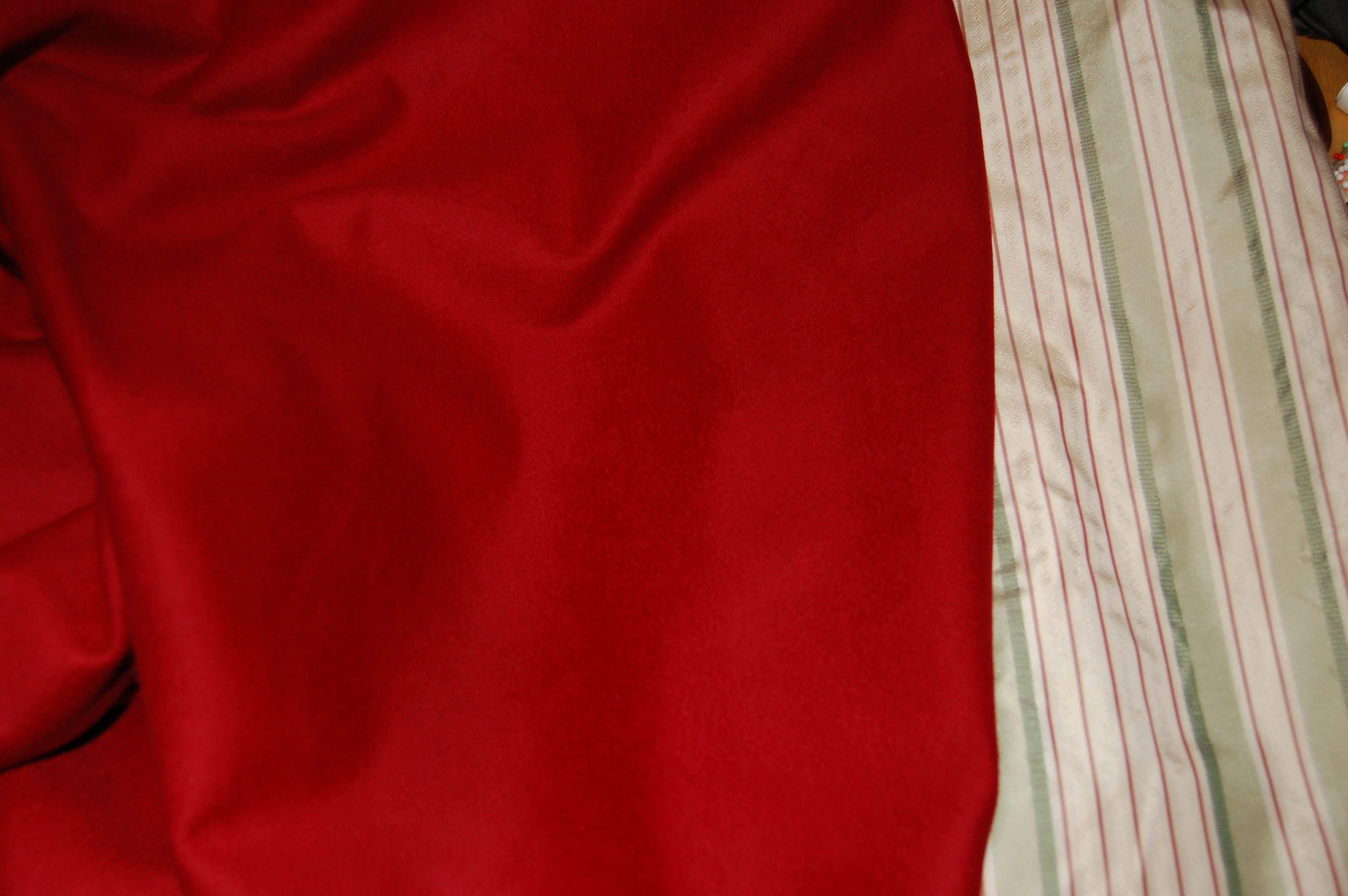
Part of this household's Strategic Fabric Reserve.
Part of this household’s Strategic Fabric Reserve.

Yardage arrived in the patriotic red, white and blue “if it fits, it ships” box on Wednesday, and when opened, we all proceeded to pet the lovely nap of the wool. Mr S wrapped himself in it, and I knew then that I would be making a red broadcloth coat of one kind or another.

It probably won’t be the “Quemans Pattern” coat John Buss mentions, not when I’ve got silk fabric for a waistcoat. The silk is from the remnant table at Artee Fabrics in Pawtucket. With careful cutting and a plain back for at least one waistcoat, there should be just enough to make both a 1770s and a 1790s waistcoat. We’ll get fancy around here eventually.
Eating in the Field: Single-Day Events

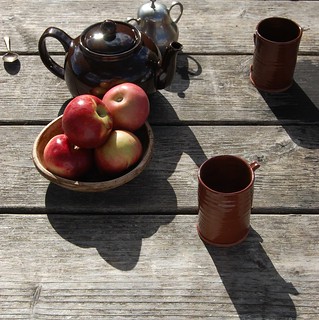
Tea Time at Nathan Hale, 2013

I’m not an expert, and your results may vary, but here’s what I’ve learned.

Single Day Events without Fires

(e.g. Battle Road, parades, Fort Lee)
For single-day, warm-weather events, ice packs covered in cloths at the bottom of a basket or slipped into a market wallet can keep food cold.

Pasties are self-contained, period appropriate, and require no “hardware” to eat. I wrap them in parchment or plain white paper and tie them with string, or wrap them individually in plain white cloths. Because the filling is cooked and then baked in the pastry, they keep and travel very well. I have a basic receipt here for pork pies; they’re good with chicken, too. Keep the filling a little on the dry side, and  you won’t need a plate. I’ve never made an all-vegetable pasty, because I live with T-Rex in a hoodie, but I imagine it would be delicious with parsnips, squash, and maybe even kale.

Another single-day-event solution is bread and cheese. John Buss of the 10th Massachusetts was all about cheese. He writes home longing for cheese, and writes, too, that he can eat cheese again because he’s recovered from the small pox. (That’s one of those historic statements that I try not to imagine too much about.) I’ve never had the time to bake bread from the Amelia Simmons’ cookbook, but I’ve had bread made from it, and it’s great. Pressed for time? Worked later than you thought you’d have to? Whole Foods Take-and-Bake baguettes have played the role of home-made bread, as have various loaves from other grocery stores.

The Hive blog has some good recommendations to fill your basket, so with some repackaging and artful packing, you can assemble an 18th century pick-a-nick basket, or stuff a market wallet with suitable foods. Just please, please: peel stickers off the fruit, and don’t pack bananas, which aren’t seen in the U.S. much before 1880.

Eating in the Field

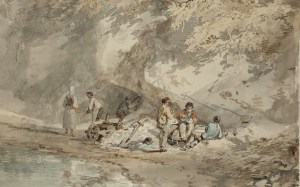
Workmen Lunching in a Gravel Pit circa 1797 Joseph Mallord William Turner 1775-1851
Workmen Lunching in a Gravel Pit, circa 1797. Joseph Mallord William Turner 1775-1851

A compatriot asked how we handle food and cooking in the field. What do we do about “yucky stuff?” by which she meant meat.

She was doing just about the same stuff we were doing, and with Battle Road around the corner, I thought I’d write about food in the field, and ways we handle it. Other people will have other ideas, but the main things I think about are:

  • Maintaining authenticity and food safety (Nobody wants flux.)
  • Historical eating is seasonal, local eating
  • Gear: less is not only more, but easier

Food safety is one of those things where you really don’t want to compromise too much, though from eating at the farm, I think there is more leeway than we admit. I will confess that when I was poor and in school, I stored dairy products on the windowsill of my studio when there was no fridge, so eating at the farm is like eating… when I was a whole lot younger.

Here are my principles. I’m not an expert, your mileage may vary, but this is where I begin.

Universal Truths

Start with who you are.
Objects you bring, and food you eat, should be true to your impression.
Authenticity goes beyond the date of accouterments: a porcelain tea set may be quite correct for a 1778 Newport or 1763 Boston parlor, but it makes very little sense if you are with a Continental private. One chipped plate is different for a woman to carry, or a piece of pewter. How long either would last you is another story, but at least you’d have a story. If you are the Colonel’s wife, it’s a different matter, even more so if it’s a British Colonel.

Food safety trumps purest authenticity.
Cloth covered, hidden ice packs will hurt no one and may save you misery later.

Stay Hydrated.

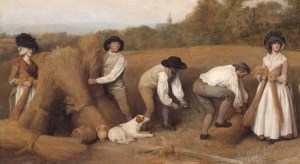
Reapers 1785 George Stubbs 1724-1806
Reapers, 1785. George Stubbs 1724-1806

Soldiers drank water.

In a hot summer camp, we keep a large pitcher full of water (see the Stubbs painting at left). Covered with a white linen or cotton cloth, it will keep coolish and free of dust & insects (or dog fur & fleas, if you’re in the Stubbs painting). We sliced limes into our enormous pitcher, and refilled it all day from the pump at OSV.

Limes are in period; justifying a source can be tricky, but at a certain level, safety trumps authenticity. 98 degrees and 90% humidity means drinking a lot of water.

Chances are you’re a caffeine addict like me, so what do you do? Boil water in a kettle, and bring tea in a screw of clean white paper is one answer. What’s your justification? I’m a personal fan of ‘stole it from my master,’ but in small quantities, perhaps you got it from home, or did a farm woman  a favor. Or stole it from her. John Smith (I kid you not), Sergeant in Colonel Lippitt’s Rhode Island State Regiment, in Continental Service, writes in his diary* of apprehending geese and chickens who failed to respond with the correct password when challenged.

*Published as “Sergeant John Smith’s Diary of 1776”, edited by Louise Rau, in Mississippi Valley Historical Review, No. 20, 1933, pages 247 – 270. NB: Kitty Calash recommends reading, not stealing.

Tomorrow: Food-related recommendations by event type.

Over(h)alls, Trousers, & Breeches, oh, my!

Trousers, ca 1793. MMA,1988.342.3

Gentleman can agree to disagree on the attributed date of this garment, just as gentlemen might agree to differ on whether to call these trousers or overalls. It’s all in the crotch length, friends, and we’ll just back away.

But before I return a book of letters to the lender, I wanted to record some of the details that struck me.

Right from the start, the John Buss Letters, edited by Ed Nash, are filled with details. I got excited because, in a slightly random and not at all fabric-hoarding way, I purchased a remnant of grey striped woolen goods from Wm Booth, with the intention of making a jacket or trousers from the fabric.

This notion was rejected by my resident tenant farmer, who has particular ideas about his appearance and the quality of goods which should encase his limbs. Rebuffed from my historic fashion fantasy, I turned for solace to the John Buss letters, determined to make it all up by learning the history of the tenant farmer’s new regiment.

And lo, on page 9, in the very second letter, John writes home to his parents in Leominster, MA on October 1, 1776, saying that “my trowis has got very thin, I should be very glad if mother would make me a pare of striped wooling trowis as son as you can…” My tenant farmer was not impressed by my excitement.

Yes, all my fantasies are documented. But look: John Buss’s trousers are thin, not his breeches. And he’s clear about the difference between trousers, overhalls and breeches. In a February 22, 1778 letter from Valley Forge, Buss tells how he drawd from stores in Bennington “one frock, one Jacket, one Pare overhalls, one of stockings, one Pare of shoes and one shirt. Albany, October 25th., 1777, I drawd a  Red Jacket Quemans Pattern. November 5th., I drawd a pare of Braches and a pare of fresh shoes that was not worth tow shillings.”

Later, Buss requests lining (linen) to make breeches, as he is hot. So he draws clear distinctions between these garment forms. This is a costumer’s dream, really, and for me–oh, those striped wooling trowis! Now I have to make them. Look out, Young Mr…they’re headed your way. And lucky me, I have documentation for that red broadcloth remnant I bought in a random and utterly non-fabric-hoarding way.