Shameful and Shifty: HSF #2,UFO

Chaos on deck, assistant elsewhere

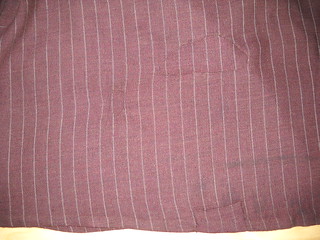
It’s not done, it’s as simple as that. I had a shift in hand for HSF #2: UFO. Along the way, I made significant progress: side seams sewn up, sleeve seams sewn up, and all of them flat-felled, until, at last: One sleeve band and a hem stood between me and completion. Whatever week that was, on that Sunday evening, reader, I slept. Work does that to me.
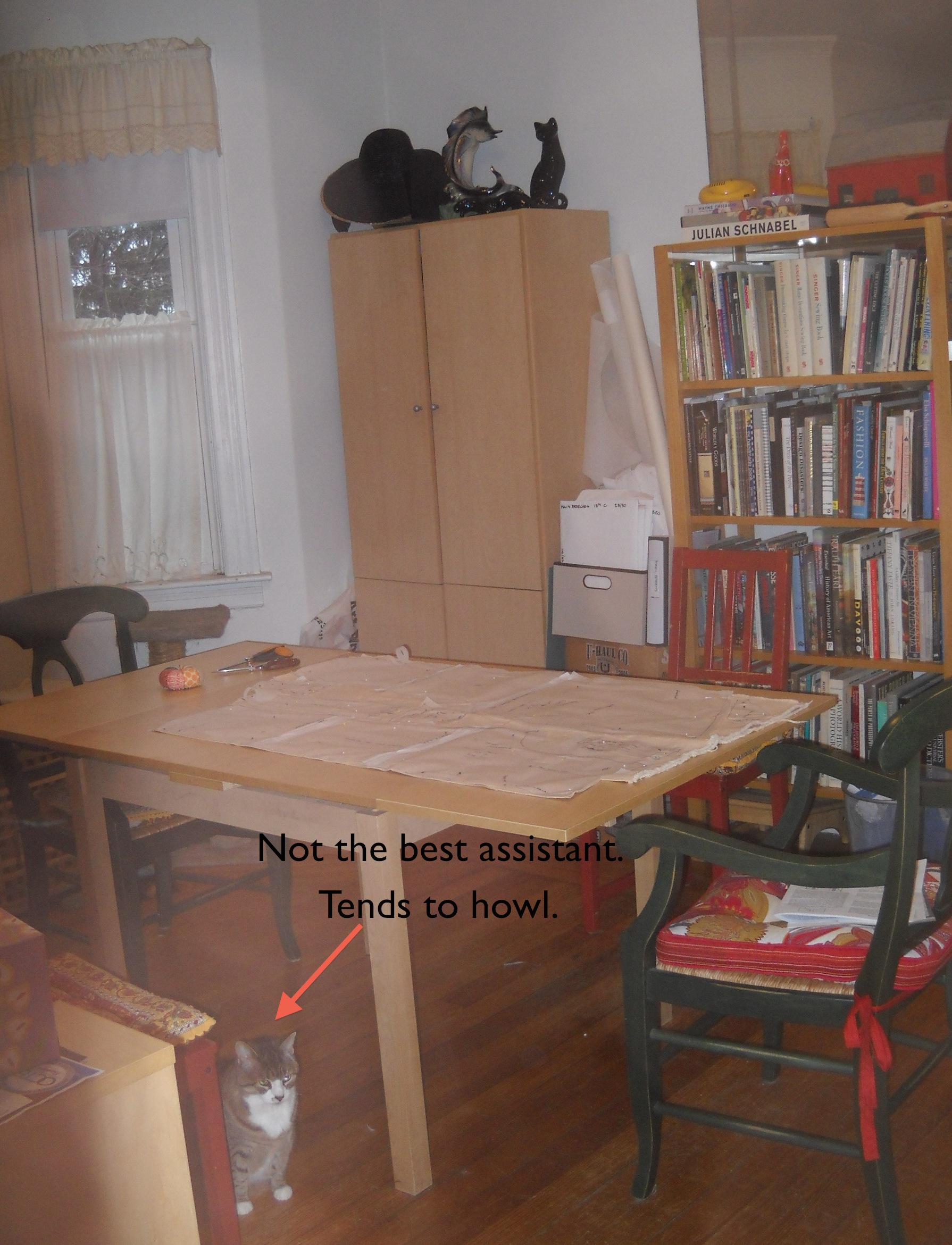
Dining/sewing/library room with "assistant"
Assistant has been howling more of late

Luckily, I can kick it forward to HSF#3, Under it All, because that petticoat isn’t cutting itself out. It’s not its fault: there’s homework piled on top of the table, a bill from the dentist, and other assorted bonnet-related chaos. All day long the linen and cotton listen to my howling assistant, then the Young Mr comes home and coughs, and what’s yardage to do? Drape over a chair, flat-out, folded, and exhausted.

It’s not history until it hurts, and I can assure you that from how my colleagues and I feel, our Library is chock-full of history goodness (along with 18,240 moved books and a great deal of newly assembled Ikea furniture).

Petticoat Burns

Per Hillstrom, Kitchen Scene

You know this site, right? History Myths Debunked examines the stories about the past many like to think are true, and Death By Petticoat is one of the favorites. Here it is on an English site catering to reenactors. There’s a variation I’d never heard, about wetting petticoat hems to keep them from engulfing the wearer in flames. (OK, mild exaggeration: to keep the petticoat from igniting fully, thus… hat tip to Back Country Maiden for pointing this out.)

As someone who just finished mending a petticoat, you’d think I’d leap at the chance to drench my hem in water to prevent future mending episodes, but not so. For one thing, in the house or in the camp, that’s water I had to haul or cause to have hauled, and I’m not wasting it. Wet the hems and what’s next? Caked lumps of ash, mud, and.or other filth. No thanks.

High-tech historical cooking

The burns I got in my dress were acquired at the end of the day when we were hearth cooking and were practically in the fireplace ourselves. That is where you must be if you wish to stir the sauce until it thickens, and there was the hoisting of roast in its pan a couple of times, and general playing with fire in pursuit of food. My ca. 1799 dress is longer than my 1770s petticoats and gowns, and the extra inch or two probably contributed to the burns. But I wasn’t engulfed by flames, because the damn thing is wool. Self-extinguishing wool, worn with linen and wool petticoats and a linen apron. not going to go up in flames. Also not going to get dipped in water–and wouldn’t that result in steam and hence scalded shins?

I don’t know where these rumours start, but they could have started with a cynical curator joking with house tour guides who failed to get the joke. Not that I know anything about a story of about Providence kitten named Georgie in honor of George Washington’s visit to a large brick house on a hill .

Sense and Sensibility and Secretions

Mended holes

I managed to mend my dress this weekend, motivated primarily by its odor and the desire to hang it up for an airing.  The holes at the hem were such that the patch had to be applied over the fabric and not behind. It tends to wiggle, but the mends are done and the dress is hung up to “air,” which means  it is “in the drafty front hall trying to make my coats smell like wood smoke, tallow, and animal secretions.”

I told you my feet were big.

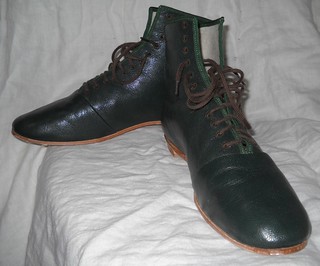
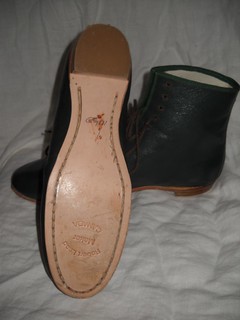
The Robert Land shoes arrived on Saturday, along with a heavy box of wool. That’s tucked away for now (trousers and overalls come first, oh my) but not the boots. Ignore the size marked on the sole–that’s a vanity size–but note the smears. I believe that for the shoemaker, as for so many of us, the historic item is not done until you have bled upon it.

I should note here that the shoes really make ones feet look like the feet of women in fashion plates. Those trippy little poses with dainty toes are achievable in these, and the minute I find someone to photograph that, I will. It’s a very different foot experience from 18th century buckle shoes.

It’s not done until you’ve bled on it.

In a mark of solidarity, I bled on the ribbon that’s going on my new bonnet. I spent Saturday making, and unmaking, a remaking, a late 1810s bonnet. I’m still not quite satisfied with the shape, but have the silks and ribbons ready for when I convince myself to go ahead and stitch it up. Sunday I made a late 18th century/early 19th century bonnet. After bleeding on the trim, I finally had the sense to stop.