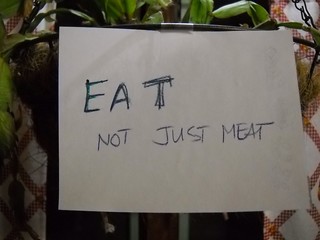
Eat, Not Just Meat

Good advice for every day, if you’re not t-rex

The Young Mr has been  unsupervised some of this week (he’s old enough but not always as mature as one might prefer) and I have left him notes to help him with some basics, as he does prefer to rise long after I’ve left for work. In the bathroom, BRUSH YOUR TEETH is affixed to the mirror (should’ve added + HAIR). In the kitchen, another note is taped to the Christmas Cactus above the sink.

My coworkers, many of whom have known the Young Mr since he was in a stroller and had nicknames like Possum Baby and Seal Monkey (he just shivered a small death when you read those names), found this note hilarious. The kid has a reputation as a one-human plague of locusts: he once ate a third of a pound of ham in a 20-minute span while his father and I went to the grocery store. He will eat a large head of lettuce in the hours between when he gets home from school and I get home from work. Entire tins of Altoids vanish suddenly, and all I get is a sulky, guilty look.

So I found this blog  post, What’s For Supper? very interesting, as I had been thinking of late, How would I feed the kid in the 18th century winter?

Fantastic Hairdress with Fruit & Vegetable Motif, 65.692.8, MMA

Fortunately, there would have been vegetables. And whether the beds were hot with manure or straw, there would have been some greens. At the farm we had salad in January; would it make it to February, or March? Don’t know, but I love the idea of spinach. Parsnips store well (scrub hard) and are delicious, and apples, too.

I think we forget we did not invent the larger world: it was big before we got here, with ships circumnavigating the globe and caravans crossing mountains long before container ships began losing sneakers on the ocean.
Shoe Envy

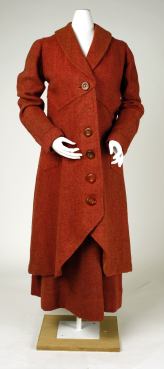
Suit, 1914-1918. MMA

Yes, I am as shallow as stereotypes might suggest: I see shoes, I often want shoes. Even my current co-workers know about the red leather Cuban-heeledAdrienne Vittadini pumps I passed up when they were on post-Christmas sale at Marshall Field’s way back in the Dark Ages. They would have gone nicely with this red wool suit from the Met.

There’s a Steam Railway in Essex, CT and when we went on Staff Day, we were told the train car was from 1914, an excellent year for fashion–at least before that August. It seemed like a great plan: make 1914 clothes and ride the train again next fall, possibly carrying vintage luggage or a basket with a delicious picnic. Really, who’s in? Let’s book it!

The World War I era has fascinated me for a long time, from Vera Brittain to Siegfried Sassoon,  from Wobblies (perhaps because I grew up in Chicago) to war memorials, so the Steam Train Outing in Period Dress was particularly tempting, and I started a board for early 20th century costume. Downton Abbey fans will enjoy it, too, and while I tired of Swedish murders and finally caved to Downton’s charms, my film choice for the period is Testament of Youth.

Libby Hall Dog Photo from flickr

When I saw the American Duchess pre-order for Gibson shoes, I was sorely tempted. (They’re quite similar to what the lady on the right is wearing.) Fortunately, I am saved by my pedal extremities, for which my size is not yet available.

But what really holds me back is the thought of sewing the corset. It’s like the hip surgery I don’t want to have: I know how painful it is, and how inescapable. There is no way to properly dress in the past unless you do it from the skin out. But shoes–and those fantastic Edwardian hats–might just get me to make that corset. Shallow, isn’t it?

Three sticks, two kettles, no matches

Soldiers Cooking, 1798 National Army Museum (UK), 1983-11-63-1

Here’s some visual evidence for why we travel with three sticks, two kettles, and no matches. (We bring the sticks as we suspect the sites where we camp & cook don’t want amateur logging on their grounds.)  I stumbled upon this at the National Army Museum in the UK. Here’s what they say about the image:

Soldiers from an unknown unit attend to their cooking pot on a break from their duties during the Wars of the French Revolution (1793-1802). They are accompanied by their womenfolk. Although only a few men from each unit were officially allowed to marry and have their wives and families accompany them, women would have been found in almost every British military camp. Some worked as cooks, laundry women and sutlers (camp followers who sold provisions), while others were prostitutes.

One of the things one learns when reading about women who followed the armies of the Revolutionary War is that prostitution–at least for those following the American army– was not high on the list of occupations for women.

Why not? Lack of ready cash, folks.

Working for the Army would get you rations, and that literal meal ticket was desirable in a time of shortages and want. If you’d been burned out of your home or farm (I’m looking at you, 54th Reg’t of Foot, Aquidneck Island torchers) what would you eat? What would you do? It depended, of course, but one thing to do would be to follow your husband if he had enlisted.

I know less about the women who followed the British Army, but for a Continental Army start, I recommend the following books:

Belonging to the Army. Mayer, Holly A. USC Press, 1996.

Liberty’s Daughters. Norton, Mary Beth. Cornell, 1980. (My edition, 1996)

Revolutionary Mothers. Berkin, Carol. Vintage Books, 2005.

In Pursuit of Liberty. Werner, Emmy. Potomac Books, 2009.

The last title is about children in the time of the Revolution, not women, but considering who was left home with the children, and in trying to understand what the time might have been like for the Young Mr, I’ve given it a read as well.

As for the camp gear? We keep it at a minimum based on period images. We don’t all sleep in one tent, but we pack as light as we can. It’s nice when authenticity and ease are the same.

Bloody Overalls

Just started backstitching, already bleeding

But that’s still better than the story I heard yesterday about the incredibly authentic, effluvial-field dipp’d overalls that gave a mender dysentery…you come here for this, right, not the pretty dresses?

My thumb has split– yay, winter!–so everything will be a little trickier. Guess I’ll lay off handling white silk gowns at work, and documents, but the sewing will continue.

The Line of Truth

We went up to the Adjutant’s house yesterday, now that the roads are cleared again, and the lads got measured. Best of all, Mr S got fitted. He has what I ungenerously call “The Hump,” and what the Adjutant describes as “Shoulders Roll Forward.” The Adjutant has tact; I’m the wife, I calls it like I sees it.

It was really helpful. I knew the coat was too big (Mr S is built more like an 18th century soldier than a 21st century office worker), but I knew it had more wrong with it that too much fabric. At left, see the chalk line? The sleeve seam sits at the shoulder point, where I am told it will be uncomfortable as it rubs, which will also wear out the shirt faster. I knew what to do it the sleeve had been on a gown– unstitch it and re-align it under the shoulder strap, mark it and trim the excess off the head. In a way, that’s just what I will do here. There’s also excess to take out of the upper arm, but that’s not too bad for a garment that I made in a hurry and never really fitted to the wearer. And I have until mid-April to do it.

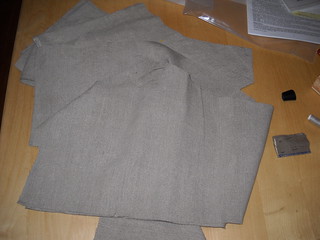
I have two of these greige stacks to transform.

At the same time, I also have to transform two of these piles of pieces into well-fitted, hand-sewn overalls. Despite the pride I’ll feel in accomplishing what I expect will, under guidance, be the best-fitted, most authentic garments I’ve made, saving my green checked apron, there’s a minor measure of terror mixed in to all this…hope those back stitches hold…