Dresses and Evidence

Sandby: Sara Hough, YCBA

Here is Sara Hough, Mrs. T. P. Sandby’s Nursery Maid drawn by Paul Sandby ca. 1805, from the Yale Center for British art. She’s rather lovely, and though I’d tend to put her date earlier than 1805 based on the clothing, I don’t know enough (anything) about the Sandbys, and it may be that the dates of Sara’s employment fixed the date of the drawing. But doesn’t that robe and train look distinctly 1790s?

What I like about it is that here is a maid wearing an open robe and train–how impractical, especially in a nursery–so the drawing makes a third kind of evidence in addition to fashion plates and extant examples.
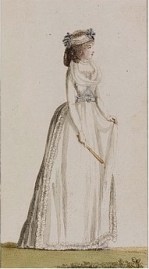
1794, V&A
1794, V&A
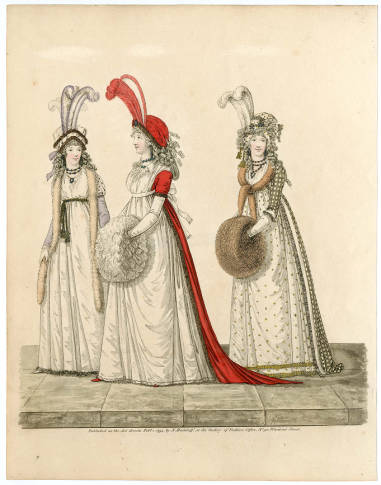
1795, MMA
1795, MMA

1794 and 1795 fashion plates from the V&A and the Met show similar robes, though the V&A is described as a walking dress, and the Met’s plate shows evening dress. Extant examples include the Kyoto chintz gown, and this chintz gown at the V&A.

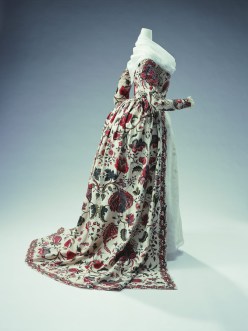
1795-1800, V&A
1795-1800, V&A
1780s, KCI
1780s, KCI

I like how art once again blows up my expectations and makes me think more about the time frame when styles can be worn, and why: maids lag mistresses in style? Comfort and personal taste? or is the assigned date just not right? It’s an evasive “circa,” which can wiggle 5 to 10 years either way, depending on the collection’s standards. The drawing could be 1795, and it’s not later than 1809, when Sandby died.

Aside from the questions and quibbles over the date, the image gives us great information about how to wear an open robe with an apron, how to carry scissors, what watering cans looked like around 1800, the profile of shoes and caps, and how hair might be styled.

Projects & Supplies

From the Franklin Mill store

On Saturday, my friend Dana and I went to the Franklin Mill Store in, yes, Franklin, MA. Their 20% off everything sale ends this coming Saturday, when Dana is working and I am taking the Young Mr to an admissions open house at a local school. So off we went, and here’s what I came back with.

From the left:

  • Green English broadcloth for Mr S’s frock coat.
  • Dark blue Italian linen-cotton blend heavy weight plain weave for Mr S’s summer frock coat, to be modeled in part on one at work that a historic costume specialist calls “Joe Providence.”
  • Interfacing for waistcoats and frock coats, already successfully applied to the Young Mr’s new waistcoat collar.
  • Green ribbon for a black taffeta bonnet to be made from the black taffeta seen here, and enough taffeta for a petticoat.
  • Brown wool for buttons. Expect tangling.
Magasin des Modes, June 1787, thanks to Dames a la Mode

The taffeta for the petticoat seems out of character for my linen and wool life, but I have a plan. At the Artee Fabrics store in Pawtucket, I picked up a remnant of green silk taffeta, but not enough for a full dress or gown. There is enough for an open robe, though, and I got an idea watching The Duchess.  One costume is dark redingcote over a rose petticoat: not my colors. But then I found this fashion plate, with green over black, and there you are. Pure costume fantasy, but  fun to make. Or at least fun to think about making–there’s always swearing.

To keep track of these insane plans, I started a projects page to list the schemes and deadlines. We’ll see how it goes.

Sleeping 18th Century-Style

the_idle_servant1There was a mild flurry about a year ago around the release of Evening’s Empire, by Craig Koslofsky. Like the 2005 book by Roger Ekirch, At Day’s Close: Night in Times Past, Koslofsky’s book examines pre-electric lighting patterns of behaviour at night, including sleep patterns.  The BBC has a nice article on the two here. Both Koslofsky and Ekirch assert that until the 19th century, humans typically slept in two blocks of about 4 hours each, and scientists confirm this natural tendency.

Last year, between December and March, I had the luck to test this theory, and once again, it seems I will be sleeping old school, in blocks of time. Unfortunately, these blocks of time are often 2 hours and not 4 hours, as the scientists and historians claim we need. User testing of one shows me that 2 hour sleep blocks (or 4 hours followed by 2 hours) are inadequate and I may be near-hallucinatory by March, just as I was last year.

When doing living history, its always better not to skimp on resources.

Light & Night

Morland: Woman Reading by a Paper-Bell Shade: YCBA

Winter’s hard for me. I don’t like the lack of light, I don’t like the shortness of the days and how the sky is pale and stretched in these months. But this is a good time to think about basic needs, like light and heat and warm clothing.

The New York Times came to my rescue this morning with the article by Holland Cotter (and others) on “Artworks That Shine in New York Museums.” Cotter is one of my favorite critics and writers, and he, along with Karen Rosenberg, Roberta Smith, and other NYT critics, have selected some interesting pieces.

De La Tour: Penitent Magdalen, MMA

Ken Johnson leads with Georges De La Tour’s Penitent Magdalen. It’s earlier than my usual era but I was attracted to the image of the flame in the mirror; it’s not just a lighting device, of course, it’s a metaphor, but the rendering of the candlelight, and the use of the mirror to boost that light, tells us about how 17th and 18th century painters saw light, and how light was manipulated. We know from our simple experiments at work that mirrors really do amplify light, and that large stately rooms would only glitter with lots of candles and lots of mirrors. Light gives us a window on economy and wealth, as a precious commodity that cost money or labor to have.

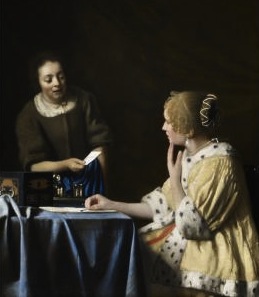
Vermeer: Mistress and Maid, The Frick

Cotter looks at Vermeer’s Mistress and Maid at the Frick, and notes the lack of obvious natural light or other light sources, and the overall dark mood of the scene. But Cotter’s writing shines, as he concludes the little essay: Whatever Vermeer’s anxious thoughts, light stayed on his mind. It scintillates in the pearls the woman wears in her hair and shines in the butter-yellow silk of her jacket. And the blacked-out space the women occupy turns out to have sunlit windows after all. We see them reflected in glassware on the writing table as tiny lozenges of light, far in the distance, as if at the end of a tunnel, but there.

Writing like that is its own kind of light, a joy to have in the daily newspaper on a cold, short day. In all, four critics look at five paintings each from a range of cultures and time periods. It’s enough to make one want to hop a train south.