Evenings by the Fire

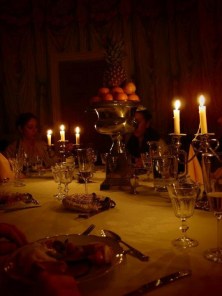
I am chasing two things at once these days: late 18th century high-style table settings, and late 18th century life after dark. They’re related topics, but in a way they’re not.

Setting aside the table, for I have diagrams and dishes and silver service identified and am down to questions of exact napkin folding and placement, how did people spend their time in the 18th century? We assume life was more tuned than ours to diurnal rhythms ( see Circles and Lines) but was it always?

There were differences between the days of servants, slaves and masters, and one good place for resources on those differences is Colonial Williamsburg. Like OSV, CW has placed some of their research papers online. For the house where I work, the Daily Schedule for a Young Gentry Woman is very helpful:

“From about 8:30 p. m. until 10 or 11 p.m. she, members of her family, and guests socialize at home or with neighbors. Their evening activities include conversation, toasting friends, singing or listening to music, reading aloud, playing cards or board games such as backgammon, dancing, and taking moonlight strolls. … “Kate read the Vicar of Wakefield to me this evening and highly entertained me” (Robert Hunter journal, 1786).  … “We play’d whist from 9 to 11. Capt. Clopper & myself, Mr. Harris & Munroe” (Ruth Henshaw Bascom diary, 1802).”

These observations of Virginia pastimes coincide with how we know Providence residents spent their evenings in the late 18th century. How late people stayed up was determined in part by need: was there work still to be done writing a sermon? was a family member ill? and in part by access: were there candles by which to work or read?

Fun to think and read about, but for now, I must put it aside. Fort Lee is tomorrow, and I have mending to do or we will all be cold. It will be an early bed for us all tonight, since we are driving down tomorrow morning. Photos on Sunday, as long as I remember the camera.
Light, or Lack of It

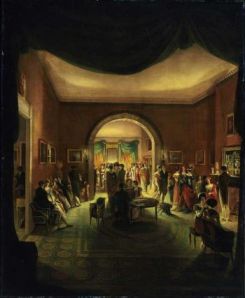
The Tea Party, 1824, MFA Boston

On Saturday evening, we drove up to Old Sturbridge Village for their “Evening of Illumination” tour. The village is by no means as fancy as the house depicted at left, but the gentle quality of the candlelight captured by Henry Sargent reminds me of the evening. I took no photos, because I just wanted to enjoy the experience…and learn from it.

Candles used in New England were usually home made, dipped, and of tallow. (See here for one reference.) The Browns of Providence had a spermaceti candle manufactory, and people in cities and towns often bought candles–by the pound, not by the stick. Spermaceti supposedly burns brighter than beeswax or tallow, but the only spermaceti candles I know of are accessioned museum objects and will never be lit.

In thinking about upcoming programs at two different sites, I’ve been thinking about what it was like to live in the dark, and to work mostly within the sun’s hours, and then judiciously by candle light. Sharon Burnston says, “Sew by daylight, knit by candlelight,” and if you think about process, you can imagine that  in low light, even the fine thread of sock knitting is far more manageable than fine sewing.

Large fireplaces provided both heat and light, and candles are surprisingly bright. I suspect that an evening by a fireplace, reading aloud by candlelight while a friend or sibling knit, was pleasant enough in a wool gown, or with a shawl over muslin. The trip to bed would have been another matter, and getting up something else indeed.

It is also well to remember that class difference would have created comfort differences: a servant would have been colder getting up than the master, for the servant would rise in a cold room and be expected to light a fire in the master’s bedroom. Rural workers would also have risen in a cold room, to cold or frozen water.

These are some of the things I’m thinking about as I read and look and get ready for programs, and for winter.

Meet Cassandra

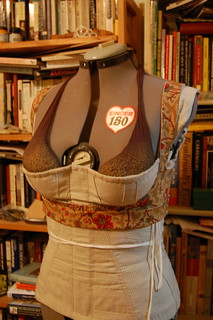
Cassandra’s my dress form, purchased on sale and with a free shipping coupon. If you don’t know the myth, Cassandra is the young woman with the gift of prophecy who was cursed by Apollo… so that no one believed her predictions. She is my measurements, but not quite my shape. Thanks to American Duchess for the “Bean Boob” idea, though my mother said, when we went shopping for her post-mastectomy prosthesis, “It feels like bags of lentils. If I’d known how much [the prosthesis] would cost, I’d have made my own bag of lentils.” My mother is a tiny blonde woman with a weakness for Airedale terriers and violent cartoons.

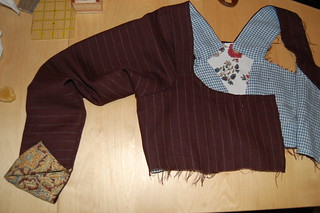
But Cassandra has proven very useful, dressed as she is in the newly chopped- and-dropped stays. She’s also sporting the bodice of what will be a bodiced petticoat, as soon as I can bring myself to cut into the beautiful wool, of which Burnley & Trowbridge has no more. I’ll want that wool petticoat for another weekend at Coggeshall Farm, coming up around the corner on December 1, and for which much must be sewn, including a long-sleeved wool dress based on Past Patterns’ Lewis and Clark dress.

I nearly got the bodice and sleeves all done on Monday, from cutting to sewing, while “watching” the original Swedish Wallander on Netflix. It’s more a process of reading than watching, with moments of clarity when I clearly recognize words. Thanks to my Dad for the connection with our Swedish roots…fish stew, Aquavit, and proper swearing.

By the time you set these sleevils the fourth or fifth time, they go pretty well. I have made this dress three times before, with two muslins along the way. The changes I made this time include cutting the sleeve as one piece and not three, lengthening the sleeves to the wrist, and adding a little over an inch to the bodice all the way around. Older ladies wore their waists lower than teenage girls, and though I like the way the L&C dress fits, I wanted a lower waist to suit my age, and the earlier year.

The Once-Forgotten Memorial

MHS PHO:23683

In the 1990s, when I worked in St. Louis, the Soldiers’ Memorial, central to the Downtown Memorial Plaza, felt more forgotten than anything else. Several wars later, it has a new life. Built to commemorate the dead of World War I, the Memorial had a central place in Progressive politics and the City Beautiful movement in St. Louis before it became a Federal Emergency Administration of Public Works project and was, finally, built and finished just in time for World War II.

FDR visited on October 14, 1936, and in his speech dedicating the site, declared, “We build monuments to commemorate the spirit of sacrifice in war- reminders of our desire for peace.”

Soldiers’ Memorial was built to commemorate men like Lieutenant Victor O. Crane of St. Louis who was killed at Soissons on July 19 or 21, 1918. His letters, excerpted below, are in the collection of the Missouri Historical Society, probably in the World War I collection , though I failed to note that in the draft exhibit script these quotes are from.

Lt. Victor O. Crane, Letter to his Mother, Feb 4, 1918: “I am mighty glad to be over here, so don’t worry mother dear for this is the most fortunate opportunity of my life, there is not a man back in the states that I would trade places with and you know ‘All things work together for good.’”

MHS PHO:33602

Letter to Lt. Victor O. Crane’s mother from 2nd Lieut. Cowing: “You were constantly in his thoughts, and just the night before the attack started he took me to one side and asked me to notify you in case of any accident to him. He took part in the great offensive and went over the top five times before his death. He did his part bravely and well. ”

Gold Star Ceiling

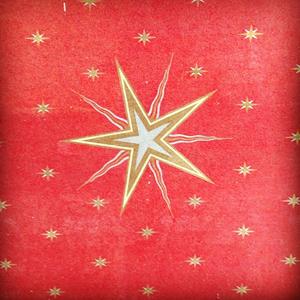
One of the most striking features of the memorial is the ceiling of the central area, dedicated to the Gold Star Mothers. It would be cold comfort, that tile ceiling, but the visual allusion is undoubtedly striking and a vibrant, brilliant, reminder of the human cost of war.