My clothes are finished, and there was just enough left from a petticoat to cut the fronts, welts, facings and collar of a waistcoat for the Young Mr. It will have to be backed with the grey broadcloth of his father’s coat, which was brought to the brink of buttonholes Sunday evening.
Tonight, trousers to cut out, and a progress check-in for Mr S’s waistcoat. Menswear has such different construction techniques, stay tape and diagonal basting, such structure! I was better at those techniques 20 years ago, and now I don’t know what I’ve done with the books on couture techniques.
It’s a great quantity of buttonholes, really, so better not to count (24 + 18 + 10= 52) on the way to the 1,000 that Henry Cooke prescribes for proficiency. Will I ever get there? I will at least get better at them, or so I hope. When these garments are done, I think I will have done 100 in the past 12 months.
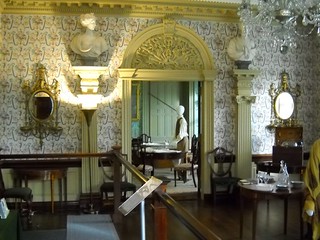
No progress photos: just newly acquired mirrors (drive across CT and back as fast as you can!), hung in place.
The cold on the Palisades was not as bitter this past weekend as it was last year; there must have been at least an 8 degree (F) difference. There was a rumour of 37F/2C but I think it was about 45-50F (7-10C). Where there was sun, it was quite pleasant, as the wind was gentle.
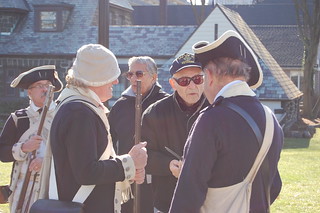
So what did we wear? Mr S and the Young Mr had long underwear under their uniforms (white so it would not show under the overalls), and long stockings, too; the Young Mr has a wool waistcoat, and is still so wiggly that I don’t know how much he feels the cold yet.
Layers are your friend
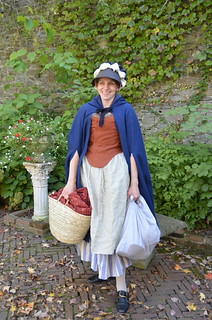
I wore my 1780s wool jacket, two linen petticoats and a wool petticoat, my still-unfaced cloak, and wool stockings, and was comfortable enough at nooning to take off my cloak. It’s a long cloak, based on one in the collection at work, but blue broadcloth and not drab (the extant cloak is drab, but both drab or dun and blue appear in RI runaway ads).
So what’s the key to keeping warm? Then, as now, (or now dressing as then) it does seem to be layers. The wool petticoat makes an effective barrier against cold, and the wool jacket is warm. I tried patterning mitts, but my hands are so large relative to my wrists that I tore the muslins at the thumb or had very baggy wrists.
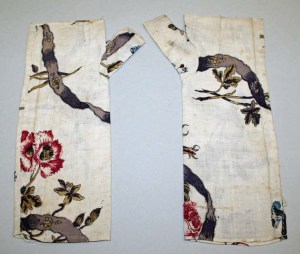
These chintz mitts from the Met (C.I.39.13.185a–d) seem to have a similar tendency to width at the wrist, and might work better than the pair I was following from Costume Close Up. It was late and I was tired, so a fresh start might work to keep my hands warm.
Post-war women with long sleeves would have been able to avoid that chill wind on the forearms, and I look forward to wearing my new long-sleeved wool dress.
Surreal: that was the word for the morning at Monument Park. The RI Reg’t walked over the park instead of parading with the troops, because one of our members has not been well, and did not think he could keep up with the parade. It was odd to follow the reenactors in 18th century clothing under power lines and past high rise apartment buildings shouldering out old frame homes, but the surrealism really kicked in at the park.
Describing sniper fire in WWII to salsa music
There it became multi-sensory when the ceremony’s organizers turned on the music. It wasn’t exactly merengue, and it wasn’t exactly salsa…then the soundtrack switched to updated Big Band hits and finally landed on a strange, over-the-top, quasi-operatic version of “Battle Hymn of the Republic.”
So when you look at the photos on flickr, play some salsa or an album you might have ordered at 2 AM from a TV ad, and think about standing in 40F/4C weather eavesdropping on politicians talking about inching closer to universal health, and the lessons of Hurricane Sandy for high-rise dwellers, while squeezing up next to you for a photo op.
Later, at Fort Lee Historic Park, the artillery demonstration was loud and satisfying, but we got behind schedule and to the oddness of the morning was added rushing. It was capped off at the end by the order to fix bayonets, which led to bayonets being caught in branches.
Bayonets fixed, Capt. Becker takes measure of the trees
Finally, for me, the day nearly foundered when I pulled my phone out of pocket at the end of the event to check the time, and saw my boss had been texting me all afternoon over a non-crisis. Part of why I love re-enacting and living history so much is that it takes me so far away from myself and from my daily existence. It’s related (slightly) to my work, but to be so far away in place and time and effort is a delight. I can’t just throw the phone away or not take it along: I am supposed to be on call, all the time…but it’s history, not a hospital, and if budgets change, so should expectations.
Last night, I leaned back on the pillows and felt the cold seep through my shirt. Our house, at 62 or 64 degrees, is warmer than the 58 degrees Moses Brown recorded in the early 19th century and warmer than the mid-50s temperatures some people I know still keep. But I have layers I can wear, wool or wicking space-age materials, and will wear anything to bed to keep warm. What did people wear in the 18th century? How did they stay warm in bed?
One solution was the bed warmer, the long-handled brass pan filled with hot coals and swiped over the linen sheets of a bed just before the sleeper hopped in. This method required strength, speed and a steady hand, and worked best if someone other than the sleeper could do the swiping. Heat would dissipate quickly while a warming pan was stowed safely.
Another option was heated stones or bricks wrapped in fabric and tucked into the foot of the bed. That sounds good to me now, cold as my sheets can be. Jane Nylander writes in “Our Own Snug Fireside” that some people perceived warming the bed as a sign of weakness, and it is hard to document such a mundane act.
Truly quotidian details are hard to find in written primary sources: people in the past took their daily lives as much for granted as we take ours. How often do our diarists today record whether they wore socks to bed?
In the collection at work, we do have one woolen flannel shift from the early part of the 19th century. I suspect I will want to copy that for January.

 My clothes are finished, and there was just enough left from a petticoat to cut the fronts, welts, facings and collar of a waistcoat for the Young Mr. It will have to be backed with the grey broadcloth of his father’s coat, which was brought to the brink of buttonholes Sunday evening.


 Kirsten Hammerstrom
You must be logged in to post a comment.