
After Cheer

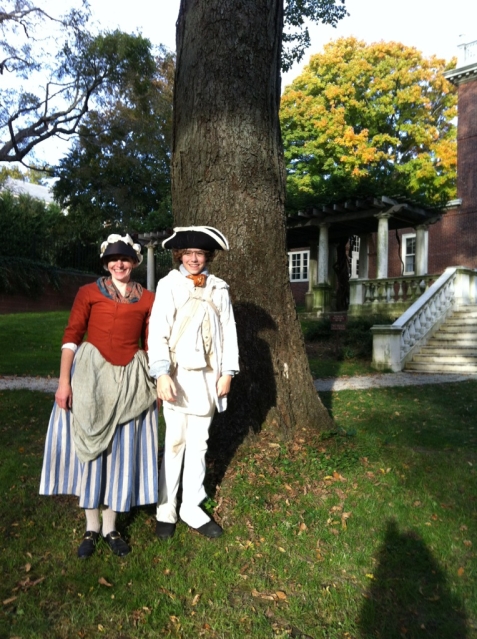
With the Young Mr on the lawn at the John Brown House Museum: he came, he dressed, he ate, he drummed. At the end of the day, his friend and his friend’s mother finally came, and thanks to them, I have a photo to post. I could crop out her shadow and the tree, but then you’d miss how lovely the place is.

What a day! It started at 7:00 and held two–no, three–surprises, which will result in at least one rant and one possible act of mischief later.

Surprise number one: The British did not show up. They didn’t call or write, either. Yikes. Mild mischief pending expected apology.

Surprise number two: Sew 18th Century came to visit with her darling daughter and husband. Yay! We’ve met before at an ALHFAM meeting, but it is always so lovely to see another costume blogger and museum person in real life. Thanks so much for coming!

Surprise number three: I made a lavender tea bread that was delicious, against all expectations, and which was largely consumed by Mr S. Good thing those overalls are adjustable, huh? More on that bread later this week; I will be making it for Nathan Hale this coming weekend.

But wait, there’s surprise number four. One of the volunteer docents who belongs to a local reenactment group came “dressed up,” and sat on the front porch entertaining visitors with children’s games.  We had a station for children’s games, and she competed with it, rather than coordinating. Also, the garments she wore were, um, not to standards. So that’s going to require some...tact

All in all, the people who came seemed to have a great time. They were incredibly engaged, learned a lot from some very enthusiastic reenactors, docents, guides, and staff. It would have been nice if there were more knitters, and if our Civil War knitter had not been booted off the front porch by surprise number four.

I think we had about 200 people on the site, 90+ in the house and a bit more outside. With about 15-18 reenactors, that meant that the people who came into camp had a kind of immersive experience, and that can be lost at larger events like Redcoats & Rebels.

And even more cheering, links to my blog from American Duchess. Neat!

What Cheer?

20121013-062557.jpg

Here’s what cheer: the French backed out at just about the last minute, via email, citing “family events.” They have had this event on their website for 10 months. Surely they knew last fall, or last winter, or this summer, or a month ago, when their family birthdays or anniversaries were. Things that happened 50 or 60 years ago–seems like you had some advance notice on that one, folks.

Anyway, lucky for us they sent in notice before we gave a tour of the museum to the French Ambassador and the regional Consul, but not before we’d marketed this to the Alliance Francaise and the French American school. I think there’s crepe on somebody’s face. (Forgive the lack of accents: I’m doing this on the web on my iPad, so symbols are hard to insert.)

Overalls are done, though I did get a nosebleed last night and bleed on one of the ankles near the vamp, I think. Historic sewing isn’t done until you’ve bled on it at least once. Which brings me to the devil dress.

20121013-063230.jpgAh, yes, it is 34 degrees this morning, so my wool is packed into my runaway bag. (In my basket I will have the rosewood box and pewter creamer I stole from my master.) The devil dress fits, in its way, but I think I have not yet figured out quite how to apply it to, and keep it on, my body. Cassandra the dress form (she’s full of bad news I ignore) allows me to pin into her, of course, but my own flesh is so much less accommodating. For one thing, it bleeds, and for another, I say “ouch.”

This is the only picture I like, and I wish I’d taken off my watch. Rest assured I do not wear it in camp.

At 7:00, my ride will arrive and off we’ll go, safety tape and fire extinguishers in hand, with the hope that someone–anyone–comes to this crazy event. We do want to win attendance.

Buttonholes Made Fun

For a time, I worked with a young man who sang at work. It wasn’t “Old Man River” or railroad work songs, but simpler, more repetitive phrases: “Up the stairs, down the stairs” while moving around the house, or “broccoli, broccoli; broccoli, broccoli” making his lunch. The habit had its charms and its hilarity, but now the little sing-song phrases get stuck in my head, like today’s “try not scream, try not to scream.”

20121011-064643.jpgButtonholes!! Board decisions! Bad fit! The last two are only hypothetical, I must remember. There’s been no real board meeting to cut that $100K from next year’s budget, and I haven’t laced into my stays and tried on the new dress yet.

I have been working on buttonholes, and have a new favorite sewing tool: a sharp chisel. It would be ideal to get one that could pass for period, and a mallet as well, because hammering a sharp blade through overalls has proven oddly satisfying. I might take on fancy waistcoats for the sheer pleasure of mallet use.20121011-064502.jpg

The dress is basted and hemmed and ready to be tried on and tested. there’s a little bit of minor finish work I can do at lunch today, but the big push this evening will have to be gathering up the gear and loading the car, fitting the ankles of the overalls to the wearer so those buttons and buttonholes, and the evil tongue, can be sewn.

That leaves Friday for finish work, which seems like a reasonable plan. I can always work on the shift during What Cheer! Day, as long as there is not too much running back and forth to do.

Death by a Dull Board

The New Parliament Pudding, Met Museum

On Monday, The Still Room Blog had a fun post about murder mysteries set in museums, and the dearth of deaths of collections managers and registrars because of their low profile. If no one knows you exist, how can you get killed off in fiction?

Well, folks, here’s how: turn a non-profit board loose in a room with the general figures that appear in an annual report, and ask them a ‘fictional’ question about cutting money from an NPO’s budget. Ask, “What program would you cut?” Be sure not to give them a list of programs or detailed financial information, but only the kind of broad-stroke, simplified information that is publicly available.

Guess what they’ll cut? They’ll cut the non-public functions of the museum program because it’s non-public. (I feel nauseated as I type those words, just as ill as I felt last night.) And after all, it’s reversible! They can always hire other curators, collections managers, photographers, registrars. Cataloging gets put on hold, so what? There are still all the displays up in the house museum–and that’s all it is, a house museum, not a real museum–so we can have those positions again if things improve. We just stop collecting objects, but that’s OK, because after all, we’re not a museum!

It’s enough to make a cat laugh, and a curator, collections manager, registrar, or photographer vomit.

It was an interesting choice, made primarily because the objects were perceived as having no constituents, and those who existed didn’t matter–what do we care about the experts at Yale or Winterthur, or the Met? What do we care about the curators at the regional museums? They’re the elite, and we’re not pandering to them.

Seriously.

I’m no Wendy Cooper or Morrie Heckscher (though I have met Mr. H and moved furniture with him in my museum, and my mother knew his father) but I suspect that the group I was with last night would let them go, too, in an “academic” exercise. After all, they could consult when needed–for a fee, of course, take it or leave it–and that would be a savings. See? Win-win.

Just to be clear, it was only an exercise last night, and nothing more. But it was highly instructive in the ways that boards function when they do not fully understand how museums work (they think the Director of Education does all the exhibits) and how important is it for collections managers, registrars, and digital imaging specialists/photographers and yes, even curators, to make clear and public what they do. Without those people, museums will not know what they have, where it is, who gave it to them, or what it looks like. They also will not know where, in other museums, there are related objects and make the connections between local, regional, and national collections.

Who else will tell you the stories of the objects, and how they relate to one another?
Who else will assemble the material, physical evidence of the past?
Who else will connect you to a real object, provide you with an authentic, meaningful experience?

I hope I don’t get to find out, because I think one of the board members once suggested Boy Scouts could catalog the collection.

Remember, it was only a exercise. Instructive, though, and urgent: behind the scenes workers need to raise their profile and explain what they do, and why it’s important. Cataloging librarians, this means you, too.