
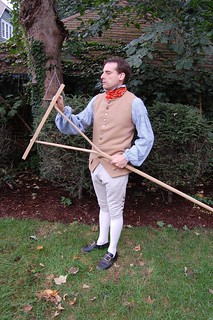
 Not me, but Mr. S. I finished the last of 20 or so button holes on waistcoat and breeches, and got him to agree to get dressed and be photographed. He chose the rake, as he likes 18th century work. He hopes to join in as a volunteer laborer at Coggeshall Farm this coming weekend, and these are his clothes.
The shirt, which he has had for a year, is from the Kannik’s Korner pattern, made in a blue and white check linen purchased from Wm Booth Draper. There was a check shirt in the clothing inventory of a 2nd RI soldier who died at the Battle of Monmouth, and this small blue and white check is found throughout New England at this time in shirts and aprons. The neck handkerchief is from Time Travel Textiles. He has another one in blue that he likes to wear with his uniform on hot days.
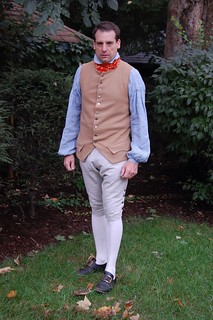 The waistcoat is adapted from a BAR pattern I got from the captain. The wool is a Wm Booth Draper remnant that was not enough to make a jacket for me. It just made the waistcoat for him, and is lined in a striped linen from Jo Ann fabrics that was lurking in the stash. The breeches are made from the Mill Farm pattern, which doesn’t have diagrams but has well-written instructions. I finally got pockets to work using that pattern the first time out! The fabric is a linen-cotton blend from a remnant table at the local mill store. The waistband is lined with a utility linen from Wm Booth Draper, as there was not enough for the waistband…because these started out as overalls. They became a hot mess because Mr. S has large, single-speed-bike up Providence Hills calves. Henry Cooke got a look at the man in shorts a few weeks ago, but still thinks he can fit them. I say, it will take Mr. Cooke’s skill. At least Burnley & Trowbridge stockings fit over them.
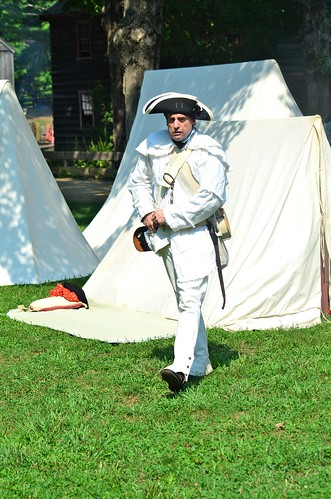 The last photo shows him at Redcoats & Rebels this year, striding across the common to join the 10th Massachusetts. Here as above, the shoes are Robert Land’s Williamsburg shoes, and the buckles are from G Gedney Godwin. I went with plainer buckles with rounded corners because that was called for by the uniform specifications in the Continental Army, so that the buckles would not wear through the tongues of the uniform overalls. Shoes & buckles were Mr S’s Christmas gifts. The tan waistcoat was supposed to be as well, but the buttonholes got the better of me. Once I get past the first two, they’re OK, but at the start of the buttonholes for a man’s waistcoat or breeches, I have a kind of Kubler-Ross reaction: denial, anger, bargaining, depression, and acceptance.
 I’m so glad he likes reenacting. Buttonholes aside, it’s been a great learning experience sewing for him. Onward to a regimental, and to this: No farmer’s smock for him, thank you. Next year, his laborer intends to be well-dressed. At least with those big buttons, there won’t be that many button holes…though I bet the total area of button hole sewing is the same!


 Kirsten Hammerstrom
You must be logged in to post a comment.