What Table Manners?

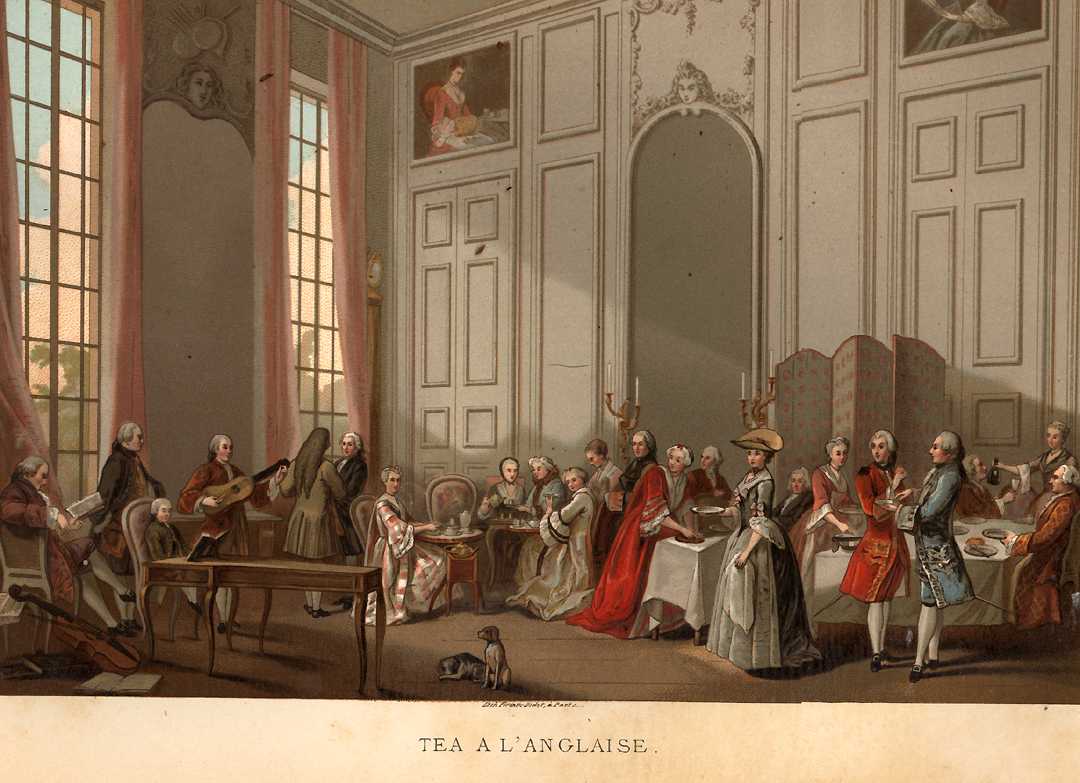
When you think of 18th century dining, which image comes to mind, tea on the left, or the sea captains to the right?
While I did not carouse with sea captains this weekend, at dinner today, I found myself deeply envious of someone’s skill in eating from a knife. I shoveled food onto my spoon yesterday with abandon. I coveted the last three pieces of quince tart today despite knowing that one of those pieces was for my husband. And I am not ashamed. Ok, not too ashamed.

The best part of living history is always what you learn, and I feel a separate blog post should deal with “the public, god love ’em.” What I learned this weekend was less about quilting and more about living old school. Ok, and maybe more about the public’s…breadth….than depth…

The most instructive thing was about being hungry and thirsty. Thirsty as in my lips are dry and I know I need to drink, which means being past thirsty and at dehydrated. Yesterday I went all day without peeing and that’s not right. Both yesterday and today I left the farm hungry, not because there was not food but because I ate mindful of leaving enough for those eating after me. The goose pie was delicious and seriously worth eating standing up in the kitchen. I’d fight for that pie.

Eating boiled dinner (ham, parsnips, carrots and turnips) along with a pudding, with 18th century utensils was challenging. Two-tine forks have great sticking ability but not much carrying ability.  Spoons are your friend. Knives may be better as trowels than cutting implements. No one really cares about your manners, they are too hungry to notice. Boiled pudding is this season’s smash hit.

Coggeshall Farm uses Amelia Simmon’s American Cookery, which I started reading last week. It is full of useful receipts based on American ingredients and I recommend it. Here is the receipt for the fantastic, sliceable pudding we had today:

A boiled Flour Pudding_.
One quart milk, 9 eggs, 7 spoons flour, a little salt, put into a
strong cloth and boiled three quarters of an hour.

There were hot words about those “7 spoons” from the kitchen staff and to be honest, I did not quiz them fully on the size of the spoons they used. But whatever magic they worked, it was truly delicious with and without the molasses cream sauce. Sliced and eaten with spoon or fingers (I snitched some later in the kitchen), it a consistency of solidity like the best parts of a Swedish rice pudding, though smooth.

It is hard to countenance how hungry people must have been much of the time in the past. More than the extreme hunger of the soldiers (like Greenman and Plumb Martin), I think common people experienced days of lacking, and accepted them, with the seasons. Food was not constant, but in flux, and even at harvest, I think, or hope, that one was mindful of the needs of others.

For more on seasonality and 18th century ways of thinking or seeing, read Circles and Lines: The Shape of Life in Early America. That’s what I’m going to pretend to do while I fall asleep.

Black Bonnet Miscellany

Lot 102
AMERICAN OR ENGLISH SCHOOL LATE 18TH / EARLY 19TH CENTURY
LADY IN BLACK BONNET
In the original giltwood frames and glass, on original wood backing.
Pastel on paper
22 by 18 inches

The Sotheby’s Americana catalog arrived at work, and I had a pleasant walk browsing the sale lots as I walked from one building to another. This lovely lady is offered with her mate, a gentleman in a blue coat with brass buttons. They’re of a school of portraits made as the centuries turned, pastels rather than oils, less expensive and perhaps easier to drag about for an itinerant artist. She’s lovely, in her frothy white ruff, with that well-made bonnet. That’s a bonnet I’d like to try making…eventually.

For now, the most brilliant thing I can recommend is Hallie Larkin’s blog post on 18th century buttonholes. Needless to say, I have not been doing them right. Read, learn, and look forward to better buttonholes. Brilliant. Did I mention brilliant? The photos from Neal Hurst at B&T are especially helpful, and honestly, I am so glad I didn’t tackle the green coat’s buttonholes yet. Or a spencer. See? Value in procrastination, distraction, or whatever you want to call it. Better buttonholes…it’s like salvation!

More on the quilting process later, when I manage to download the photos I took of the stencil process, and when I take some of the sandwich and frame situation. And then there’s more documentation…along with a couple of meetings, mailing my mother’s birthday package, I forgot breakfast, and pitching the boiler repair to my boss–and finishing the new cap I started. And this is an easy day!

Mourning Embroideries

As a rule, I dislike samplers. Sacrilege, I know, but the rows of letters and numbers and tidy stitches seem to me like running in place, instead of running to get somewhere.

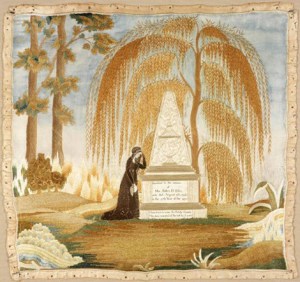
But I do like pictorial embroideries, and on this day, posting about a frothy bonnet in a painting in a Sotheby’s catalog seemed…well, too trivial. So instead, here’s a fantastic mourning picture from the Met. By Charlotte Brown, of Rhode Island, it memorializes Salome Brown and her husband Moses Brown, though not the Moses Brown.

Just because I’m not a fan doesn’t mean I don’t recognize types. In a google image search, I found this item, and knew immediately it was Rhode Island. Made in 1808, it lives at RISD, and a textile designer has done wonderful things based on it. Both RISD’s and the Met’s have the weeping woman, the weeping willow, the urn/cenotaph feature, the pastoral landscape.

But wait…the provenance of the Met’s picture is minimal: “Once property of the late Florence Maine, antiques dealer of Ridgefield and Wilton Connecticut. (Advertisement of embroidery in August 1953 Antiques magazine.)” So I started searching for Moses Brown and Salome Brown in the Rhode Island Historical Cemeteries Database, and I came up empty.

Yes, there are Moses Browns. There is no Salome Brown. But I can’t find a Moses with these dates. That doesn’t mean he didn’t exist, or that this isn’t a Rhode Island sampler; not every cemetery has been transcribed and not every headstone survived.  There is one Charlotte Brown with a date worth considering, and she is the daughter of Thomas and Rebecca Brown, and would have been 7 when this was made. Not impossible, but I’m not fully sold yet. I now have more questions about the one at the Met, and about the people memorialized. Those questions may well be answered in an accession file at the Met, but sitting on the public side of the catalog record, I have questions that only research can answer, and that I hope will one day be done as part of the Sampler Archive Project. 

For now, I think I’ll enjoy a sense of visual literacy in Rhode Island imagery, the lasting beauty of these memorials, and let it go at that.

Framing a Plan

cross-posted from A Lively Experiment, all images copyright RIHS.

This coming weekend, I’ll be joining in at the Coggeshall Farm Harvest Fair, along with my co-worker who helped clean the museum 18th-century style. She will be helping with cleaning and laundry and ironing (must remember to pack the lavender and vinegar solution), while I will tackle a quilted petticoat.

At first glance you might think I’ll have the easier weekend, and in some ways, I will, sitting in a parlor with a quilting frame. On the other hand, I booked myself a weekend with worries that have pestered me since we were invited in mid-August. Is the fabric I’ve chosen going to work? Do I know enough about the quilted petticoats in the RIHS collections? What kind of quilting frame is correct? And where did I stash the batting?

Research is always the place to start. I compiled a Pinterest board of quilted petticoats  in other collections to build my visual literacy, and tracked down articles by Lynne Zacek Bassett in PieceWork[i] and in the  Textiles in New England  II: Dublin Seminar for New England Folklife Proceedings[ii].  From the Textiles in New England proceedings, I learned that September is the second-most common month for quilting mentions in diaries for the late 18th and early 19th century in New England (May is the most often mentioned, Octobe is third). This was a relief as I wondered if quilting in September was even appropriate. With that resolved, I was able to move on to aesthetics.

New England and Rhode Island quilted petticoats share some general characteristics: the overall skirt is quilted in a diamond or diaper grid of about 1” square. Below this is a decorative band or border, usually about 12” deep. The top of this is set off from the grid by a cyma curve or wave pattern. Some examples use an undulating feather border, and others have a stylized arc and clam shell border.  The background of the border is stitched in diagonal lines. Sometimes the direction is set from center front, and lines radiate to the left and right, and in other cases the lines radiate to left and right from the center line of each arced segment.

Within the border, floral and animal motifs are quilted. Animals seem prevalent in New England quilts—there is even a mermaid in Connecticut—but none of our quilts have a mermaid. We have sunflowers, pomegranates, and carnations similar in form to the stylized flowers that appear in samplers and embroideries of this time period. Animals include deer, lions, squirrels and a creature that looks like an oryx but may be an elk. Birds are represented as well, peacocks and stylized songbirds as well as an owl, and even what seem to be roosters.

I drew these conclusions not only from reading, but from examining two quilted petticoats in the RIHS Collection, the lighter one made ca. 1745 by Alice Tripp [Casey], accession number 1985.7.1, and the darker one made in 1770 by Anna Waterman [Clapp], accession number 1982.76.3. In the catalog record, the images for 1985.7.1 are incorrect–they are for 1982.76.2, and the confusion testament to cataloging and linking records in a building several blocks from where the petticoats are stored. Now, at least, we can work on correctly them.

The quilted petticoat that I plan to make will use the typical Rhode Island elements. The top portion will be quilted with an overall diamond pattern, while a feather border will set off the bottom band. Within that, I will quilt squirrels, chickens, and probably an owl and a cat, because they are favorite creatures in my household. I’ll also quilt in my initials, just as Anna Waterman did in her quilt.

You can join us at Coggeshall Farm Museum this weekend, September 15 & 16, starting at 10 each day, and see RIHS staff members in action! We think it will be a good warm up for What Cheer! Day, coming to the RIHS on Saturday, October 13.


[i] “Sarah Halsey’s Mermaid Petticoat.” PieceWork. January/February 2003

[ii] ‘..a dull business alone’: Cooperative Quilting in New England, 1750-1850.” Textiles in New England II: Four Centuries of Material Life, The Dublin Seminar for New England Folklife Annual Proceedings 1999. Boston University Press, 2001.