Housekeeping!

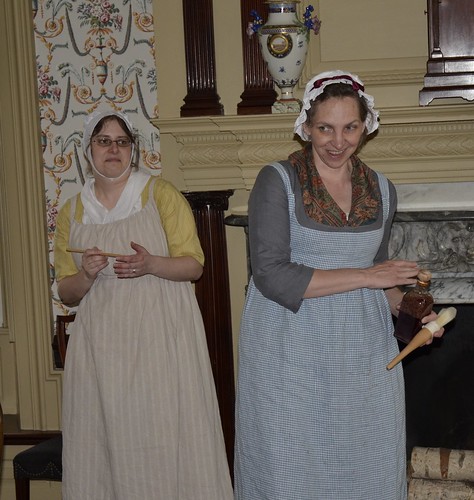
Dana wisely stands back while I pull the cork on 18th century cleaner

Hey, there’s a maid in my parlor, or, tidying up the belated thank-yous.

In chronological order, this blog was nominated for a Super Sweet Blogging award, which is a tricky thing for me, because folks, I am not sweet. I’m not even Truvia. It is not a nice thing to have to decline an award, but I cannot list 13 blogs, and really, I am not sweet, and I don’t eat sweets much, either. More savory…or salty… Vinegar and lavender… But to take the sort of weasel-y, non-sucrose way out, many, many thanks to Thoughts from an American Woman for the generous nomination and for following my blog. I’m always astonished by, and grateful for, the variety of readers and hope people enjoy the ride.

Then I found out about the Liebster Award, from Sabine at Kleidung um 1800. Thank you! 5 blogs with fewer than 200 followers I can manage.

An American Seamstress, sewing costumes and sharing her process

The Pragmatic Costumer, real-life sewing

Tracy Loves History, history I never knew

Kim-ing, sewing from this century and the last

Letters of Note, correspondence that deserves a wider audience

I don’t know if all of these blogs qualify as having fewer than 200 followers, but I do know there’s some interesting writing out there. It’s good to know other people are trying the same things, or different things, taking some risks trying to learn to skills, and sharing their experiences. Thanks to all who read and write.

And now, I’m off to find money for boilers and an event, finish a new shift, send my kid to school on time, and generally hope I muddle through this day with openness and as much joy as I can manage.

Images and Ideas

If the museum date is mutable, what to do? How to take non-illustrated Vogue for the Lower Sorts and turn it into an actual plan for a garment? By using period images.

Anne Carrowle runs away in 1774 in “an India red and black and white calicoe long gown,” but what does that mean?

Start with the negatives: It means she is not wearing a short gown or a bed gown or a jacket. She’s probably wearing what we most commonly think of women wearing, an ankle- or near-ankle length dress, open in the front (remember that the petticoat is described!) that pins to a stomacher or is fastened with bands or a band over a handkerchief.  (Excellent info on the topic At the Sign of the Golden Scissors blog.)

 When I start thinking about a gown for 1774, I start looking for earlier images. Not too much earlier, but a range. In this case, Anne left England in 1769, so 1769-1774 seems like a reasonable time frame. I made a Pinterest board for 1765-1774 ideas, which is easier than posting them all here.

To the left is a robe that’s clearly open: it’s hanging open. Laundry-work, women washing at Sandpit Gate, Paul Sandby, 1765; watercolor. Royal Collection.

1765 gets us closer to the time period, and it is before Anne left England, and it’s likely from the class she was born into. But it is early.

The two prints above are both from 1774; on the left, note the maid’s gown, which hangs open and has robings. On the left, the old woman asleep wears a gown laced over a stomacher.

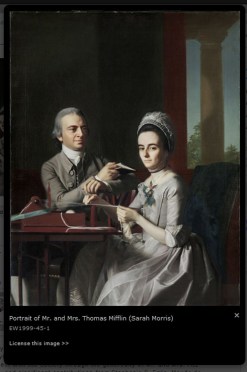
But best of all perhaps is this image, of Thomas Mifflin and his wife, Sarah Morris Mifflin, painted by Copley in 1773. Thomas Mifflin (1744-1800) and his wife, Sarah Morris Mifflin (1747?-1790), were the only Philadelphians painted by John Singleton Copley. Mifflin was an ardent patriot and by the time this portrait was made, had established himself as a successful merchant; later he rose to the rank of major general in the Continental Army, and was elected the first governor of Pennsylvania after the United States achieved independence.

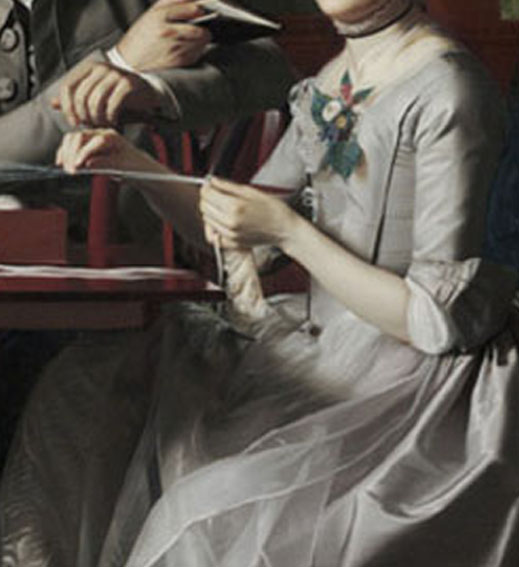
Why does this work for me? Because these are Philadelphians, and my woman ran away from the Philadelphia area. The detail really shows that Mrs. Mifflin is wearing an open robe with robings and stomacher over a quilted petticoat with a filmy white apron. This is multiple tiers above Anne Carrowle, but the style is what I’m aping, not the materials (obviously silk).

Another Copley portrait, of Mr. and Mrs. Isaac Winslow, depicts a woman in a gown with robings and a stomacher. Jemima Winslow is 41 in the painting, putting the style into my ballpark, and better still, the gown is of a patterned fabric.

Below is a detail of the fabric and stomacher. Though it will be a vastly simplified version, I think I have a model for my dress.