Houston, We Have a Tent

Well, almost.

One of the guys in the regiment traded the widow of another guy a RevWar GI Joe for a  tent. But he doesn’t need the tent, so he called us because he heard we were thinking about making a tent. The conversation with Mr. S took many more words than that, but I think that’s about the gist of the transaction. Poles are being sought, and even if they are not found, we have a draw knife. So we have tentage for August– one more thing to cross off the list. I still want to make a hemp canvas tent, but at least we should be set for August.

Today, after we went to an antique mall in Greenville, I started on a delayed project. We have wallpaper-covered boxes at work, and today I found a roll of wallpaper border. It’s not 18th century, but it reminded me of some late 18th-century paper at work. So I bought it, and started on boxes. The housewife I made is nice, but I’d like a bigger box for hiding things in–combs, toothbrush, who knows what. It’s a simple enough project using A. C. Moore boxes, paint, the border, and glue as well as generous applications of sandpaper. Tonight, paint; tomorrow, sandpaper.

Chintzy Follow Up

I was thinking about what one would want to know in order to get any clarity on what Dutch chintz or jackets (or short gowns) in the ads could mean. There’d be the question of where the runaway came from originally (Netherlands or one of the German states). What the writer of the ad meant by chintz. And jacket/short gown/gown-that-is-short/caraco, and what that might really mean. And what the provenance is (really) for extant garments. Chintz is the easiest part there. And the blue Dutch chintz could be something like the Den Haan and Wagenmakers: 

I don’t know enough to draw a conclusion any more spectacular or detailed than “clothing other than gowns was worn by working women, and it was sometimes of calico or chintz.”


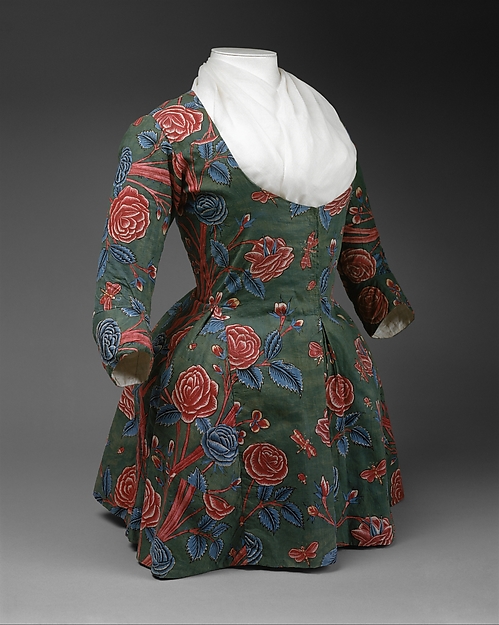
The catalog record for the jacket/caraco at the Met doesn’t say who owned it or how they know the origin is the Netherlands. It would be helpful to know if that meant just fabric, or fabric and finished garment.

Laying out this jacket and the ones at Snowshill, and the other examples in collections, would be interesting and might be revealing. Same with the short gowns in the world, from Williamsburg to Genessee Country Village.

Over time, I hope to see and learn enough to get a little closer to understanding something, and it might be more about the origins of people in the early US, and not anything about clothing. It will depend on how hard I work at it, and where I look.

Dutch Treat

I started thinking about calico jackets, short gowns, and bed gowns because OSV is around the corner, and it will be hot. At Dighton, I took off my jacket and worked in my stays because it was cooler, and at OSV I may wish to do the same thing cooking or washing. And what better thing to make than a jacket or short- or bed gown which takes little fabric and not much time.

For short gown/bed gown patterns, I’d been looking at Duran Textiles’ Newsletter, even though it is European. The general principles are the same, and I need to tweak my pattern as I don’t like the fit over the petticoat in the back.

And then I looked at images of women in bed gowns, and the paintings by Chardin, (above, 1738, right, 1747) show women in short garments over petticoats. Lovely. The rich solid of the brown with madder and the print are both attractive and practical, and I have a madder petticoat and pink striped petticoat. I could easily be a Chardin.

To get more grounded, North American Colony-based ideas, I looked through my Vogue for the Lower Sorts, Wenches Wives and Servant Girls, and found a woman running away in a Dutch calico jacket or short gown. She is a Dutch bound servant, but Catharine Mum takes off in New York with “a callicoe short gown, a green camblet gown, two striped camblet petticoats, a Dutch chintz jacket, one white and some ozenbrig aprons, a black bonnet…” and is described in an ad in the New York Gazette, 17 January 1774 (WWSG, p. 69). In Pennsylvania, a Dutch servant girl takes off in a Dutch jacket and a striped lincey petticoat (Pennsylvania Gazette, 30 March 1774, WWSG, p. 74).

Dutch chintz? Interesting–could the white ground bed gown/short gown be made of Dutch chintz? Browsing the Snowshill Collection, I found this:
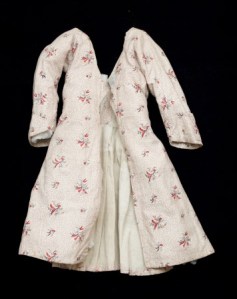
Place of origin? Holland.

Is this Dutch chintz? Snowshill calls this a caraco, 1780-1800. Is it? It is a jacket? Is it a gown that is short? Is the blue Dutch jacket blue chintz, or is the style Dutch?

What are the links between the 1747 Chardin, the woman running away in 1774 New York wearing Dutch chintz, and the ca. 1780 Snowshill garment? Maybe there aren’t any, but it seems like there is a thread of some kind, though it may be a twisted and evolving thread.
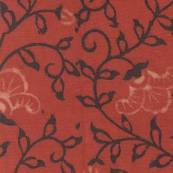
None of this answers or solves my very local working fashion dilemma, except that I feel more confident that a short, skirted garment made of patterned cotton is a reasonable garment to make. I chose some kalam kari fabric and we shall see what I can make.

But first, a muslin.

Summer Eating

What to eat in the field in August? Redcoats & Rebels approaches, and food must be prepared. This time, we are camping over. That means that pretty much everything must be ready by 1:30 on August 3, and there is nothing like a deadline to focus attention.

To start with, I turned to The Compleat Housewife: or Accomplished Gentlewoman’s Companion, published in 1739. The author presents seasonal menus, because one important thing to remember is that historical eating was seasonal and local. (This concept may sound familiar to fans of Alice Waters or Mark Bittman.)

The suggestions are, of course, beyond the realm of soldiers’ rations.

Westphalia Ham & Chicken.
Bisque of Fish.
Haunch of Venison, roasted.
Venison Pasty.
Roasted fowls a la daube.
White fricassee of Chicken.
Roasted Turkeys Larded.
Beef a la Mode.
Roasted Lobsters.
Rock of Snow and Syllabub.

But take a closer look: beef a la mode is a kind of pot roast, so beef in a kettle with water and veg cooked over a fire ought to do. It’s what we call “officer chow,” and what the boys ate at Fort Lee. I was mostly looking for vegetables in season, or fruits, but the farmers’ market will provide that limitation.

So here’s what I think:
Pasties made Thursday night or Friday morning for supper on Friday.
Gingerbread cake for treats.
Oatmeal and fruit for breakfast Saturday morning, or else boiled eggs, bread, and fruit.
Bread, cheese, fruit and sliced ham for lunch on Saturday.
Tea, shrub, and gingerbread cake for Saturday tea.
Beef stew for supper on Saturday.

Breakfast and lunch will be the same for Sunday, and we pack up and leave on Sunday afternoon, so I won’t need to make Sunday supper in camp.

It’s reasonably authentic to the 18th century, though not to common soldiers’ rations. But the guys won’t want to eat firecake and water.