Put a Lid on It!

Yes, I have a bonnet problem.

I don’t know how I find all the sites and blogs I find, but I came across another interesting one today while waiting for data to load: An American Seamstress, finishing a waistcoat and struggling with a bonnet.

Have I fought with bonnets! I love bonnets, and I come by this honestly: my grandmother had a shoes thing and a hat thing, and the hat thing came with “hat face,” a particularly foxy-grandma face she make when trying on hats. So while I thought I ought to write about tent research, or the cool ad I found for a shop in Newport selling dry goods and haberdashery, now I think the heck with all that. Bonnets!

Here’s what I’ve learned, and what I’ve used. (for all images, click for a larger version)

Buckram. What they sell at Jo-Ann’s is not what you want. It is too thin to be much use unless you glue it to chip board (today’s equivalent of paste board). For more on chip board, see Kannik’s Korner on bonnets. I buy mine at Utrecht because  they’re in town. Dick Blick has it, buy the single ply.

Better buckram. I ordered a kit from Timely Tresses just to get my hands on a proven pattern and real millinery supplies. They’re hard to find in real life, and ordering online when you can’t touch stuff is hard. I did find some very sturdy buckram locally at Ryco, a mill store selling quilting fabrics, and lots of other stuff.

Millinery wire. Accept no substitutes in wire. Just trust me. I have successfully used cane originally purchased for stays. I had left overs, it curves, it worked when stitched to buckram.

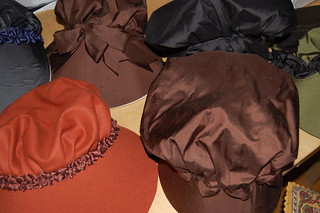
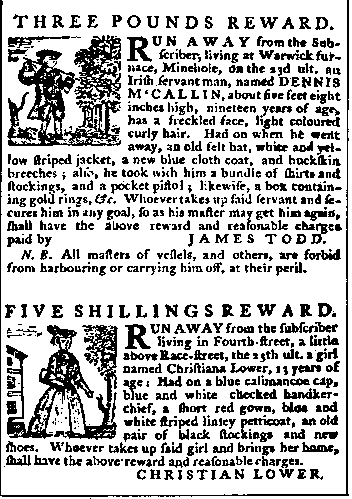
Silk. The difference between taffeta and dupioni is visible and tangible (dupioni left, taffeta right). Use taffeta. I don’t always, and I still like my dupioni bonnet but most of why it works is its size and the fact that my impression is middling-trending-lower. (And saucy. I sometimes think a raised eyebrow and a loud handkerchief can make up for a lot, especially crooked petticoat hems.) But the runaway ads include stuff (wool) and linen bonnets, so read them closely for ideas.

Make a muslin first: we all know, it applies here, too. For cauls, bigger is usually better for the 18th century. For some of the bonnets, I use the lighter weight buckram to sew an insert between the caul and the lining to keep the crown more erect and poufy. At the end of the day, you might deflate, but why should your fabulous bonnet?

Trim it up. I often use strips of self fabric folded over and looped to make “bows,” because that’s how the Williamsburg bonnet looks to me. I’ve also used ribbon, so this: use silk. Less silk is better than more poly, really really, it will handle and feel and look better, and so will you. I use Burnley & Trowbridge  and Wm Booth Draper silk ribbons, and bought some from a sutler who sold herbs and hand-dyed silk ribbon.

My next bonnet will be a black silk lined with red with the red-hand dyed silk ribbon trim, based on a runaway ad. Will it be done by OSV? Probably not, but once you have it down, a nice hand-sewn bonnet is about a day’s work.
Runaway Styles

Many thanks to Becky Fifield (The Still Room Blog) for revisiting the article she published last year on her amazing Runaway Clothing Database (RCD). It is available now as a downloadable PDF from the publisher’s website. I devoured it for its systematic look at classifying–cataloguing, really–not just the runaways themselves, but their articles of clothing.

What Becky did with nearly 900 ads was to create catalog records for each woman who ran away, as well as her clothing. It’s a phenomenal project, and one that works well now, in an age of computer databases and improved cataloguing nomenclature. It is also a testament to dedication and love: the amount of time to construct the database and enter all the records is significant. That’s hours, tens of hours, of work before the fun part of analyzing the data can begin.

Kudos to Becky, for hard work and inspiration!

Fine Sewing

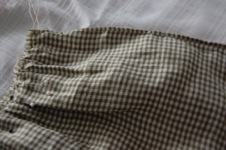
20120720-211927.jpgI made the time today to finish something I’d started back in June at Dress U. I was fortunate enough to be in Sharon Burnston’s Fine Sewing class, and got started on an apron. Even before I started reenacting and sewing 18th century clothes for myself, I admired Sharon Burnston’s work and the fantastic Fitting and Proper, which I ordered for the library at work several years ago. Ms. Burnston is the living definition of a stitch counter or thread counter in the very best way, and here’s why: she counts threads, and that counts.

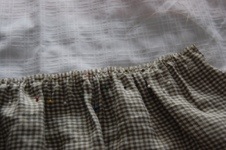
20120720-212029.jpgOne of the key points I learned was the relationship between the threads and the stitches– essentially 2 x 2 for this project. Using a traditional New England fabric makes it easy–with a linen check, you can just about “cut on dotted line” and know you’re set.

We started by hemming each side of the apron for a couple of inches, just to get started. Stitch two over, in little crosses. Then, at the top of the rectangle, we gathered. The gathers were the illuminating part: Stroke gathers. Using the check as a guide, we ran even gathering stitches twice along the top.

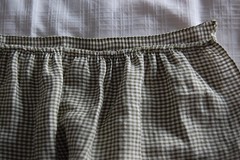
20120720-212120.jpg I used the every-other check pattern, so the gathers were small. Ms. Burnston suggested that the best way to think of stroke gathering was as proto-smocking, and to make an evenly spaced running stitch with cotton quilting thread. The top row of gathers will be buried in the waistband, the bottom row gets pulled. Just make sure the replicate the top row exactly!

When you pull the threads, the fabric makes lovely even gathers. Pulling them down with a needle or pin–stroking them–makes them lie down even more evenly and nicely.

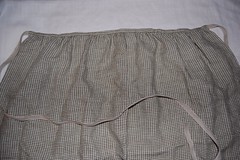
Then its on to the waistband and finishing with linen tape ties.

So, at last, finished object, green and white check. Along the Connecticut River valley, the predominate check was blue and white, but I look at this and think, maybe that’s what they mean by “bad color” in the runway ads– a kind of end-of-vat green.

ETA: Thread! I forgot the thread part. Fine stitches are achieved by using a fine needle and thread–obvious, right? Size 12 needles, if they suit your hands, and a fine linen thread. When I got home, I used 80/2 white linen thread. It worked really well, with infrequent breaks. Use plenty of beeswax, and the thread will break far less frequently–if at all–especially if you use shorter lengths. Since you need to run the gathering thread the entire width of the linen, cotton or even cotton/poly is best used for the gathers. My hands are really big, but even so I use fine quilting needles from England and manage pretty small stitches. I’ve used John James and Richard Hemming & Sons, but both had to be ordered online. Dritz applique needles can be found at Jo-Ann, if you’re in a hurry, or, like me, discover all your favorite needles are bent, blunt, or stuck in a crack in the floorboards…

Roller Print Doll

20120717-180141.jpg

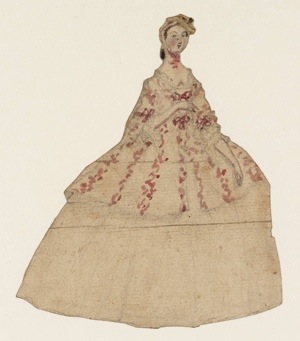
Cruising the Tate’s catalog, I found this, a cutout doll by Susanna Duncombe, no date, but clearly 18th century, since Susanna Dumcombe’s dates are 1725 -1812. I had to double check, but yes, she was 87 when she died.

There are fabulous bonnet drawings, and more of these wonderful cut outs. This one struck me, though, because the “jacket” and the petticoat do not match. Conventional wisdom is that patterned jackets and petticoats were always worn together. The title notes it is unfinished, so the petticoat might have matched if Susanna had finished the doll. There is clear line for a jacket hem, though, so it is at least a two-piece garment,

I think we might not know the “always” and “never” rules. And, too, I think that “always” and “never” are likely to be different depending on the status of the wearer. Plenty of runaways took off in calico jackets and short gowns worn with striped petticoats. (The 18th century was probably much more colorful than we credit.)

The fabric looks a lot like a roller print Burnley & Trowbridge had last spring. I wonder about its cut, too; it looks like a pet en l’air, as the loose-pleated kind of saque-back short garments are known. And that reminded me of the caracos fashion plates mimic-of-modes investigated.

Again, I draw no conclusions. But here is a fantastic serendipitous find, a period paper doll in what looks like a roller-printed garment. Too fancy for who I am in camp, but what a lovely garment to make, and then have to plan a picnic to wear to.