Fashion Plate Treasure Trove

The interwebs: evil bringer of spam and annoying chain emails, but also home to fantastic surprises like the Casey Fashion Plate Collection at the LA Public Library. I can sit in New England and browse thousands of images from 1780 to 1880, a virtual time warp J. Crew catalog of “I have to make that!” and “Color! Regency in Color!”

You can’t blow them up to the kind of size you’d want, but if you know clothing, the enlargements they allow are probably enough to get you where you need to go.

Now I have more ideas than I have time, but at least some will use up fabric I bought at the silk store in Pawtucket, and remnants from Wm. Booth Draper (I think I have enough wool/silk “stuff” for that blue spencer.)


Red. I love red. And that’s a lot of detail that holds up pretty well under zoom. Thank you, LA Public Library!

Shake Your Tail Feathers

Men’s 18th century coats amaze and delight me. On some of the earlier fine suits, the pleats are exuberant but controlled, layers of fabric tucked together in the skirt.

You could argue they’re feminizing, and somewhere I read that men’s suits have evolved in cut and design to make the male body less threatening. You could argue that they have the formal appeal and function of a peacock’s tail, signaling financial health and status.

This is perhaps most true of the tails on court coats, fancy and fine yet restrained, conservative, and non-threatening. After all, you cannot exceed your rank.

Fortunately for me, I need only construct a simple linen coat by tomorrow. The back seam was sewn this morning, and I started on the pleats. The pattern lines did not clearly mark the peaks and valleys, so I’ve played with it four times.

This evening, Costume Close Up will be my guide, and with any luck, a coat will be “done enough” for an event twelve hours from how. The coat may not be lined in 12 hours, but it will be wearable enough for an evening march that recreates part of the Gaspee incident of 240 years ago tomorrow.  I’ve only known since Wednesday night that I was needed, but with any luck, some of the Second Helping Regiment will come and help.

Tea Party Madness

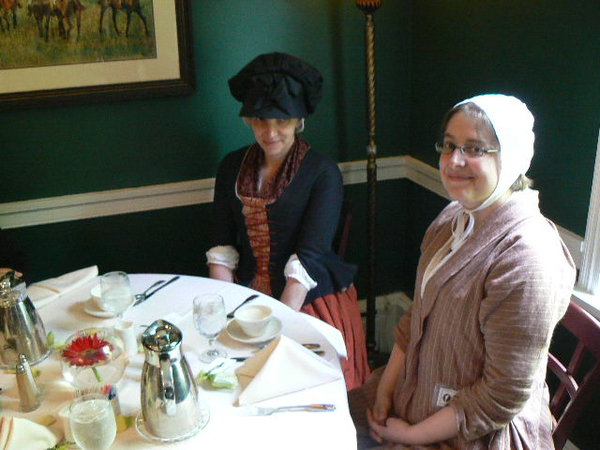
There they are, those lower sorts! We had tea, with delicious scones and excellent company in the form of booksellers from Brooklyn. We don’t get out to tea very often, and it was a pleasant introduction to more old-fashioned notions of parties.

This is a useful thing, because the known bonnet wearer must prepare cake and punch for an as-yet-unknown quantity of guests to include the Second Helping Regiment. Perhaps the historic recipes are not so far off in quantity after all..

The clip is from The Compleat Housewife: or, Accomplish’d Gentlewoman’s Companion. A similar recipe appears in The Art of Cookery Made Plain and Simple, by Hannah Glasse. You can find it on the Colonial Williamsburg website, along with a translation for the 21st century cook. I think I’ll try it, and I’ll have to start soon to get it right by the end of June.

Now for a punch recipe for an unknown quantity…

The Lower Sorts Crash a Party, Again

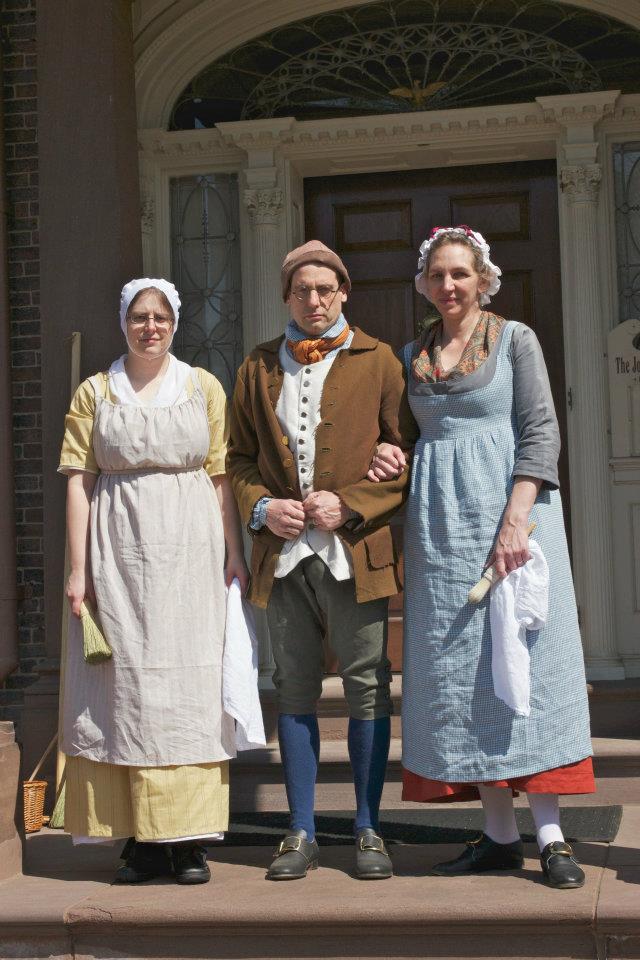
See the two women at the right? The one in the brown bonnet with a hand at her face is me, exhausted after driving to Malvern from Providence; the young lady in yellow stripes is Dana. We are in our best dresses, the Past Patterns 1796-1803 front-closing gown.

That wasn’t the party where we felt the most like country mice, but we did feel like country mice much of the time, and that’s because we are. (That’s my husband, veteran of the 2nd RI Reg’t, standing beside me.) Someone needs to represent the lower sorts, and honestly, at the reenactments I go to, I’m often the best-dressed woman, the recent ran-away-from-Newport. The excuse I can use for wearing Indian print cottons is that I am from a port city (Newport or Providence) and that I can afford small pieces, or second-hand items. Certainly in the Colonies there is economic churning, and Styles suggests that the common people are not forgoing style and fashion as a concern in clothing acquisition.

I know what a servant or housewife might wear for working: The short gown, certainly, is the most comfortable and easy option, and uses so little fabric that it can be easily and relatively affordably made in prints.

But how might a servant, or a soldier’s (or, in 1796, farmer’s or blacksmith’s) wife have dressed for a party?