Tea Party Madness

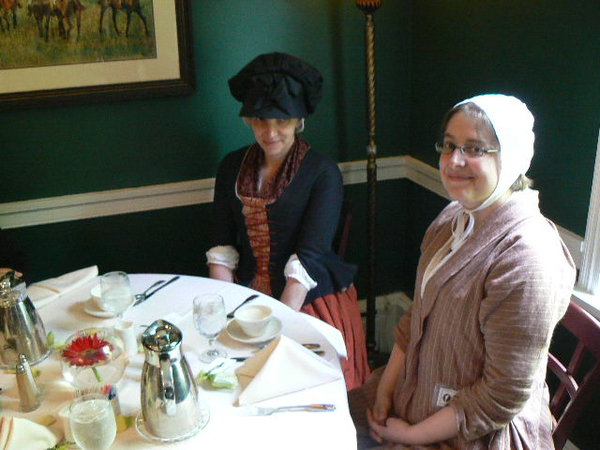
There they are, those lower sorts! We had tea, with delicious scones and excellent company in the form of booksellers from Brooklyn. We don’t get out to tea very often, and it was a pleasant introduction to more old-fashioned notions of parties.

This is a useful thing, because the known bonnet wearer must prepare cake and punch for an as-yet-unknown quantity of guests to include the Second Helping Regiment. Perhaps the historic recipes are not so far off in quantity after all..

The clip is from The Compleat Housewife: or, Accomplish’d Gentlewoman’s Companion. A similar recipe appears in The Art of Cookery Made Plain and Simple, by Hannah Glasse. You can find it on the Colonial Williamsburg website, along with a translation for the 21st century cook. I think I’ll try it, and I’ll have to start soon to get it right by the end of June.

Now for a punch recipe for an unknown quantity…

The Lower Sorts Crash a Party, Again

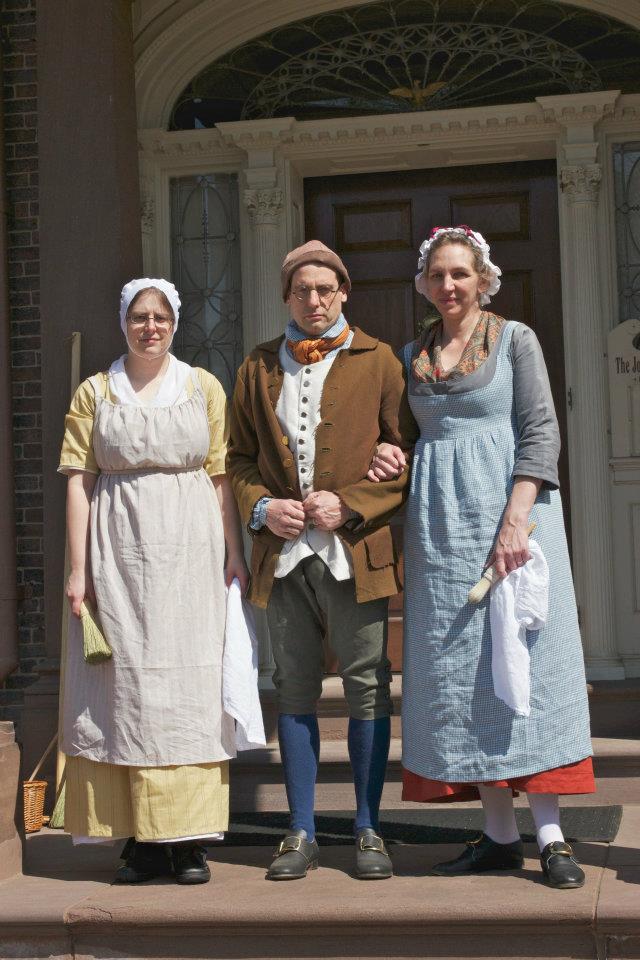
See the two women at the right? The one in the brown bonnet with a hand at her face is me, exhausted after driving to Malvern from Providence; the young lady in yellow stripes is Dana. We are in our best dresses, the Past Patterns 1796-1803 front-closing gown.

That wasn’t the party where we felt the most like country mice, but we did feel like country mice much of the time, and that’s because we are. (That’s my husband, veteran of the 2nd RI Reg’t, standing beside me.) Someone needs to represent the lower sorts, and honestly, at the reenactments I go to, I’m often the best-dressed woman, the recent ran-away-from-Newport. The excuse I can use for wearing Indian print cottons is that I am from a port city (Newport or Providence) and that I can afford small pieces, or second-hand items. Certainly in the Colonies there is economic churning, and Styles suggests that the common people are not forgoing style and fashion as a concern in clothing acquisition.

I know what a servant or housewife might wear for working: The short gown, certainly, is the most comfortable and easy option, and uses so little fabric that it can be easily and relatively affordably made in prints.

But how might a servant, or a soldier’s (or, in 1796, farmer’s or blacksmith’s) wife have dressed for a party?