Making It

One of the most satisfying things about reenacting is that you get to make things. Not just can make things, but must.

Do you want a gown to wear to an event? Gotta make one.

Want the gown to fit properly? Better make stays.

Everyone in our Regiment makes things, and not just for reenacting: there’s a toy sculptor, a machinist, a gunsmith, a diorama and replica maker, a photographer among the ranks.

There are two things I most enjoy about reenacting: one is making the clothing. As a refugee from art school (I escaped with a Master’s degree and no teaching prospects), I need to make things. If I wasn’t sewing, I’d be painting, and Robert Gamblin paints and good quality canvas aren’t cheap.

The other thing I enjoy is cooking, and being able to cook for a crowd, with limitations. When I plan for a party or family celebration, anything goes. Thai, Indian, English, Swedish, anything. For reenacting, the food needs to be both period- and class- appropriate as well as seasonally appropriate. And sometimes the best results come from limiting yourself.

One of the favorite recipes I’ve made for the Second Helping Regiment is a Gingerbread Cake recorded by a local family in a 1928 family cookbook. The family has been in Rhode Island since 1637, and were ardent patriots in the American Revolution. I have no qualms about using their 1928 recipe, since that is only the year in which it was written down—we don’t know how long they’d been making this.

Ingredients

¼ cup butter
1 cup sugar
1 tsp baking soda
1 cup boiling water
[last two ingredients: pour over butter and stir]
To the above mixture add ¾ cup molasses

Sift into the liquid mixture:
1 ½ cup flour
½ tsp ginger
1 tsp cinnamon
pinch of salt

Drop in one unbeaten egg. Beat whole with eggbeater and bake in slow over for about half an hour.

I use an 8 x 11.5 x 2 inch glass pan and bake at 350 for a little more than 30 minutes; my oven is always a little slow, being a cheap landlord-installed electric affair.

Eating in the Field, or, Hunger is no Game, Mom.

Breakfast at Battle Road

The first time both Dave and Tom were in an event was a parade in Norton, MA. Carl ate Ritz crackers from a paper tube in his haversack; the boys had nothing, but we stopped for hamburgers on the way home.

The first time we were all in an event was Redcoats to Rebels at Old Sturbridge Village. Dave packed us lunches of sandwiches on soft rolls (wrapped in tinfoil), apples, and juice pouches. Just try to find a private, off-duty place to eat an anachronistic lunch when you’re at the largest re-enactment in New England.

After that, I got smarter. I used take-and-bake baguettes from Whole Foods, or other crusty breads, to make sandwiches. I wrapped the sandwiches in freezer paper, or parchment paper, and tied the packages up with string. Now I wrap sandwiches in white cotton napkins or towels bought from a big-box store—I cut the tags off to disguise them, so I can’t tell where I got them, and I no longer remember.

At OSV, I was hot and thirsty, so I bought a tin cup. The Captain had a lot to say about it, but passed it as ‘acceptable,’ so I have continued to use it. The boys have canteens, but what about water for me? I make lemonade for some events, boiling lemon juice and sugar to make syrup, and diluting that with ice water from the Brita pitcher. I decant this concoction to some snap-lid bottles that used to hold French lemonade. The snap-top can be removed and replaced with a cork, and I am working to replace the bottles with ‘1895’ pressed into the glass. But for now, I wrap them in striped linen-look kitchen towels.

Here’s how I pack the ‘picnic’ basket (purchased at Michael’s on sale) for a hot summer day:

On the bottom layer, two large gel ice packs I also use for post-physical therapy pain; cover these with striped, linen-look kitchen towel.

On top of the ice packs, two glass bottles of lemonade or water, chilled overnight, each wrapped in a towel.

Sandwiches or pasties (recipes to come), wrapped in paper or in white napkins.

Captain approved mug, from Burnley & Trowbridge.

Pack apples into the remaining spaces; make a place for your own tin cup or redware mug. Let the guys use their canteens; if they want lemonade or your cold water, you can share the mug or cup.

Top with a plate of gingerbread, wrapped in paper and tied with string.

Food keeps cold, and you can eat your picnic in public, knowing that you’re authentic enough to pass muster.

Clothing Criticism

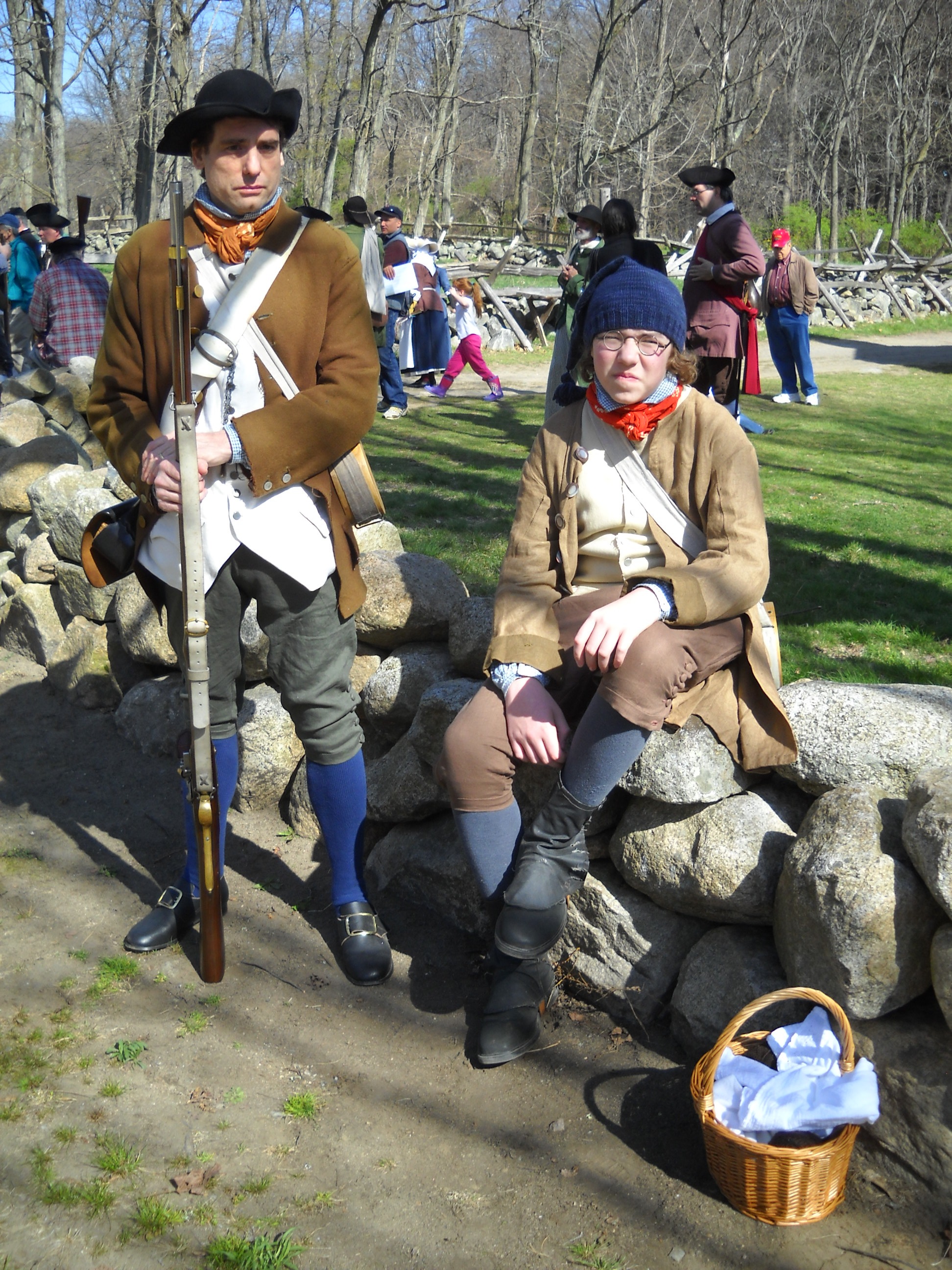
Boys at Battle Road.

Standards, people. The list serves erupt at least quarterly on the subject of authenticity in reenacting. We must have standards.

Yes, we must. We must do the best we can to recreate the past, and to share the best history we possibly can. But that does not give us a license to hurt others with words.

The Captain told me Saturday that “It used to be so bad in the Brigade, and in the Continental Line, too, that women would come up to a newcomer like you,”—here he fingered my cloak, all hand-sewn, of Wm Booth 100% wool broadcloth in a color documented to a RI runaway, and patterned after a period cloak in a RI museum—“and say, ‘Is that machine stitched?’ and proceed to criticize what the woman was wearing. The woman would never come back.  She’d take her husband with her, and we’d lose a soldier forever.”

I had to tell him they still do that, just now they do it behind people’s backs, on list serves and on blogs. “I know,” I said, “because they’ve written about me.”  After that, I hunted up the documentation for the specific little fabric trick I’d done, and date it to 1785. Oops, OK, not appropriate to a Brigade event, being two years after the end of the war.

And then again, I’ve seen similar handling of fabric in a ca. 1760 child’s frock coat from RI…. But the stinger was in, and the gown, my favorite of but two gowns, is relegated to non-Brigade events.

So where does this leave us? I can be as bad a stitch counter as the next person, able to discern a machine-stitched pocket welt at 20 paces. Sometimes I can tell a seam is machine-stitched, too. And yet…

I will confess: Machine-stitched breeches were worn by my men at Battle Road. It was that or not go at all. The buttonholes are all hand-finished, as are the eyelets. Thank goodness Dana helped me with Thomas’s breeches, or I would not have slept at all that Friday night. Two pairs of breeches had to be made, a dozen eyelets and 30 buttonholes in total. The buttons were cheaters, too, fabric-covered, but for most I used the metal blanks fitted with metal backs. For some I used rings and gathered fabric around the ring to form the shank.

Those are the least of the problems with the breeches. Despite muslin fittings on squirming boys, the legs are too long and should be shortened. Dave’s are too loose at the knee, and his waistcoat is also too loose, now. Thomas ought to wear leather-soled shoes, and the gaiters he had were too small. His breeches, too, are too long, the knee band too tight.

I know all these things. Will I fix them? Not necessarily. Their overalls are in greater need of replacement, battles loom, and time is limited. Perhaps next winter I will be able to re-fit their breeches. Until then, we’ll muddle through with what we have, upgrading the necessary, and avoiding the egregious.

For the rest of the state where we live, I hope to emulate The Hive and create workshops to help educate museum staff members in the fine art of not dressing like a tavern wench. Educating is surely better than criticizing without offering alternatives.

Imag[in]ing the Past

Photographers in the background prepare to stalk their prey.

Last Friday, R. L. Fifield wrote about being in other people’s family albums. In the future, I think I’ll turn the camera on the crowd as she did at the Battle of Brooklyn. It is an odd thing to be an animal in the zoo, as the boys and I have been.

But what seems even odder is the how the public behaves.

I have not been shoved too hard myself, but I have been elbowed and ignored. I have seen grown men push their way through a group of chatting reenactors, shouldering past the men they didn’t want to talk to as if they were sleek as a cat. (Note to the Rude: If you give a speech at an event and state your name and organizational affiliation, perhaps you should not actually shove the participants aside later, even if they are “only” privates.)

Brian and Thomas, too oblique for the woman behind me.

I have heard a woman with a point-and-shoot camera yell at my son and the Regiment’s adult drummer, “Turn around! I can’t see your faces!” Really, I had no idea Brian possessed an Evil Eye, but it’s a good one.

I have watched an elderly gentleman with a large digital SLR pull and tug on my husband’s hunting frock to force him into a portrait with woman he did not know.

And that was all just on Saturday in a small town in RI. Similar behavior, with more foot-crushing and shoving, was on display at Fort Lee, NJ last November. (A NJ camera club came to the Fort Lee event, which was listed on their website as a good event for taking photos.)

We’re reenactors, not dolls.

Please,  ask before touching, or tugging. We’re happy to explain what we’re wearing and let you touch our clothes but we don’t like being pulled around to suit your aesthetics.

Please don’t step on the women in kit. We can’t be in the battle, but we like to watch it, too, and the guys on the field are our friends, husbands, sons, fathers…we care about them.

In short, remember we’re people too, and we’re happy, delighted—eager, even—to share the history with you. But let’s minimize the tugging, shoving, pulling, and yelling.